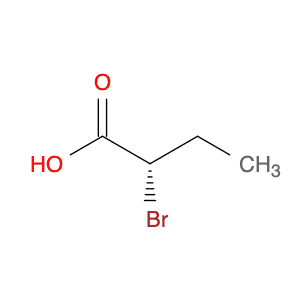
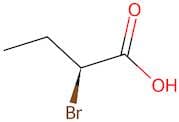
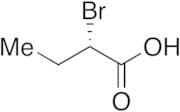
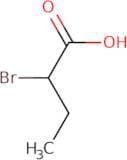
CAS 32659-49-7
:Ácido butanoico, 2-bromo-, (2S)-
Descrição:
O ácido butanoico, 2-bromo-, (2S)-, com o número CAS 32659-49-7, é um composto quiral caracterizado pela presença de um átomo de bromo no segundo carbono da cadeia do ácido butanoico. Este composto pertence à classe dos ácidos carboxílicos, que são conhecidos por suas propriedades ácidas devido à presença de um grupo carboxila (-COOH). A designação (2S) indica que possui uma estereoisomeria específica, tornando-se um dos dois enantiômeros. O ácido butanoico em si é um ácido graxo de cadeia reta de quatro carbonos, e a introdução do átomo de bromo pode influenciar sua reatividade e interações com outras moléculas. A presença do átomo de bromo pode aumentar seu caráter eletrofílico, tornando-o útil em várias reações químicas, incluindo reações de substituição e acoplamento. Além disso, os derivados do ácido butanoico são frequentemente estudados por sua atividade biológica e aplicações potenciais em produtos farmacêuticos e agroquímicos. No geral, este composto exibe propriedades únicas devido às suas características estruturais e estereoisomeria.
Fórmula:C4H7BrO2
Sinónimos:- Butanoicacid, 2-bromo-, (S)-
- Butyric acid, 2-bromo-, (S)-
- (S)-2-Bromobutanoicacid
- (S)-2-Bromobutyric acid
- L-2-Bromobutanoic acid
- L-2-Bromobutyric acid
- L-a-Bromobutanoic acid
Ordenar por
Pureza (%)
0
100
|
0
|
50
|
90
|
95
|
100
6 produtos.
(S)-2-Bromobutyric Acid
CAS:Produto ControladoApplications (S)-2-Bromobutyric Acid is a key intermediate for the introduction of a particular stereogenic unit into the structure of chiral active pharmaceutical compounds,
Not a dangerous good if item is equal to or less than 1g/ml and there is less than 100g/ml in the package
References Brenna, E. et al.: Org. Proc. Res. Dev., 16, 262 (2012);Fórmula:C4H7BrO2Cor e Forma:ColourlessPeso molecular:167.0(S)-2-Bromobutyric acid
CAS:(S)-2-Bromobutyric acid is a chiral compound. It is an enantiomer of the biologically inactive (R)-2-bromobutyric acid. The (S)-enantiomer has been shown to exhibit biological activity, with a kinetic and detectable activity that are similar to those of the parent molecule. This compound can be used as a precursor for pharmaceuticals, such as antibiotics, which would be useful in cases where bacteria have developed resistance to existing antibiotics. The dehalogenase enzyme catalyzes the hydrolysis of halogenated aromatic compounds in a way that produces an alcohol and hydrogen bromide. This reaction can be detected by changes in the chemical properties of the environment or by detecting changes in the optical rotation or fluorescence of the product.Fórmula:C4H7BrO2Pureza:Min. 95%Peso molecular:167 g/mol