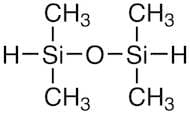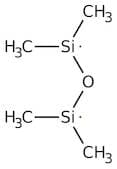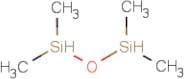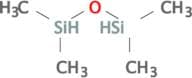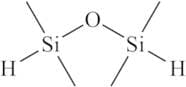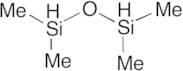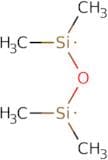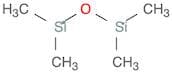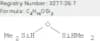
CAS 3277-26-7
:1,1,3,3-Tetrametildisiloxano
- 1,1,3,3-Tetramethyl-1,3-dihydrodisiloxane
- 1,1,3,3-Tetramethyl-1,3-disiloxane
- 1,1,3,3-Tetramethyldisiloxan
- 1,1,3,3-Tetramethyldisiloxane
- 1,1,3,3-Tetrametildisiloxano
- 1,3-Dihydrogen-1,1,3,3-tetramethyldisiloxane
- 1,3-Dihydrotetramethyldisiloxane
- Bis(dimethylsilyl) ether
- Bis(dimethylsilyl) oxide
- Dimethylsilyl ether
- Disiloxane, Tetramethyl-
- Dowsil 3-7010
- Ls 7040
- Nsc 155369
- T 2030
- T 2030 (siloxane)
- Tetramethyldisiloxane
- [(Dimethylsilyl)oxy]dimethylsilane
- sym-Tetramethyldisiloxane
- Disiloxane, 1,1,3,3-tetramethyl-
- 1,1,1,3-tetramethyldisiloxane
- TMDSO
- 1,1,3,3-tetramethyldisiloxane-1,3-diyl
- Tetramethyldiydrodisiloxane
- Hydrogen containing double head 1,1,3,3-Tetramethyldisiloxane
- dimethylsilylether
- Tetramethyldisiloxan
- (CH3)2HSiOSiH(CH3)2
- SILOXANE HSI2
- 1,1,3,3-tetramethyl-disiloxan
- 1,1,3,3-TETRAMETHYLDISILOXANE 97+%
- CT2030
- 1,1,3,3-TETRAMETHYLDISILOXANE,WACKER QUALITY
- Ver mais sinónimos
1,1,3,3-Tetramethyldisiloxane
CAS:Fórmula:C4H14OSi2Pureza:>97.0%(GC)Cor e Forma:Colorless to Almost colorless clear liquidPeso molecular:134.331,1,3,3-Tetramethyldisiloxane, 97%
CAS:1,1,3,3-Tetramethyldisiloxane is used as a monomer in the production of silicone polymers or silicone resins. It is used as a precursor to prepare other organosilicon compounds. It is also utilized in non-aqueous polymer preparation as well as a laboratory reagent. This Thermo Scientific Chemicals bFórmula:C4H12OSi2Pureza:97%Cor e Forma:Clear colorless, LiquidPeso molecular:132.311,1,3,3-Tetramethyldisiloxane, 99+% TMDSO
CAS:1,1,3,3-Tetramethyldisiloxane, 99+% TMDSO (99.9999%-Si) PURATREM
Fórmula:C4H14OSi2Pureza:99+% TMDSOCor e Forma:colorless liq.Peso molecular:134.321,1,3,3-Tetramethyldisiloxane
CAS:Fórmula:C4H12OSi2Pureza:≥ 99.0%Cor e Forma:Clear, colourless liquidPeso molecular:132.311,1,3,3-Tetramethyldisiloxane
CAS:1,1,3,3-TetramethyldisiloxaneFórmula:C4H14OSi2Pureza:≥95%Cor e Forma: clear liquidPeso molecular:134.32g/mol1,1,3,3-Tetramethyldisiloxane
CAS:S16125 - 1,1,3,3-Tetramethyldisiloxane
Fórmula:C4H14OSi2Pureza:97%Cor e Forma:LiquidPeso molecular:134.3251,1,3,3-TETRAMETHYLDISILOXANE, 98%
CAS:Alkenylsilane Cross-Coupling Agent
The cross-coupling reaction is a highly useful methodology for the formation of carbon-carbon bonds. It involves two reagents, with one typically being a suitable organometallic reagent - the nucleophile - and the other a suitable organic substrate, normally an unsaturated halide, tosylate or similar - the electrophile.
ALD Material
Atomic layer deposition (ALD) is a chemically self-limiting deposition technique that is based on the sequential use of a gaseous chemical process. A thin film (as fine as -0.1 Å per cycle) results from repeating the deposition sequence as many times as needed to reach a certain thickness. The major characteristic of the films is the resulting conformality and the controlled deposition manner. Precursor selection is key in ALD processes, namely finding molecules which will have enough reactivity to produce the desired films yet are stable enough to be handled and safely delivered to the reaction chamber.
Siloxane-Based Silane Reducing Agent
Organosilanes are hydrocarbon-like and possess the ability to serve as both ionic and free-radical reducing agents. These reagents and their reaction by-products are safer and more easily handled and disposed than many other reducing agents. The metallic nature of silicon and its low electronegativity relative to hydrogen lead to polarization of the Si-H bond yielding a hydridic hydrogen and a milder reducing agent compared to aluminum-, boron-, and other metal-based hydrides. A summary of some key silane reductions are presented in Table 1 of the Silicon-Based Reducing Agents brochure.
1,1,3,3-Tetramethyldisiloxane; 1,1-Dihydro-1,1,3,3-tetramethyldisiloxane; TMDO; TMDS
Viscosity, 20 °C: 0.56 cStΔHcomb: 4,383 kJ/molΔHvap: 30.3 kJ/molVapor pressure, 27 °C: 194.8 mmReduces aromatic aldehydes to benzyl halidesEmployed in reductive halogenation of aldehydes and epoxidesUsed to link ferrocenylsilane, polyolefin block copolymers into stable cylindrical formsEndcapper for polymerization of hydride terminated siliconesOrganic reducing agentEmployed in high-yield reduction of amides to amines in the presence of other reducible groupsReduces anisoles to arenesHydrosilylates terminal alkynes to form alkenylsilanes capable of cross-coupling with aryl and vinyl halidesExtensive review of silicon based reducing agents: Larson, G.; Fry, J. L. "Ionic and Organometallic-Catalyzed Organosilane Reductions", Wipf, P., Ed.; Wiley, 2007Extensive review of silicon based cross-coupling agents: Denmark, S. E. et al. "Organic Reactions, Volume 75" Denmark, S. E. ed., John Wiley and Sons, 233, 2011Fórmula:C4H14OSi2Pureza:98%Cor e Forma:LiquidPeso molecular:134.221,1,3,3-TETRAMETHYLDISILOXANE, 99%
CAS:Fórmula:C4H14OSi2Pureza:99%Cor e Forma:LiquidPeso molecular:134.331,1,3,3-Tetramethyldisiloxane
CAS:Produto ControladoApplications 1,1,3,3-Tetramethyldisiloxane is an organosilane reducing agent and can be used in several reduction reactions including reductive formation of sulfides and reductive etherification.
Not a dangerous good if item is equal to or less than 1g/ml and there is less than 100g/ml in the package
References Pesti, J., et al.: Org. Process Res. Dev., pages ahead of print (2016);Fórmula:C4H14OSi2Cor e Forma:NeatPeso molecular:134.321,1,3,3-Tetramethyldisiloxane
CAS:1,1,3,3-Tetramethyldisiloxane is a chemical compound that belongs to the group of functional groups. It can be isolated from hydrolysis of methyltrichlorosilane with sodium hydroxide and cellulose acetate. 1,1,3,3-Tetramethyldisiloxane has two isomers with different properties: 3-methylsilsesquioxane and 3-ethylsilsesquioxane. The former has an ethyl group at the end of its molecule and the latter has an ethyl group in the middle. The two isomers are not interchangeable because they have different physical properties. The 3-methylsilsesquioxane isomer reacts with aluminium to form a metathesis reaction product containing silanol groups on one side of the aluminum molecule and hydroxy groups on the other side. This product can be used as a catalyst for subsequent reactions in organic synthesis reactions involving
Fórmula:C4H14OSi2Pureza:Min. 95%Cor e Forma:Clear LiquidPeso molecular:134.32 g/mol1,1,3,3-Tetramethyldisiloxane
CAS:Fórmula:C4H12OSi2Pureza:98%Cor e Forma:LiquidPeso molecular:132.30851,1,3,3-Tetramethyldisiloxane (TMDS) extrapure, 98%
CAS:Fórmula:C4H14OSi2Pureza:min. 98%Cor e Forma:Clear, Colourless, LiquidPeso molecular:134.32