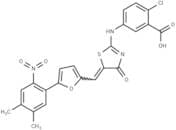
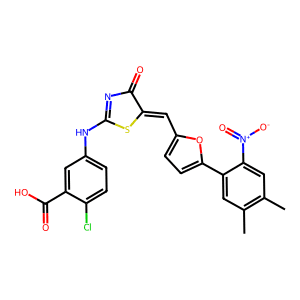
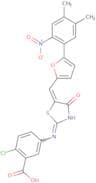
![2-Chloro-5-[[5-[[5-(4,5-dimethyl-2-nitrophenyl)-2-furanyl]methylene]-4,5-dihydro-4-oxo-2-thiazolyl…](/_next/image/?url=https%3A%2Fstatic.cymitquimica.com%2Fcas-image%2Fthumb-webp%2F387375-2-chloro-5-5-5-45-dimethyl-2-nitrophenyl-2-furanyl-methylene-45-dihydro-4-oxo-2-thiazolyl-amino-benzoicacid.webp&w=3840&q=75)
CAS 331002-70-1
:Ácido 2-cloro-5-[[5-[[5-(4,5-dimetil-2-nitrofenil)-2-furanil]metileno]-4,5-diidro-4-oxo-2-tiazolil]amino]benzóico
- 2-Chloro-5-[[5-[[5-(4,5-dimethyl-2-nitrophenyl)-2-furanyl]methylene]-4,5-dihydro-4-oxo-2-thiazolyl]amino]benzoic acid
- PT 1
- Benzoic acid, 2-chloro-5-[[5-[[5-(4,5-dimethyl-2-nitrophenyl)-2-furanyl]methylene]-4,5-dihydro-4-oxo-2-thiazolyl]amino]-
- RTHRCOIONCZINZ-JMIUGGIZSA-N
- 2-Chloro-5-[[5-[[5-(4,5-Dimethyl-2-nitrophenyl)-2-furanyl]methylene]-4,5-dihydro-4-oxo-2-thiazolyl]amino]benzoicacid
PT-1
CAS:PT-1 is an AMPKα1 activator that dose-dependently activates AMPK α1394, α1335, and α2398 and enhances AMPK phosphorylation.Fórmula:C23H16ClN3O6SPureza:99.62%Cor e Forma:SolidPeso molecular:497.91PT 1
CAS:PT 1 is a carboxyl-functionalized chiral polythiophene that has been used in vitro to synthesize a biodegradable implant. This compound has shown potential for the treatment of cancers and inflammatory diseases due to its ability to bind insulin or hematopoietic cells. PT 1 can be synthesized through coordination chemistry, and its molecular structure features sequences with antigen binding properties. PT 1 has shown the ability to inhibit ketoconazole enantiomer and proinflammatory cytokines such as TNF-α, IL-6, and IL-1β.
PT 1 is an electronic interaction molecule that has been shown to have anti-cancer effects on various cancer cell lines, including hepatocellular carcinoma (HCC), human breast adenocarcinoma (MCF7), pancreatic ductal adenocarcinoma (PANC1), lung cancer (LNCaP), prostate cancer (PC3) and leukemia (HLFórmula:C23H16ClN3O6SPureza:Min. 95%Peso molecular:497.91 g/mol