CAS 334-48-5
:Ácido decanoico
Descrição:
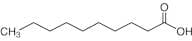
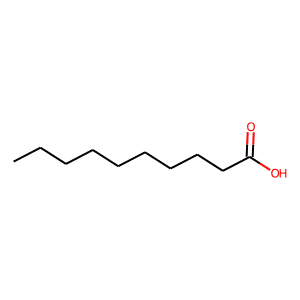
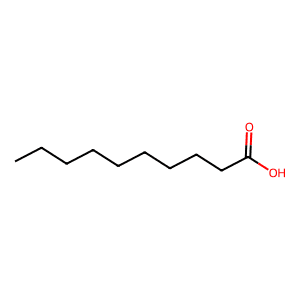
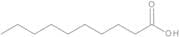
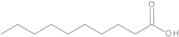
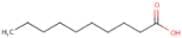
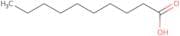
Ácido decanoico, também conhecido como ácido caprílico, é um ácido graxo saturado com a fórmula química C10H20O2. É caracterizado por uma estrutura de cadeia reta composta por dez átomos de carbono, com um grupo funcional de ácido carboxílico (-COOH) em uma extremidade. Este composto é um líquido oleoso e incolor à temperatura ambiente e tem um odor distintivo, ligeiramente desagradável, que lembra manteiga rançosa. Ácido decanoico é insolúvel em água, mas solúvel em solventes orgânicos como etanol e éter. É comumente encontrado em óleo de coco e óleo de palmiste e é utilizado em várias aplicações, incluindo aromatização de alimentos, cosméticos e como surfactante em processos industriais. Além disso, Ácido decanoico tem potenciais benefícios para a saúde, pois é um ácido graxo de cadeia média que pode ser metabolizado rapidamente para energia. Suas propriedades antimicrobianas também o tornam interessante na preservação de alimentos e em pesquisas relacionadas à saúde. No geral, Ácido decanoico é um composto versátil com relevância industrial e biológica significativa.
Fórmula:C10H20O2
InChI:InChI=1S/C10H20O2/c1-2-3-4-5-6-7-8-9-10(11)12/h2-9H2,1H3,(H,11,12)
Chave InChI:InChIKey=GHVNFZFCNZKVNT-UHFFFAOYSA-N
SMILES:C(CCCCCC)CCC(O)=O
Sinónimos:- 1-Decanoic acid
- 1-Nonanecarboxylic acid
- Acide decanoique
- Acido Decanoico
- Caprates
- Capric Acid Free Acid Sigma Grade
- Capric acid
- Caprinic acid
- Caprinsaeure
- Caprynic acid
- Decanoic Acid (C10)
- Decansaure
- Decoic acid
- Decylic acid
- Edenor C 10-98-100
- Emery 659
- Lunac 10-95
- Lunac 10-98
- Lunac 10-98E
- N-Capric Acid
- N-Caprinic Acid
- Naa 102
- Nsc 5025
- Palamac 99-10
- Palmac 99-10
- Prifac 2906
- Prifac 296
- n-Decanoic acid
- n-Decoic acid
- n-Decylic acid
- Ver mais sinónimos
Ordenar por
Pureza (%)
0
100
|
0
|
50
|
90
|
95
|
100
14 produtos.
Decanoic Acid
CAS:Fórmula:C10H20O2Pureza:>98.0%(GC)(T)Cor e Forma:White or Colorless to Light yellow powder to lump to clear liquidPeso molecular:172.27Decanoic acid, 99%
CAS:Decanoic acid is used in perfumes, resins, lubricants, greases, dyes, plastics, pharmaceuticals and food additives. It is involved in the preparation of wetting agents and sodium deconate, which is an active component in soap. It is also used as a plasticizer and as an absorption enhancer in guineaFórmula:C10H20O2Pureza:99%Cor e Forma:White, Crystals or powder or crystalline powder or chunks or fused solidPeso molecular:172.27Decanoic acid
CAS:Decanoic acidFórmula:C10H20O2Pureza:98%Cor e Forma: colourless semi- solidPeso molecular:172.2646g/molDecanoic acid
CAS:Fórmula:C10H20O2Pureza:≥ 98.0%Cor e Forma:White to off-white powder, crystals or solidPeso molecular:172.27Decanoic Acid
CAS:Decanoic Acid (Caprynic acid) acts as a non-competitive AMPA receptor antagonist.Fórmula:C10H20O2Pureza:98.59%Cor e Forma:Crystalline Solid SolidPeso molecular:172.26Decanoic Acid
CAS:Produto ControladoApplications Decanoic acid is used in manufacturing of esters for artificial fruit flavors and perfumes.
References Oro, L., et al.: Acta Pharmacol. Toxicol., 18, 141 (1961),Fórmula:C10H20O2Cor e Forma:White To YellowPeso molecular:172.26Capric Acid (n-Decanoic Acid) pure, C10-99%
CAS:Fórmula:C10H20O2Pureza:min. 99%Cor e Forma:Clear, Colourless to slight yellow, LiquidPeso molecular:172.27Decanoic acid
CAS:Decanoic acid is a saturated fatty acid that has been used as a pharmaceutical agent for the treatment of congestive heart failure. Decanoic acid is also used in the production of glycol ethers and as an intermediate in organic synthesis. The melting point of decanoic acid is between 30 and 35 degrees Celsius, which is lower than the melting points of caproic acid (40 degress) or lauric acid (45 degrees Celsius). Decanoic acid has been shown to reduce blood glucose levels in diabetic mice and rats and has also been shown to have antimicrobial activity against c. glabrata, S. aureus, and E. coli. Decanoic acid may be effective as an adjuvant therapy for melanoma by inducing apoptosis through mitochondrial membrane potential disruption.Fórmula:C10H20O2Pureza:Min. 95%Cor e Forma:PowderPeso molecular:172.26 g/mol