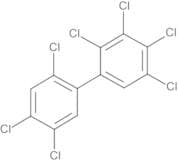
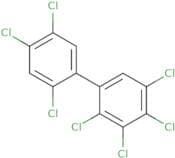
CAS 35065-29-3
:PCB 180
- 1,1'-Biphenyl, 2,2',3,4,4',5,5'-Heptachloro-
- 1,1′-Biphenyl, 2,2′,3,4,4′,5,5′-heptachloro-
- 2,2',3,4,4',5,5'-Heptachloro-1,1'-biphenyl
- 2,2',3,4,4',5,5'-Pcb
- 2,2′,3,4,4′,5,5′-Heptachloro-1,1′-biphenyl
- 2,2′,3,4,4′,5,5′-Heptachlorobiphenyl
- 2,3,4,5,2',4',5'-Heptachlorobiphenyl
- 2,3,4,5,2′,4′,5′-Heptachlorobiphenyl
- Cb 180
- K 180
- Pcb 180
PCB-Mix 7 10 µg/mL in Isooctane
CAS:Produto Controlado- 16606-02-3
- 32598-11-1
- 32598-14-4
- 34883-43-7
- 35065-27-1
- 35065-28-2
- 35065-29-3
- 35693-99-3
- 35694-08-7
- 37680-65-2
- 37680-73-2
- 41464-39-5
- 52663-63-5
- 52663-78-2
- 7012-37-5
Fórmula:C12H4Cl6Cor e Forma:MixturePeso molecular:360.882,2',3,4,4',5,5'-Heptachlorobiphenyl
CAS:Produto ControladoFórmula:C12H3Cl7Cor e Forma:NeatPeso molecular:395.32PCB No 180
CAS:Produto ControladoPCB No 180 is a polychlorinated biphenyl (PCB) that is classified as an environmental pollutant. PCB No 180 can be found in the environment, in human adipose tissue and maternal blood, and in the brain of laboratory animals. PCB No 180 has been shown to affect the brain functions of animals by altering the concentrations of neurotransmitters and neuromodulators. It also affects lipid metabolism, which causes changes in body weight, fat distribution, and insulin sensitivity. The effects of PCB No 180 are mediated through toll-like receptor 4 (TLR4). In vitro studies have shown that 3T3-L1 preadipocytes treated with PCB No 180 had increased levels of matrix metalloproteinase-9 (MMP-9) and decreased levels of adiponectin. PCB No 180 also inhibits polymerase chain reaction (PCR) amplification for mitochondrial DNA analysis.
Fórmula:C12H3Cl7Pureza:Min. 95%Cor e Forma:PowderPeso molecular:395.32 g/mol