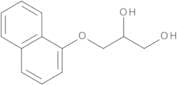
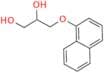
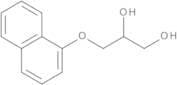
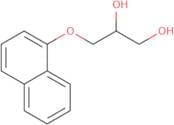
CAS 36112-95-5
:Glicol de propranolol
Descrição:
Glicol de propranolol, identificado pelo seu número CAS 36112-95-5, é um derivado do propranolol, um antagonista beta-adrenérgico não seletivo comumente usado para tratar várias condições cardiovasculares, ansiedade e profilaxia de enxaqueca. Este composto é caracterizado por sua capacidade de inibir a ação das catecolaminas nos receptores beta, levando a efeitos como diminuição da frequência cardíaca e da pressão arterial. Glicol de propranolol é tipicamente um pó cristalino branco a off-white, exibindo solubilidade moderada em água e solventes orgânicos, o que facilita sua formulação em preparações farmacêuticas. A substância também pode possuir uma variedade de propriedades farmacocinéticas, incluindo absorção, distribuição, metabolismo e excreção, semelhantes às de seu composto pai, propranolol. Seu perfil de segurança e potenciais efeitos colaterais geralmente estão alinhados com os do propranolol, exigindo consideração cuidadosa no uso clínico. Assim como qualquer composto farmacêutico, o manuseio e as condições de armazenamento adequadas são essenciais para manter sua estabilidade e eficácia.
Fórmula:C13H14O3
InChI:InChI=1/C13H14O3/c14-8-11(15)9-16-13-7-3-5-10-4-1-2-6-12(10)13/h1-7,11,14-15H,8-9H2
Chave InChI:InChIKey=BYNNMWGWFIGTIC-UHFFFAOYSA-N
SMILES:O(CC(CO)O)C=1C2=C(C=CC1)C=CC=C2
Sinónimos:- 1,2-Propanediol, 3-(1-naphthalenyloxy)-
- 1,2-Propanediol, 3-(1-naphthyloxy)-
- 1-(α-Naphthoxy)-2,3-propylene glycol
- 3-(1-Naphthalenyloxy)-1,2-propanediol
- 3-(1-Naphthyloxy)propane-1,2-diol
- 3-(α-Naphthoxy)-1,2-propanediol
- 3-(α-Naphthoxy)-1,2-propylene glycol
- Propranolol glycol
- 3-(naphthalen-1-yloxy)propane-1,2-diol
- Propanolol glycol
- 3-(1-Naphtyloxy)propane-1,2-diol
- Propranolol Hydrochloride EP Impurity A
- Propranolol iMpurity A, diol derivative
- 1,2-Dihydroxy-3-(1-naphthoxy)propane
- 3-(1-Naphthyloxy)-1,2-propanediol
- Propranolol Impurity A
- Propranolol EP Impurity A (Propranolol Diol Derivative)
- (2RS)-3-(Naphthalen-1-yloxy)propane
- Propranolol EP impurity A
- Propranolol HCl impurity A
- Propranolol-1
- Ver mais sinónimos
Ordenar por
Pureza (%)
0
100
|
0
|
50
|
90
|
95
|
100
7 produtos.
Propranolol Related Compound A (3-(Naphthalen-1-yloxy)propane-1,2-diol)
CAS:Ether-alcohols and their halogenated, sulfonated, nitrated or nitrosated derivatives not elsewhere specified or includedFórmula:C13H14O3Cor e Forma:White PowderPeso molecular:218.09429Propranolol EP Impurity A (Propranolol USP Related Compound A, Propranolol Diol Derivative)
CAS:Fórmula:C13H14O3Cor e Forma:Off-White SolidPeso molecular:218.25(2RS)-3-(Naphthalen-1-yloxy)propane-1,2-diol (Diol Derivative)
CAS:Produto ControladoFórmula:C13H14O3Cor e Forma:NeatPeso molecular:218.253-(1-Naphthalenyloxy)-1,2-propanediol
CAS:Produto ControladoApplications 3-(1-Naphthalenyloxy)-1,2-propanediol is an impurity of Propranolol (P831800), an β−Adrenergic blocker used as a antihypertensive and antilanginal agent.
Not a dangerous good if item is equal to or less than 1g/ml and there is less than 100g/ml in the package
References Semple, H.A., et al.: Drug. Metabolism. Dispost., 23, 794 (1995); Liedholm, H., et al.: Euro. J. Clin. Pharmacol., 38, 469 (1990);Fórmula:C13H14O3Cor e Forma:WhitePeso molecular:218.25Propranolol glycol
CAS:Propranolol is a beta-adrenergic receptor antagonist that blocks the binding of epinephrine (adrenaline) or norepinephrine to these receptors. It is used in the treatment of hypertension, angina, and other cardiac disorders. Propranolol hydrolyzes in vivo to produce its active form, propranolol glycol. The enzyme responsible for this hydrolysis is unknown. It has been shown that propranolol glycol can be detected in urine samples after oral administration as well as by fluorescence detection methods. Propranolol glycol has been found to be an effective inhibitor of carboxypeptidase A2, an enzyme involved in the metabolism of drugs such as morphine and cephalosporin C. Propranolol Glycol is a beta-adrenergic receptor antagonist that blocks the binding of epinephrine (adrenaline) or norepinephrine to these receptors. It is used inFórmula:C13H14O3Pureza:Min. 95%Peso molecular:218.25 g/mol