

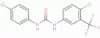
CAS 369-77-7
:halocarboneto
Descrição:
A substância química conhecida como halocarboneto, com o número CAS 369-77-7, é um tipo de composto organohalogenado. Normalmente contém átomos de carbono ligados a átomos de halogênio, como cloro, bromo ou flúor. Os halocarbonos são caracterizados por suas diversas propriedades químicas, que podem variar significativamente com base no halogênio específico e na estrutura de carbono presente. Eles são frequentemente usados em várias aplicações industriais, incluindo como solventes, refrigerantes e na produção de produtos farmacêuticos. Os halocarbonos podem exibir diferentes graus de estabilidade, volatilidade e reatividade, dependendo de sua estrutura molecular. Alguns halocarbonos são conhecidos por seu impacto ambiental, particularmente aqueles que contribuem para a degradação da camada de ozônio ou têm alto potencial de aquecimento global. Considerações de segurança são cruciais ao manusear halocarbonos, pois podem ser tóxicos ou prejudiciais à saúde humana e ao meio ambiente. Métodos adequados de armazenamento e descarte são essenciais para mitigar os riscos associados a esses compostos.
Fórmula:C14H9Cl2F3N2O
InChI:InChI=1/C14H9Cl2F3N2O/c15-8-1-3-9(4-2-8)20-13(22)21-10-5-6-12(16)11(7-10)14(17,18)19/h1-7H,(H2,20,21,22)
Chave InChI:InChIKey=ZFSXZJXLKAJIGS-UHFFFAOYSA-N
SMILES:N(C(NC1=CC=C(Cl)C=C1)=O)C2=CC(C(F)(F)F)=C(Cl)C=C2
Sinónimos:- 1-(4-Chlorophenyl)-3-[4-Chloro-3-(Trifluoromethyl)Phenyl]Urea
- 3-(Trifluoromethyl)-4,4′-dichlorocarbanilide
- 3-Trifluoromethyl-4,4′-dichloro-N,N′-diphenylurea
- 4,4'-Dichlro-3-(trifluoromethyl)carbanilide
- 4,4′-Dichloro-3-(trifluoromethyl)carbanilide
- 44Dichloro3Trifluoromethylcarbanilide
- Carbanilide, 4,4′-dichloro-3-(trifluoromethyl)-
- Cloflucarban
- Clofucarban
- Irgasan CF<sub>3</sub>
- Irgosan CF3
- N-(4-Chlorophenyl)-N'-[4-Chloro-3-(Trifluoromethyl)Phenyl]-Ure
- N-(4-Chlorophenyl)-N-[4-chloro-3-(triflu-romethyl)phenyl]-ures
- N-(4-Chlorophenyl)-N′-[4-chloro-3-(trifluoromethyl)phenyl]urea
- NSC 114133
- Tfc-
- Trifluoromethyl44Dichlorocarbanilide
- Trifluoromethyldichlorocarbanilide
- Urea, N-(4-chlorophenyl)-N′-[4-chloro-3-(trifluoromethyl)phenyl]-
- Halocarban
- Halocarbon
- N-(3-Trifluoromethyl-4-chlorophenyl)-N'-(4-chlorophenyl)urea
- Ver mais sinónimos
Ordenar por
Pureza (%)
0
100
|
0
|
50
|
90
|
95
|
100
5 produtos.
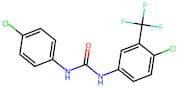
1-(4-Chlorophenyl)-3-[4-chloro-3-(trifluoromethyl)phenyl]urea, 97%
CAS:This Thermo Scientific Chemicals brand product was originally part of the Alfa Aesar product portfolio. Some documentation and label information may refer to the legacy brand. The original Alfa Aesar product / item code or SKU reference has not changed as a part of the brand transition to Thermo SciFórmula:C14H9Cl2F3N2OPureza:97%Peso molecular:349.13Halocarban
CAS:Cloflucarban can be used as a disinfectant agent.Fórmula:C14H9Cl2F3N2OCor e Forma:SolidPeso molecular:349.143-[4-Chloro-3-(trifluoromethyl)phenyl]-1-(4-chlorophenyl)urea
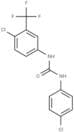
CAS:3-[4-Chloro-3-(trifluoromethyl)phenyl]-1-(4-chlorophenyl)urea is a compound that has been shown to be an antimicrobial agent. It is used in wastewater treatment, where it has been shown to be effective against enterocolitica. 3-[4-Chloro-3-(trifluoromethyl)phenyl]-1-(4-chlorophenyl)urea is also active against other Gram positive and Gram negative bacteria, including methicillin resistant Staphylococcus aureus (MRSA). The mechanism of action is not well understood, but it may work by inhibiting the production of enzymes or by interfering with protein synthesis. This compound can kill bacteria without harming human cells and is biocompatible with living tissue.Fórmula:C14H9Cl2F3N2OPureza:Min. 95%Peso molecular:349.1 g/mol
![1-(4-Chlorophenyl)-3-[4-chloro-3-(trifluoromethyl)phenyl]urea, 97%](/_next/image/?url=https%3A%2Fstatic.cymitquimica.com%2Fproducts%2F02%2Fthumb%2FH65397.jpg&w=3840&q=75)




![3-[4-Chloro-3-(trifluoromethyl)phenyl]-1-(4-chlorophenyl)urea](/_next/image/?url=https%3A%2Fstatic.cymitquimica.com%2Fproducts%2F3D%2Fthumb%2FAAA36977.jpg&w=3840&q=75)
