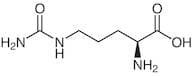
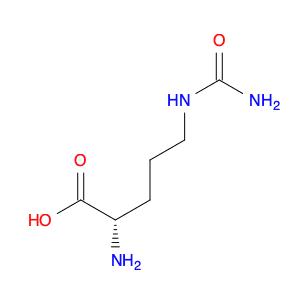
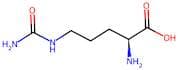
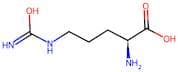
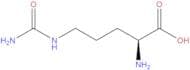
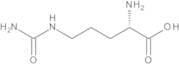
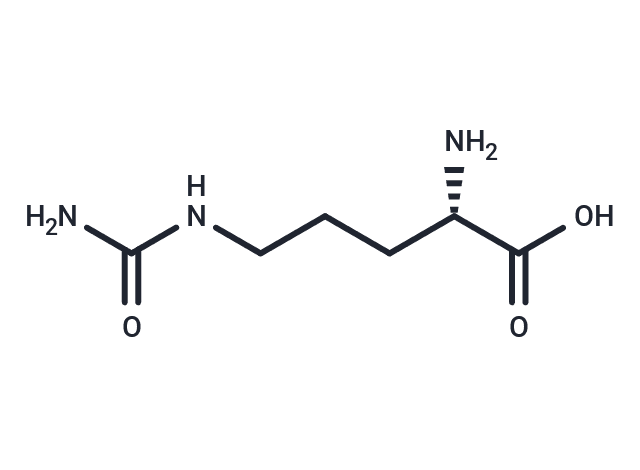
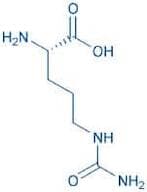
CAS 372-75-8
:L(+)-Citrulina
Descrição:
L(+)-Citrulina é um aminoácido não essencial que desempenha um papel significativo no ciclo da ureia, facilitando a remoção de amônia do corpo. É uma substância cristalina e incolor que é solúvel em água e tem um sabor ligeiramente doce. L(+)-Citrulina é encontrado naturalmente em vários alimentos, particularmente na melancia, e também é produzido endogenamente no corpo. É conhecido por seus potenciais benefícios em melhorar o desempenho atlético, melhorar o fluxo sanguíneo e apoiar a saúde cardiovascular ao aumentar os níveis de óxido nítrico. O composto é frequentemente usado como um suplemento dietético, particularmente entre atletas e entusiastas do fitness, devido à sua suposta capacidade de reduzir a dor muscular e melhorar a recuperação. L(+)-Citrulina está tipicamente disponível tanto na forma livre quanto como parte de dipeptídeos ou proteínas. Seu perfil de segurança é geralmente favorável, com poucos efeitos colaterais relatados quando consumido em quantidades apropriadas. No geral, L(+)-Citrulina é reconhecido por sua importância fisiológica e potenciais benefícios à saúde.
Fórmula:C6H13N3O3
InChI:InChI=1S/C6H13N3O3/c7-4(5(10)11)2-1-3-9-6(8)12/h4H,1-3,7H2,(H,10,11)(H3,8,9,12)/t4-/m0/s1
Chave InChI:InChIKey=RHGKLRLOHDJJDR-BYPYZUCNSA-N
SMILES:C(CCNC(N)=O)[C@@H](C(O)=O)N
Sinónimos:- <span class="text-smallcaps">L</span>-(+)-Citrulline
- <span class="text-smallcaps">L</span>-Ornithine, N<sup>5</sup>-(aminocarbonyl)-
- Citrulina
- Citrullin
- Citrulline
- Citrulline, L-
- H-Cit-OH
- L-(+)-2-Amino-5-ureidovaleric acid
- L-Cit-OH
- L-Citrullin
- L-Citrulline (1.12117)
- L-Ornithine, N5-(aminocarbonyl)-
- N5-carbamoyl-L-ornithine
- N<sup>5</sup>-(Aminocarbonyl)-<span class="text-smallcaps">L</span>-ornithine
- N<sup>5</sup>-Carbamoyl-<span class="text-smallcaps">L</span>-ornithine
- N<sup>δ</sup>-Carbamylornithine
- Nsc 27425
- Nδ-Carbamylornithine
- Ornithine, N5-carbamoyl-, L-
- Ornithine, N<sup>5</sup>-carbamoyl-, <span class="text-smallcaps">L</span>-
- α-Amino-δ-ureidovaleric acid
- δ-Ureidonorvaline
- L-(+)-Citrulline
- L-Citrulline
- N5-(Aminocarbonyl)-L-ornithine
- Ver mais sinónimos
Ordenar por
Pureza (%)
0
100
|
0
|
50
|
90
|
95
|
100
20 produtos.
L-Citrulline
CAS:Fórmula:C6H13N3O3Pureza:>98.0%(T)Cor e Forma:White to Almost white powder to crystalPeso molecular:175.19L-Citrulline, 98%
CAS:L-Citrulline, is used as an essential intermediate in the biosynthesis of nitric oxide from L-arginine . It is also used as a nutritional drink and biochemical reagent. This Thermo Scientific Chemicals brand product was originally part of the Alfa Aesar product portfolio. Some documentation and laFórmula:C6H13N3O3Pureza:98%Cor e Forma:Powder, WhitePeso molecular:175.19L-Citrulline
CAS:Acyclic amides (including acyclic carbamates) and their derivatives and salts thereof, nesoiFórmula:C6H13N3O3Cor e Forma:White Crystalline PowderPeso molecular:175.09569N5-(Aminocarbonyl)-L-ornithine
CAS:Fórmula:C6H13N3O3Pureza:97%Cor e Forma:SolidPeso molecular:175.1857L-Citrulline
CAS:Fórmula:C6H13N3O3Pureza:98.0 - 102.0 % (dried basis)Cor e Forma:White or almost white crystalline powderPeso molecular:175.19L-Citrulline
CAS:L-CitrullinePureza:98%Cor e Forma: white crystalline powderPeso molecular:175.18572g/mol(2S)-2-Amino-5-(carbamoylamino)pentanoic Acid (Citrulline)
CAS:Produto ControladoFórmula:C6H13N3O3Cor e Forma:NeatPeso molecular:175.19L-Citrulline
CAS:L-Citrulline is an amino acid derived from ornithine in the catabolism of proline or glutamate and glutamine, or from l-arginine via arginine-citrulline pathwayFórmula:C6H13N3O3Pureza:99.70% - 99.79%Cor e Forma:SolidPeso molecular:175.19L-Citrulline
CAS:Produto ControladoApplications An amino acid, first isolated from the juice of watermelon, Citrullus vulgaris Schrad., Cucurbitaceae. Used in the treatment of asthenia.
References Kurtz, et al.: J. Biol. Chem., 122, 477 (1938), Rajantie, J., et al.: J. Pediatr., 97, 927 (1980), Carpenter, T.O., et al.: N. Engl. J. Med., 312, 290 (1985),Fórmula:C6H13N3O3Cor e Forma:NeatPeso molecular:175.19L-Citrulline
CAS:L-Citrulline is a non-protein amino acid that is found in plants and animals. It is synthesized from the amino acid arginine and may be converted to L-arginine, which is an important precursor for nitric oxide synthesis. L-Citrulline has been shown to improve myocardial infarct size and reduce the severity of heart failure in rats. The mechanism of action may be due to its ability to increase ATP production and preserve mitochondrial function. L-Citrulline also has been shown to have chemiluminescence properties, which can be used as a diagnostic tool for bowel disease. L-Citrulline may also help increase the proliferation of pluripotent cells and promote their differentiation into cardiomyocytes, which could be useful for treating heart diseases.Fórmula:C6H13N3O3Pureza:Min. 95%Cor e Forma:White PowderPeso molecular:175.19 g/molL-Citrulline extrapure CHR, 99%
CAS:Fórmula:C6H13N3O3Pureza:min. 99%Cor e Forma:White, Crystalline powderPeso molecular:175.19L-Citrulline ExiPlus, Multi-Compendial, 99%
CAS:Fórmula:C6H13N3O3Pureza:min. 99%Cor e Forma:White, Crystalline powderPeso molecular:175.19H-Cit-OH
CAS:L-citrulline is an intermediate in the biosynthesis of nitric oxide.Fórmula:C6H13N3O3Pureza:> 99%Cor e Forma:WhitePeso molecular:175.19