CAS 3757-88-8
:tributil(feniletinil)estannano
Descrição:
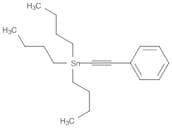
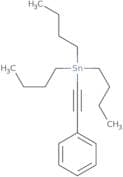
tributil(feniletinil)estannano, com o número CAS 3757-88-8, é um composto organoestânico caracterizado pela presença de um átomo de estanho ligado a três grupos butila e um grupo feniletilino. Este composto geralmente apresenta uma aparência incolor a amarelo pálido e é conhecido por sua volatilidade relativamente baixa. É solúvel em solventes orgânicos, tornando-o útil em várias aplicações químicas. A presença do grupo feniletilino confere uma reatividade única, particularmente em reações de acilo, que podem ser exploradas na síntese orgânica e na ciência dos materiais. Compostos organoestânicos como tributil(feniletinil)estannano são frequentemente estudados por suas potenciais aplicações em catálise, bem como no desenvolvimento de polímeros e outros materiais avançados. No entanto, é importante notar que os compostos organoestânicos podem representar riscos ambientais e à saúde, levando a um escrutínio regulatório. Medidas adequadas de manuseio e descarte devem ser observadas ao trabalhar com esta substância para mitigar quaisquer perigos potenciais.
Fórmula:C20H32Sn
InChI:InChI=1/C8H5.3C4H9.Sn/c1-2-8-6-4-3-5-7-8;3*1-3-4-2;/h3-7H;3*1,3-4H2,2H3;/rC20H32Sn/c1-4-7-16-21(17-8-5-2,18-9-6-3)19-15-20-13-11-10-12-14-20/h10-14H,4-9,16-18H2,1-3H3
SMILES:CCCC[Sn](CCCC)(CCCC)C#Cc1ccccc1
Sinónimos:- Stannane, tributyl(2-phenylethynyl)-
- Stannane, tributyl(phenylethynyl)-
- Tributyl(phenylethynyl)stannane
Ordenar por
Pureza (%)
0
100
|
0
|
50
|
90
|
95
|
100
3 produtos.
Tributyl(phenylethynyl)tin
CAS:Produto ControladoTributyl(phenylethynyl)tin (TBT) is a palladium complex that is used in the synthesis of organic compounds. TBT is prepared by the reaction of two equivalents of phenylethyne with tributyltin chloride followed by hydrolysis. TBT has been shown to catalyze the cross-coupling reactions between alkynes and aryl bromides, which typically proceed via palladium-catalyzed cross-coupled reactions. Cross-coupling reactions are an important synthetic method for constructing organic molecules from simple starting materials. The reaction rate and kinetics of these transformations can be controlled by changing the substituents on the palladium complex. TBT has also been shown to catalyze ring opening reactions, such as those occurring in nature or can be induced synthetically. This type of reaction is typically carried out using organometallic catalysts such as nickel or copper compounds, but TBT has been foundFórmula:C20H32SnPureza:Min. 95%Cor e Forma:Clear LiquidPeso molecular:391.18 g/mol