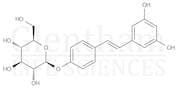
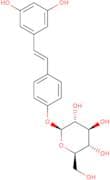
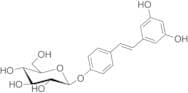
CAS 38963-95-0
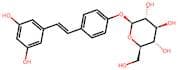
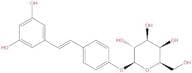
:Resveratrolosídeo
- β-D-Glucopyranoside, 4-[(1E)-2-(3,5-dihydroxyphenyl)ethenyl]phenyl
- β-D-Glucopyranoside, 4-[2-(3,5-dihydroxyphenyl)ethenyl]phenyl, (E)-
- 3,4′,5-Trihydroxystilbene 4′-mono-β-D-glycopyranoside
- Resveratroloside
- 4-[(1E)-2-(3,5-Dihydroxyphenyl)ethenyl]phenyl β-D-glucopyranoside
- Resveratrol -4'-o-beta-d-glucuronide
- Resveratrol 4'-O-beta-D-glucopyranoside
- Resveratrol 4′-O-glucopyranoside
- TRANS-RESVERATROL 4'-O-BETA-D-GLUCURONIDE
- 4-[(1E)-2-(3,5-Dihydroxyphenyl)ethenyl]phenyl beta-D-glucopyranoside
- 3,4',5-Trihydroxystilbene 4'-mono-beta-D-glycopyranoside
- trans-Resveratrol 4-O-b-D-glucopyranoside
- (2S,3R,4S,5S,6R)-2-[4-[(E)-2-(3,5-dihydroxyphenyl)ethenyl]phenoxy]-6-(hydroxymethyl)oxane-3,4,5-triol
- Resveratrol 4'-Glucoside
- Ver mais sinónimos
Resveratroloside
CAS:Resveratroloside has cardioprotective effect, it exhibits α±-glucosidase inhibitory activity, it also can inhibit hydroxylation of testosterone by CYP3A4.Fórmula:C20H22O8Pureza:99.74%Cor e Forma:SolidPeso molecular:390.38trans-Resveratrol 4'-O-β-D-glucopyranoside
CAS:trans-Resveratrol 4'-O-β-D-glucopyranosideCor e Forma:SolidPeso molecular:390.38g/moltrans-Resveratrol 4'-O-b-D-glucopyranoside
CAS:trans-Resveratrol 4'-O-b-D-glucopyranoside is a derivative of the polyphenolic compound resveratrol, which is commonly found in the skin of grapes, berries, and peanuts. This compound, classified as a glucoside, is a natural glycosylated form of resveratrol. The glycosylation enhances its water solubility and stability, potentially facilitating more effective delivery in biological systems.Fórmula:C20H22O8Pureza:Min. 95%Cor e Forma:PowderPeso molecular:390.38 g/molResveratroloside
CAS:Produto ControladoApplications Resveratroloside is a compound that shows cancer-chemopreventive and antioxidative activity through study. It is due to being a derivative of Resveratrol (R150000) which is a minor constituent of wine, correlated with serum lipid reduction and inhibition of platelet aggregation. Resveratrol is a specific inhibitor of COX-1, and it also inhibits the hydroperoxidase activity of COX-1. It has been shown to inhibit events associated with tumor initiation, promotion and progression.
References Powell, R.G., et al.: Phytochemistry, 35, 335 (1994); Jeandet, P., et al.: J. Phytopathol., 143, 135 (1995); Mattivi, F., et al.: J. Agric. Food Chem., 43, 1820 (1995); Kim, H.J et al.: Biosci. Biotechnol. Biochem., 66, 1990 (2002); Waffo-T.P. et al.: Nutr. Cancer., 40, 173 (2001);Fórmula:C20H22O8Cor e Forma:NeatPeso molecular:390.38