CAS 40176-78-1
:2-etinilquinolina
Descrição:
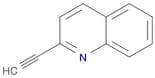
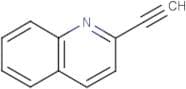
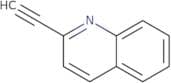
2-etinilquinolina é um composto orgânico caracterizado por sua estrutura de quinolina, que consiste em um anel de benzeno e um anel de piridina fundidos. A presença de um grupo etinila (-C≡CH) na posição 2 do anel de quinolina contribui para sua reatividade e propriedades únicas. Este composto geralmente aparece como um sólido amarelo a marrom e é conhecido por suas potenciais aplicações em síntese orgânica e ciência dos materiais. Ele exibe fluorescência, tornando-o útil em várias aplicações fotônicas. O composto também é de interesse na química medicinal devido à sua semelhança estrutural com outras moléculas biologicamente ativas. Sua síntese geralmente envolve o acoplamento de derivados de quinolina com acetileno ou compostos relacionados. Assim como muitos compostos orgânicos, 2-etinilquinolina deve ser manuseado com cuidado, pois pode representar riscos à saúde se inalado ou ingerido, e medidas de segurança adequadas devem ser tomadas durante seu uso em ambientes de laboratório.
Fórmula:C11H7N
InChI:InChI=1/C11H7N/c1-2-10-8-7-9-5-3-4-6-11(9)12-10/h1,3-8H
SMILES:C#Cc1ccc2ccccc2n1
Ordenar por
Pureza (%)
0
100
|
0
|
50
|
90
|
95
|
100
4 produtos.
2-ethynylquinoline
CAS:2-Ethynylquinoline is a molecule that has been found to be effective in the treatment of leukemia and other cancers. It inhibits protein synthesis in cells by binding to the molecule eIF4E, which prevents the production of proteins vital for cell division. 2-Ethynylquinoline has been shown to have anti-inflammatory properties, which may be due to its ability to inhibit prostaglandin synthesis. This drug also has a toxic effect on respiratory system cells, which may be due to its ability to induce apoptosis. 2-Ethynylquinoline is a potent cytotoxic agent that inhibits the growth of cancer cells by inhibiting protein synthesis and mitochondrial membrane potential. The drug also suppresses oxidative injury and cardiac dysfunction induced by fatty acid oxidation. In vivo studies have shown that 2-ethynylquinoline can cause regression of bronchial tumors in mice with pulmonary carcinomas, as well as regression of alveolar tumors in mice with metastatic lungFórmula:C11H7NPureza:Min. 95%Peso molecular:153.17 g/mol