CAS 4023-65-8
:Ácido trans-aconítico
Descrição:
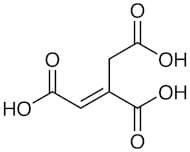
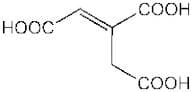
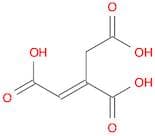
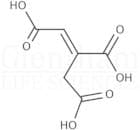
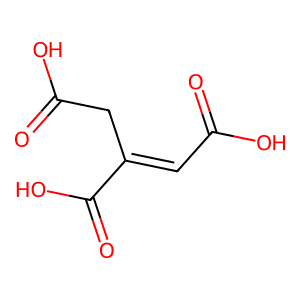
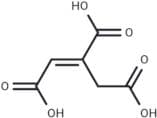
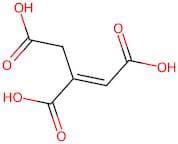
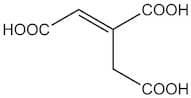
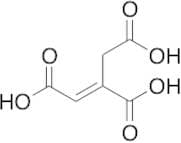
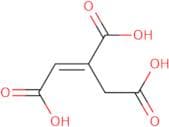
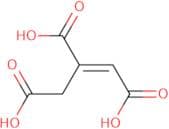
Ácido trans-aconítico, com o número CAS 4023-65-8, é um composto orgânico que pertence à classe dos ácidos dicarboxílicos insaturados. É caracterizado por sua estrutura de três carbonos com dois grupos ácidos carboxílicos (-COOH) e uma ligação dupla entre o segundo e o terceiro átomos de carbono, o que lhe confere a configuração trans. Este composto é tipicamente encontrado em forma cristalina e é solúvel em água, tornando-o útil em várias aplicações químicas. Ácido trans-aconítico é conhecido por seu papel nas vias metabólicas, particularmente no ciclo do ácido cítrico, onde pode ser interconvertido com outros metabolitos. Suas propriedades estruturais permitem que participe de várias reações químicas, incluindo esterificação e polimerização. Além disso, Ácido trans-aconítico pode servir como precursor para a síntese de outros compostos orgânicos, contribuindo para sua importância em contextos industriais e bioquímicos. No geral, sua estrutura única e reatividade fazem de Ácido trans-aconítico um assunto interessante de estudo em química orgânica.
Fórmula:C6H6O6
InChI:InChI=1S/C6H6O6/c7-4(8)1-3(6(11)12)2-5(9)10/h1H,2H2,(H,7,8)(H,9,10)(H,11,12)/b3-1+
Chave InChI:InChIKey=GTZCVFVGUGFEME-HNQUOIGGSA-N
SMILES:C(\CC(O)=O)(=C\C(O)=O)/C(O)=O
Sinónimos:- (1E)-1-Propene-1,2,3-tricarboxylic acid
- (1E)-prop-1-ene-1,2,3-tricarboxylic acid
- (1Z)-prop-1-ene-1,2,3-tricarboxylate
- (E)-1-Propene-1,2,3-tricarboxylic acid
- (E)-Aconitic acid
- 1-Propene-1,2,3-tricarboxylic acid, (1E)-
- 1-Propene-1,2,3-tricarboxylic acid, (E)-
- Aconitic acid, trans-
- trans-1-Propene-1,2,3-tricarboxylic acid
- trans-Aconitic acid, (1,2,3-Propenetricarboxylic acid)
- trans-Aconitic acid
Ordenar por
Pureza (%)
0
100
|
0
|
50
|
90
|
95
|
100
14 produtos.
trans-Aconitic Acid
CAS:Fórmula:C6H6O6Pureza:>98.0%(T)(HPLC)Cor e Forma:White to Light yellow powder to crystalPeso molecular:174.11trans-Aconitic acid, 98%
CAS:This Thermo Scientific Chemicals brand product was originally part of the Alfa Aesar product portfolio. Some documentation and label information may refer to the legacy brand. The original Alfa Aesar product / item code or SKU reference has not changed as a part of the brand transition to Thermo SciFórmula:C6H6O6Pureza:98%Cor e Forma:White to pale cream, PowderPeso molecular:174.11(E)-Prop-1-ene-1,2,3-tricarboxylic acid
CAS:Fórmula:C6H6O6Pureza:98%Cor e Forma:SolidPeso molecular:174.1082trans-Aconitic acid
CAS:Fórmula:C6H6O6Pureza:≥ 97.5%Cor e Forma:White to off-white crystalline powder or crystalsPeso molecular:174.11trans-Aconitic acid
CAS:Trans-Aconitic acid: found in urine, links to Reye's syndrome, organic aciduria, EC 2.1.1.144 substrate, soy biomarker, inhibits Leishmania transformation.Fórmula:C6H6O6Pureza:98.7%Cor e Forma:Leaflets & Plates From Water SolidPeso molecular:174.11trans-Aconitic acid
CAS:trans-Aconitic acidPureza:98%Cor e Forma:Beige SolidPeso molecular:174.11g/molTrans-aconitic acid
CAS:Acyclic polybasic carboxylic acidFórmula:C6H6O6Pureza:≥ 95.0 % (HPLC)Cor e Forma:PowderPeso molecular:174.11trans-Aconitic acid
CAS:Trans-aconitic acid is a plant metabolite that can be found in wine, honey, and other foods. It is also produced by the action of yeast on sugars and amino acids. Trans-aconitic acid is used as an analytical reagent in chromatographic analysis due to its high solubility in organic solvents. The biological function of trans-aconitic acid has not yet been determined, but it has been hypothesized that it may be involved in energy metabolism or mitochondrial membrane potential. Trans-aconitic acid binds to nuclear DNA, which could play a role in gene expression or transcriptional regulation. It also inhibits the activity of enzymes such as p-hydroxybenzoic acid form (PHBA) and zirconium oxide (ZrO). Trans-aconitic acid has been shown to inhibit the enzyme form of PHBA with an IC50 value of 0.5 mM.Fórmula:C6H6O6Pureza:Min. 95 Area-%Cor e Forma:PowderPeso molecular:174.11 g/moltrans-Aconitic acid
CAS:Trans-Aconitic acid is a chemical compound that is used as a reagent in organic synthesis.
Fórmula:C6H6O6Pureza:Min. 98 Area-%Peso molecular:174.11 g/molRef: 3D-A-2400
-Unit-ggA consultar1kgA consultar5kgA consultar10kgA consultar500gA consultar2500gA consultar