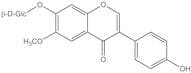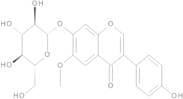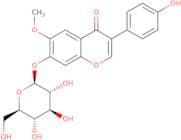
CAS 40246-10-4
:Glicitina
Descrição:
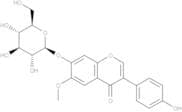
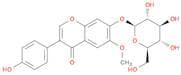
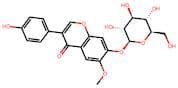
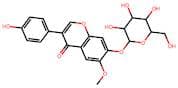
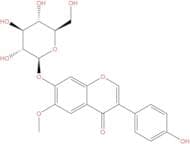
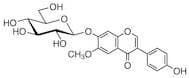
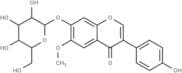
Glicitina, com o número CAS 40246-10-4, é um glicosídeo de isoflavona que ocorre naturalmente principalmente em soja e outras leguminosas. É um derivado da isoflavona genisteína, onde uma molécula de glicose está ligada, aumentando sua solubilidade e biodisponibilidade. Glicitina exibe propriedades antioxidantes, contribuindo para seus potenciais benefícios à saúde, incluindo efeitos anti-inflamatórios e possíveis papéis na regulação hormonal. Como fitoestrógeno, pode imitar o estrogênio no corpo, o que pode ter implicações para os sintomas da menopausa e a saúde óssea. Glicitina é frequentemente estudado por suas potenciais aplicações terapêuticas em várias condições de saúde, incluindo câncer e doenças cardiovasculares. Em termos de propriedades físicas, Glicitina é tipicamente um pó branco a off-white, solúvel em água e estável em condições normais de armazenamento. Seu perfil de segurança é geralmente considerado favorável, embora mais pesquisas estejam em andamento para entender completamente seus efeitos biológicos e mecanismos de ação.
Fórmula:C22H22O10
InChI:InChI=1S/C22H22O10/c1-29-15-6-12-14(30-9-13(18(12)25)10-2-4-11(24)5-3-10)7-16(15)31-22-21(28)20(27)19(26)17(8-23)32-22/h2-7,9,17,19-24,26-28H,8H2,1H3/t17-,19-,20+,21-,22-/m1/s1
Chave InChI:InChIKey=OZBAVEKZGSOMOJ-MIUGBVLSSA-N
SMILES:O=C1C=2C(=CC(O[C@@H]3O[C@H](CO)[C@@H](O)[C@H](O)[C@H]3O)=C(OC)C2)OC=C1C4=CC=C(O)C=C4
Sinónimos:- 3-(4-Hydroxyphenyl)-6-methoxy-7-[(2S,3R,4S,5S,6R)-3,4,5-trihydroxy-6-(hydroxymethyl)oxan-2-yl]oxychromen-4-one
- 3-(4-hydroxyphenyl)-6-methoxy-4-oxo-4H-chromen-7-yl beta-D-glucopyranoside
- 4H-1-Benzopyran-4-one, 7-(β-<span class="text-smallcaps">D</span>-glucopyranosyloxy)-3-(4-hydroxyphenyl)-6-methoxy-
- 7-(β-<span class="text-smallcaps">D</span>-Glucopyranosyloxy)-3-(4-hydroxyphenyl)-6-methoxy-4H-1-benzopyran-4-one
- Glycitein 7-O-glucoside
- Glycitein 7-O-β-glucoside
- Glycitein-7-β-O-glucoside
- 4H-1-Benzopyran-4-one, 7-(β-D-glucopyranosyloxy)-3-(4-hydroxyphenyl)-6-methoxy-
- 7-(β-D-Glucopyranosyloxy)-3-(4-hydroxyphenyl)-6-methoxy-4H-1-benzopyran-4-one
Ordenar por
Pureza (%)
0
100
|
0
|
50
|
90
|
95
|
100
13 produtos.
Glycitin
CAS:Glycitin analytical standard provided with w/w absolute assay, to be used for quantitative titration.Fórmula:C22H22O10Pureza:(HPLC) ≥98%Cor e Forma:PowderPeso molecular:446.41Glycitin
CAS:Other glycosides, natural or reproduced by synthesis, aFórmula:C22H22O10Cor e Forma:White Beige PowderPeso molecular:446.12134H-1-Benzopyran-4-one,7-(b-D-glucopyranosyloxy)-3-(4-hydroxyphenyl)-6-methoxy-
CAS:Fórmula:C22H22O10Pureza:98%Cor e Forma:SolidPeso molecular:446.4041Glycitin
CAS:GlycitinFórmula:C22H22O10Pureza:By hplc: 98.5% (Typical Value in Batch COA)Cor e Forma: off-white powderPeso molecular:446.40g/molGlycitin
CAS:An isoflavone glycitin is isolated from the licorice, which has good inhibitory effect on α-glucosidase with IC50of 0.5646 mg·mL- 1, better than the position control acarbose.Fórmula:C22H22O10Pureza:95%~99%Cor e Forma:PowderPeso molecular:446.408Glycitin
CAS:Fórmula:C22H22O10Pureza:>95.0%(HPLC)Cor e Forma:White to Light yellow powder to crystalPeso molecular:446.41Glycitin
CAS:Glycitin (Glycitein 7-O-β-glucoside), a natural isoflavone isolated from legumes, can promote the proliferation of bone marrow stromal cells and osteoblasts andFórmula:C22H22O10Pureza:99.71% - 99.84%Cor e Forma:White SolidPeso molecular:446.40Glycitin
CAS:Natural glycosideFórmula:C22H22O10Pureza:≥ 95.0 % (HPLC)Cor e Forma:PowderPeso molecular:446.41Glycitin
CAS:Stability Hygroscopic
Applications A metabolite of isoflavone derivatives. A derivative of Glycitein. Inhibitor.
References Whalley, J.L., et al.: Bioorg. Med. Chem. Lett., 8, 1569 (1998), Song, T., et al.: J. Agric. Food Chem., 47, 1607 (1999),Fórmula:C22H22O10Cor e Forma:WhitePeso molecular:446.4Glycitin
CAS:Glycitin is an isoflavone glycoside, which is a bioactive compound primarily derived from soybeans. This natural compound is sourced from the soy plant, Glycine max, where it serves as one of the predominant isoflavones. Isoflavones like glycitin function as phytoestrogens, plant-derived compounds that can mimic or modulate the action of estrogen in the body. Glycitin undergoes hydrolysis in the digestive system to produce its aglycone form, glycitein, which can interact with estrogen receptors and exert estrogenic effects.Fórmula:C22H22O10Pureza:Min. 98 Area-%Cor e Forma:White PowderPeso molecular:446.4 g/mol