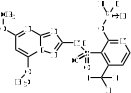
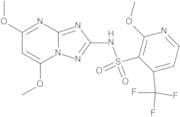
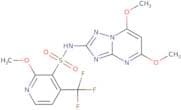
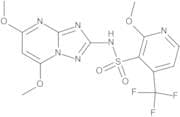
![3-Pyridinesulfonamide, N-(5,7-dimethoxy[1,2,4]triazolo[1,5-a]pyrimidin-2-yl)-2-methoxy-4-(trifluor…](/_next/image/?url=https%3A%2Fstatic.cymitquimica.com%2Fcas-image%2Fthumb-webp%2F392775-pyroxsulam.webp&w=3840&q=75)
CAS 422556-08-9
:3-Piridinasulfonamida, N-(5,7-dimetoxi[1,2,4]triazolo[1,5-a]pirimidin-2-il)-2-metoxi-4-(trifluorometil)-
Descrição:
3-Piridinasulfonamida, N-(5,7-dimetoxi[1,2,4]triazolo[1,5-a]pirimidin-2-il)-2-metoxi-4-(trifluorometil)- é um composto químico caracterizado por sua estrutura complexa, que inclui um anel de piridina, um grupo sulfonamida e uma porção de triazolopirimidina. Este composto apresenta múltiplos grupos funcionais, incluindo substituintes metóxi e trifluorometílicos, que podem influenciar sua solubilidade, reatividade e atividade biológica. A presença do grupo sulfonamida sugere aplicações potenciais em química medicinal, particularmente como um farmacóforo no desenvolvimento de medicamentos. Sabe-se que o grupo trifluorometílico melhora a lipofilicidade e a estabilidade metabólica, tornando esses compostos de interesse no design de produtos farmacêuticos. Além disso, as características estruturais do composto podem contribuir para suas interações com alvos biológicos, potencialmente levando a efeitos terapêuticos. No geral, este composto exemplifica a intrincada relação entre a estrutura molecular e a função biológica, tornando-se um assunto de interesse em vários campos, incluindo química medicinal e descoberta de medicamentos.
Fórmula:C14H13F3N6O5S
InChI:InChI=1/C14H13F3N6O5S/c1-26-8-6-9(27-2)23-13(19-8)20-12(21-23)22-29(24,25)10-7(14(15,16)17)4-5-18-11(10)28-3/h4-6H,1-3H3,(H,21,22)
Chave InChI:InChIKey=GLBLPMUBLHYFCW-UHFFFAOYSA-N
SMILES:S(NC1=NN2C(=N1)N=C(OC)C=C2OC)(=O)(=O)C=3C(C(F)(F)F)=CC=NC3OC
Sinónimos:- 3-Pyridinesulfonamide, N-(5,7-dimethoxy[1,2,4]triazolo[1,5-a]pyrimidin-2-yl)-2-methoxy-4-(trifluoromethyl)-
- 422556-08-9
- De 742
- N-(5,7-Dimethoxy[1,2,4]triazolo[1,5-a]pyrimidin-2-yl)-2-methoxy-4-(trifluoromethyl)-3-pyridinesulfonamide
- Palace
- Pyroxsulam
- Pyroxsulam [iso]
Ordenar por
Pureza (%)
0
100
|
0
|
50
|
90
|
95
|
100
7 produtos.
LC PestiMix 6 10 µg/mL in Acetonitrile
CAS:- 1007-28-9
- 1114-71-2
- 113036-88-7
- 113136-77-9
- 114420-56-3
- 115086-54-9
- 115852-48-7
- 116255-48-2
- 119791-41-2
- 121776-33-8
- 126535-15-7
- 130000-40-7
- 136849-15-5
- 138164-12-2
- 139528-85-1
- 147150-35-4
- 149508-90-7
- 180409-60-3
- 181274-17-9
- 1929-88-0
- 199119-58-9
- 2008-41-5
- 210631-68-8
- 211867-47-9
- 221667-31-8
- 223580-51-6
- 23576-24-1
- 239110-15-7
- 2439-10-3
- 25606-41-1
- 27314-13-2
- 27605-76-1
- 2797-51-5
- 302-27-2
- 321-54-0
- 32889-48-8
- 3337-71-1
- 335104-84-2
- 33820-53-0
- 35367-31-8
- 37019-18-4
- 372137-35-4
- 4151-50-2
- 422556-08-9
- 42609-52-9
- 4849-32-5
- 55861-78-4
- 57160-47-1
- 58011-68-0
- 6119-70-6
- 61432-55-1
- 64-10-8
- 66-81-9
- 69335-91-7
- 69806-50-4
- 74051-80-2
- 74222-97-2
- 76578-12-6
- 8065-36-9
- 81103-11-9
- 81335-77-5
- 82211-24-3
- 838-85-7
- 86811-58-7
- 88678-67-5
- 90982-32-4
- 91-22-5
- 93697-74-6
- 944-22-9
- 951659-40-8
- 96182-53-5
- 96525-23-4
- 97780-06-8
- 97886-45-8
- 99105-77-8
Cor e Forma:MixturePyroxsulam 100 µg/mL in Acetonitrile
CAS:Fórmula:C14H13F3N6O5SCor e Forma:Single SolutionPeso molecular:434.35Pyroxsulam
CAS:Pyroxsulam is a selective post-emergence herbicide, which is synthetically derived from the triazolopyrimidine family. It functions by inhibiting the acetolactate synthase (ALS) enzyme in plants, a critical enzyme in the biosynthesis pathway of branched-chain amino acids such as valine, leucine, and isoleucine. This inhibition disrupts protein synthesis, ultimately leading to plant death.Pyroxsulam is primarily used in agricultural settings to manage a variety of grass and broadleaf weeds in cereal crops like wheat and barley. It is highly effective at low application rates and can offer broad-spectrum control across a range of climatic conditions. Its selectivity allows for the protection of desirable cereal plants while targeting problematic weed species. The use of pyroxsulam aids in enhancing crop yield and quality by minimizing competition from weeds for nutrients, light, and water. Its activity at the enzymatic level underscores the importance of precise application timing to maximize efficacy while minimizing environmental impact.Fórmula:C14H13F3N6O5SPureza:Min. 95%Cor e Forma:PowderPeso molecular:434.35 g/mol