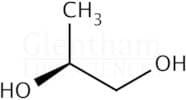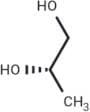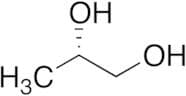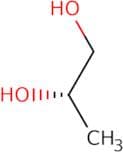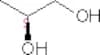
CAS 4254-15-3
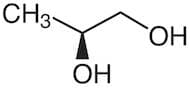
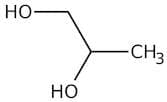
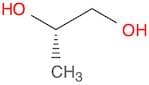
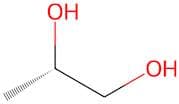
:(+)-1,2-Propano-1,2-diol
Descrição:
(+)-1,2-Propano-1,2-diol, também conhecido como propilenoglicol, é um líquido incolor, inodoro e higroscópico com um sabor doce. É um diol, o que significa que contém dois grupos hidroxila (-OH), que contribuem para sua solubilidade em água e em vários solventes orgânicos. Este composto é comumente usado em alimentos, produtos farmacêuticos e cosméticos como um umectante, solvente e conservante devido à sua baixa toxicidade e capacidade de reter a umidade. Sua fórmula química é C3H8O2, e possui um ponto de ebulição relativamente baixo e um alto ponto de ebulição em comparação com outras pequenas moléculas orgânicas. A designação (+) indica que é o enantiômero com atividade óptica específica, o que pode influenciar suas interações em sistemas biológicos. O propilenoglicol também é utilizado na produção de anticongelante e como transportador de sabores e fragrâncias. Seu perfil de segurança foi bem estudado e é geralmente reconhecido como seguro (GRAS) por agências reguladoras quando usado adequadamente.
Fórmula:C3H8O2
InChI:InChI=1/C6H12O3/c1-5-3-8-4-6(2-7)9-5/h5-7H,2-4H2,1H3/t5?,6-/m0/s1
Chave InChI:InChIKey=DNIAPMSPPWPWGF-VKHMYHEASA-N
SMILES:[C@@H](CO)(C)O
Sinónimos:- (+)-1,2-Propanediol
- (2S)-1,2-Propanediol
- (2S)-Propane-1,2-diol
- (S)-(+)-1,2-propanediol
- (S)-(+)-Propane-1,2-diol
- (S)-(+)-Propylene glycol
- (S)-2-Hydroxy-1-propanol
- (S)-2-Hydroxypropanol
- 1,2(S)-Propanediol
- 1,2-Propanediol, (2S)-
- 1,2-Propanediol, (S)-
- 3-Deoxy-sn-glycerol
- <span class="text-smallcaps">L</span>-(+)-Propanediol
- <span class="text-smallcaps">L</span>-(+)-Propylene glycol
- <span class="text-smallcaps">L</span>-1,2-Propanediol
- d-Propylene glycol
- L-(+)-Propylene glycol
- PROPYELENE GLYCOL pure
- (S)-(+)-1,2-DIHYDROXYPROPANE
- (S)-(+)-PROPYLENE GLYCEROL
- PROPYLENE GLYCOL extrapure AR
- 1,2-PROPANEDIOL, 1000MG, NEAT
- (S)-(+)-1,2-Propanediol,99%
- (S)-(+)-1,2-Propanediol,97%
- S-1,2-Propancdiol
- ALUMINUM NITRATE NONAHYDRATE 98+% &
- (S)-(+)-PROPANEDIOL
- Ver mais sinónimos
Ordenar por
Pureza (%)
0
100
|
0
|
50
|
90
|
95
|
100
11 produtos.
(S)-(+)-1,2-Propanediol
CAS:Fórmula:C3H8O2Pureza:>98.0%(GC)Cor e Forma:Colorless to Light yellow to Light orange clear liquidPeso molecular:76.10(S)-(+)-1,2-Propanediol, 97%
CAS:(S)-(+)-1,2-Propanediol acts as an organic solvent and diluent used in pharmaceutical preparations. It is also used as a chiral synthetic intermediate and substrate for enzyme studies. This Thermo Scientific Chemicals brand product was originally part of the Alfa Aesar product portfolio. Some documeFórmula:C3H8O2Pureza:97%Cor e Forma:Clear colorless, Liquid or viscous liquidPeso molecular:76.10Ref: IN-DA0032FV
5gA consultar25kgA consultar50kgA consultar10g21,00€25g25,00€50g25,00€100g28,00€250g55,00€500g73,00€(S)-(+)-1,2-Propanediol
CAS:(S)-(+)-1,2-PropanediolFórmula:C3H8O2Pureza:98%Cor e Forma: colourless liquidPeso molecular:76.09g/molS(+)-Propylene glycol
CAS:Fórmula:C3H8O2Pureza:(GC) ≥ 96.0%Cor e Forma:Clear, colourless liquidPeso molecular:76.10(S)-(+)-1,2-Propanediol
CAS:(S)-(+)-1,2-Propanediol ((2S)-propane-1,2-diol) is an endogenous compound produced by the engineered bacterium Lactococcus lactis.Fórmula:C3H8O2Pureza:99.23%Cor e Forma:Less To Light Yellow Liquid Colorless To Light Yellow LiquidPeso molecular:76.09(S)-(+)-Propane-1,2-diol
CAS:Produto ControladoApplications (S)-(+)-Propane-1,2-diol is a general reagent used in organic synthesis. (S)-(+)-Propane-1,2-diol is used in the synthesis of anti-tuberculosis agents inspired by BTZ043 for MDR resistant strains.
References Tiwari, R. et al.: ACS Med. Chem. Lett., 5, 587 (2014); Tiwari, R. et al.: J. Am. Chem. Soc., 135, 3539 (2013);Fórmula:C3H8O2Cor e Forma:ColourlessPeso molecular:76.09(S)-(+)-1,2-Propanediol
CAS:(S)-(+)-1,2-Propanediol is a diol that is a chemical compound with the molecular formula HOCHCHOH. It has an asymmetric carbon atom and can exist as two enantiomers (S)-(+)-1,2-propanediol and (R)-(-)-1,2-propanediol. The compound is produced in the laboratory by oxidation of propylene with hydrogen peroxide in the presence of a metal catalyst. It undergoes dehydration reactions to form sugars such as erythritol and xylitol. This process also occurs naturally in some plants and bacteria where glucose is oxidized to form glycerol. The conversion of propane-1,2-diol to glycerol is catalyzed by alcohol dehydrogenase from yeast or fungi such as Candida boidinii or Candida kefyr. It also reacts with other molecules such as proteins via amide formation to form new compounds called aFórmula:C3H8O2Pureza:Min. 98%Cor e Forma:Colorless Slightly Yellow Clear LiquidPeso molecular:76.09 g/mol