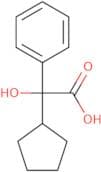
CAS 427-49-6
:Ácido α-ciclopentilmandélico
Descrição:
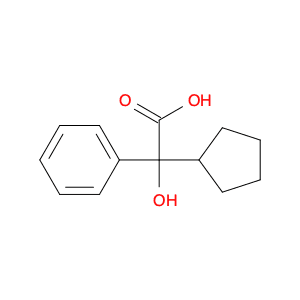
Ácido α-ciclopentilmandélico, com o número CAS 427-49-6, é um composto orgânico caracterizado pelo seu único grupo ciclopentílico ligado à estrutura do ácido mandélico. Este composto apresenta um centro quiral, o que contribui à sua potencial atividade óptica. Normalmente aparece como um sólido cristalino branco a off-white e é solúvel em solventes polares, como água e álcoois, devido à presença do grupo funcional ácido carboxílico. O grupo ciclopentílico pode influenciar a hidrofobicidade e a atividade biológica do composto, tornando-o de interesse na química medicinal e no design de fármacos. Ácido α-ciclopentilmandélico pode exibir várias propriedades biológicas, incluindo efeitos antimicrobianos ou anti-inflamatórios, embora as atividades específicas possam variar com base em modificações estruturais e na presença de substituintes. Sua síntese geralmente envolve a reação de derivados ciclopentílicos com ácido mandélico ou seus precursores. Assim como muitos ácidos orgânicos, pode participar de reações ácido-base e formar sais com bases, o que pode ser relevante para suas aplicações em farmacêuticos e síntese orgânica.
Fórmula:C13H16O3
InChI:InChI=1S/C13H16O3/c14-12(15)13(16,11-8-4-5-9-11)10-6-2-1-3-7-10/h1-3,6-7,11,16H,4-5,8-9H2,(H,14,15)
Chave InChI:InChIKey=WFLUEQCOAQCQLP-UHFFFAOYSA-N
SMILES:C(C(O)=O)(O)(C1=CC=CC=C1)C2CCCC2
Sinónimos:- (2R)-cyclopentyl(hydroxy)phenylethanoate
- (2S)-cyclopentyl(hydroxy)phenylethanoate
- (±)-Cyclopentylmandelic acid
- 2-Cyclopentyl-2-hydroxy-2-(phenyl)acetic acid
- 2-Cyclopentyl-2-hydroxy-2-phenylacetic acid
- 2-Cyclopentylmandelic acid
- Benzeneacetic acid, α-cyclopentyl-α-hydroxy-
- Cyclopentyl(Hydroxy)Phenylacetic Acid
- Cyclopentylhydroxyphenylacetic acid
- Mandelic acid, α-cyclopentyl-
- NSC 96637
- alpha-Cyclopentylmandelic acid
- α-Cyclopentyl-α-hydroxybenzeneacetic acid
- α-Cyclopentylmandelic acid
- ALFA-CYCLOPENTYLMANDELIC ACID
- Ver mais sinónimos
Ordenar por
Pureza (%)
0
100
|
0
|
50
|
90
|
95
|
100
11 produtos.
α-Cyclopentyl-DL-mandelic Acid
CAS:Fórmula:C13H16O3Pureza:>98.0%(T)(HPLC)Cor e Forma:White to Light yellow powder to crystalPeso molecular:220.27Glycopyrrolate Related Compound C (2-Cyclopentyl-2-hydroxy-2-phenylacetic acid)
CAS:Carboxylic acids w/ alcohol function but w/o other oxygen function and their derivatives, nesoiFórmula:C13H16O3Cor e Forma:White Off-White PowderPeso molecular:220.109942-Cyclopentyl-2-hydroxy-2-phenylacetic acid
CAS:Fórmula:C13H16O3Pureza:96%Cor e Forma:SolidPeso molecular:220.2643Glycopyrronium Bromide EP Impurity J (Glycopyrrolate USP Related Compound C)
CAS:Fórmula:C13H16O3Cor e Forma:Off-White SolidPeso molecular:220.272-Cyclopentyl-2-hydroxy-2-phenylacetic acid
CAS:2-Cyclopentyl-2-hydroxy-2-phenylacetic acidPureza:98%Peso molecular:220.27g/mol2-Cyclopentyl-2-hydroxy-2-phenylacetic Acid
CAS:Applications 2-Cyclopentyl-2-hydroxy-2-phenylacetic Acid is an impurity of Glycopyrrolate (G657000), a novel pharmaceutical compound based on PDE IV inhibitors; used in the treatment of respiratory complaints. It is used in the synthesis of muscarinic M3 receptor antagonists.
References Gomez, et al.: Br. J. Anaesth., 74, 549 (1995); Kumar, N. et al.: Bioorg. Med. Chem. Lett., 17, 5256 (2007);Fórmula:C13H16O3Cor e Forma:Off White To Light BrownPeso molecular:220.26Cyclopentylmandelic acid
CAS:Cyclopentylmandelic acid (CPM) is a bifunctional drug that binds to the receptors of the adrenergic system and acts as an agonist. It has been shown to have a matrix effect, which stabilizes and minimizes the effects of other drugs. CPM can also reduce carbonyl groups in the body, which are linked to stress and aging. CPM is a synthetic drug that was first isolated by chromatography. The structural formula for this drug is similar to that of cyclopentanol, with the exception of one methyl group on its side chain. CPM has been shown to have anticholinergic properties, meaning it blocks acetylcholine receptors in nerve cells and leads to dry mouth, blurred vision, constipation, and urinary retention.Fórmula:C13H16O3Cor e Forma:White PowderPeso molecular:220.27 g/mol