CAS 4421-58-3
:(7R)-4-Hidroxi-7-(hidroximetil)-N,N,N-trimetil-9-oxo-3,5,8-trioxa-4-fosfahexacosan-1-amônio sal interno 4-óxido
- Choline, hydroxide, dihydrogen phosphate, inner salt, 1-ester with 2-monostearin, L-
- (7R)-4-Hydroxy-7-(hydroxymethyl)-N,N,N-trimethyl-9-oxo-3,5,8-trioxa-4-phosphahexacosan-1-aminium inner salt 4-oxide
- 3,5,8-Trioxa-4-phosphahexacosan-1-aminium, 4-hydroxy-7-(hydroxymethyl)-N,N,N-trimethyl-9-oxo-, inner salt, 4-oxide, (7R)-
- 3,5,8-Trioxa-4-phosphahexacosan-1-aminium, 4-hydroxy-7-(hydroxymethyl)-N,N,N-trimethyl-9-oxo-, inner salt, 4-oxide, (R)-
- 2-Stearoyl-sn-glycero-3-phosphocholine
- (R)-3-hydroxy-2-(stearoyloxy)propyl (2-(trimethylammonio)ethyl) phosphate
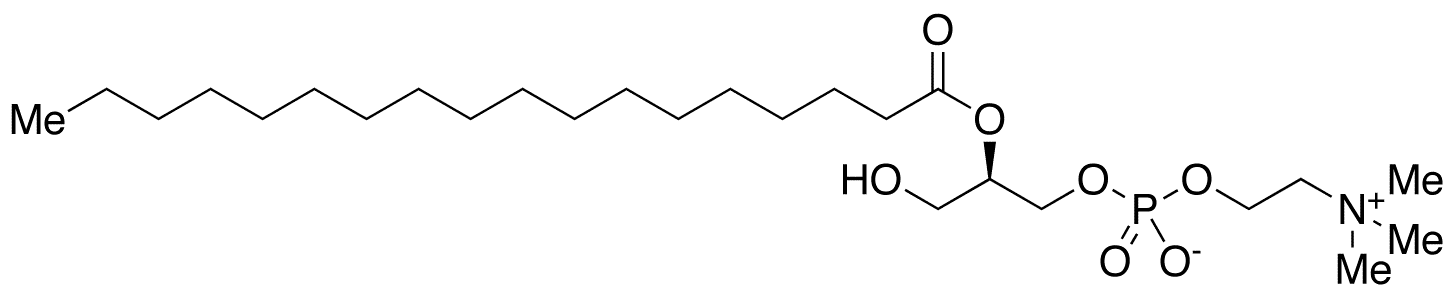
2-Stearoyl-sn-glycero-3-phosphocholine
CAS:Produto ControladoStability Hygroscopic
Applications A fatty acid that when in complex acyl-CoA acts as an Acyltransferase enzyme. Found in mice after exposure to endocrine disruptors DEHP and Aroclor 1254.
References Zhang, J. et al.: J. Pharmaceut. Biomed., 66, 287 (2012); Holub, B.J.: BBA-Lipid. Lipid. Met., 664, 221 (1981)Fórmula:C26H54NO7PCor e Forma:NeatPeso molecular:523.682-Stearoyl-d35-sn-glycero-3-phosphocholine
CAS:Produto ControladoApplications 2-Stearoyl-d35-sn-glycero-3-phosphocholine is labelled 2-Stearoyl-sn-glycero-3-phosphocholine (S686575) which is a fatty acid that when in complex acyl-CoA acts as an Acyltransferase enzyme. Found in mice after exposure to endocrine disruptors DEHP and Aroclor 1254.
References Zhang, J. et al.: J. Pharmaceut. Biomed., 66, 287 (2012); Holub, B.J.: BBA-Lipid. Lipid. Met., 664, 221 (1981)Fórmula:C26D35H19NO7PCor e Forma:NeatPeso molecular:558.8992-18:0 Lyso PC
CAS:2-18:0 Lyso PC is a hydrophobic molecule with a detector response that can be characterized by parameters such as interaction, symmetry, and linearity. Transition profiles can be used to identify the type of detector response. The transition profile for 2-18:0 Lyso PC has been shown to be symmetric, leading to a linear response.
2-18:0 Lyso PC interacts with membranes because of its hydrophobic nature. This interaction leads to membrane perturbations that can be detected using the spectroscopic technique. These perturbations in the membrane are caused by changes in the acyl chains within the membrane, which can be identified through their asymmetry.Fórmula:C26H54NO7PPureza:Min. 95%Peso molecular:523.68 g/mol2-Stearoyl-sn-glycero-3-PC
CAS:2-Stearoyl-sn-glycero-3-phosphatidylcholine (2-Stearoyl-sn-glycero-3-PC) is a lysophospholipid characterized by the presence of stearic acid at the sn-2 position. This compound has been identified in the myocardium of rabbits.Fórmula:C26H54NO7PCor e Forma:SolidPeso molecular:523.68