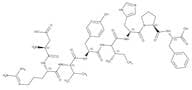
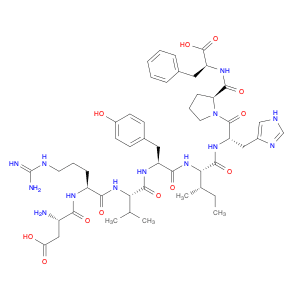
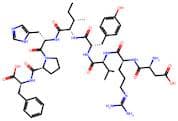
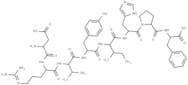
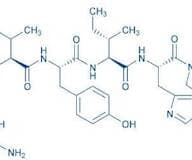
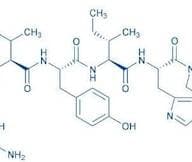
CAS 4474-91-3
:angiotensina II
- Angiotensin Ii, Human
- Angiotensin II
- Angiotensin II acetate salt
Angiotensin II (human)
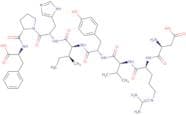
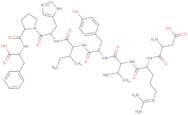
CAS:Ang II stimulates angiogenesis and increases microvessel density. In addition, the renin-angiotensin and nitric oxide-generating systems appear to interract in the regulation of cardiovascular function. Angiotensin (Ang) II is a peptide which plays an important role in the regulation of blood pressFórmula:C50H71N13O12Cor e Forma:Powder, WhitePeso molecular:1046.20(3S)-3-amino-3-{[(1S)-4-carbamimidamido-1-{[(1S)-1-{[(1S)-1-{[(1S,2S)-1-{[(2S)-1-[(2S)-2-{[(1S)-1-carboxy-2-phenylethyl]carbamoyl}pyrrolidin-1-yl]-3-(1H-imidazol-4-yl)-1-oxopropan-2-yl]carbamoyl}-2-methylbutyl]carbamoyl}-2-(4-hydroxyphenyl)ethyl]carbamoyl}-2-methylpropyl]carbamoyl}butyl]carbamoyl}propanoic acid
CAS:Fórmula:C50H71N13O12Pureza:99%Cor e Forma:SolidPeso molecular:1046.1786Angiotensin II human
CAS:Angiotensin II acts on AT1/AT2 receptors, 30% similar seven-transmembrane glycoproteins, converted from Ang I by ACE.Fórmula:C50H71N13O12Pureza:95% - >99.99%Cor e Forma:SolidPeso molecular:1046.18Angiotensin II Trifluoroacetic Acid Salt (Human)
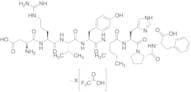
CAS:Produto ControladoApplications Angiotensin II Trifluoroacetic Acid Salt (Human) is a peptide involved in the regulation of blood pressure.
Fórmula:C50H71N13O12·x(C2HF3O2)Cor e Forma:NeatPeso molecular:1046.18 + x(114.02)Angiotensin II, human
CAS:Custom research peptide; min purity 95%. For different specs please use the Peptide Quote ToolFórmula:C50H71N13O12Peso molecular:1,046.19 g/molAngiotensin II, human
CAS:Angiotensin II is a peptide that is involved in the regulation of blood pressure and fluid balance. Angiotensin II has been shown to be an activator of angiotensin-converting enzyme (ACE), which converts angiotensin I into angiotensin II. ACE is inhibited by the drug captopril, which reduces the conversion of angiotensin I to angiotensin II. Angiotensin II has also been shown to activate potassium channels, including voltage-gated potassium channels, and inhibit calcium channels. It has been found to bind to the receptor AT1 and trigger a number of responses, including vasoconstriction and increased heart rate. The ligand for this receptor is angiotensin II. The pharmacology of Angiotensin II includes its ability to act as an inhibitor on protein interactions with various proteins or enzymes, such as alpha-1 antitrypsin or beta-2 adrenergic receptors.Fórmula:C50H71N13O12•CH3COOH•4H2OPureza:Min. 95%Peso molecular:1,178.31 g/molAngiotensin II (Human)
CAS:Angiotensin II (Human) is a peptide that is produced by the renin-angiotensin system. It has been shown to be an effective inhibitor of the cell adhesion molecule CD44, and can also stimulate the proliferation of cells in culture. Angiotensin II (Human) is a ligand for angiotensin receptors, which are found on many different types of cells. The binding of angiotensin II to these receptors stimulates the production of cyclic AMP, which causes vasoconstriction and increased blood pressure.Fórmula:C50H71N13O12Pureza:Min. 95%Peso molecular:1,046.2 g/molAngiotensin II,human
CAS:The human angiotensin II (hAng II) is a potent vasoconstrictor, which is a hormone that narrows blood vessels by causing the muscles around the blood vessels to contract. The response of vascular smooth muscle cells to hAng II is mediated through the interaction of hAng II with its receptor, which can be blocked by chemical inhibitors. Angiotensin II also has effects on other tissues, such as the heart and lungs. At high concentrations, it stimulates erythrocyte production in bone marrow. It also induces reactive oxygen species and prostaglandins, which are inflammatory substances that lead to cell death and tissue damage. The optimum concentration for this drug is 1-10 nM.Fórmula:C50H71N13O12Pureza:Min. 95%Cor e Forma:PowderPeso molecular:1,046.18 g/molAngiotensin II trifluoroacetate salt
CAS:Angiotensin II is a peptide hormone that may act as a neurotransmitter or neuromodulator. It is one of the most important vasoconstrictor and aldosterone-secreting hormones produced by the renin-angiotensin system in mammals. Angiotensin II has been shown to stimulate cardiac contractility, increase vascular resistance, and regulate blood pressure. The effect of Angiotensin II on cardiac contractility is mediated through its binding to a response element in the promoter region of genes encoding for Ca2+ channels. This binding leads to increased Ca2+ influx into cardiac cells and increased myofibrillar Ca2+ sensitivity. Angiotensin II also activates reactive oxygen species (ROS) production, which causes injury to the renal tubular epithelium and induces tubulointerstitial injury in rats with diabetes. It also stimulates squamous cell carcinoma growth by inducing reactive oxygen species (ROS) production and activating signal trans
Fórmula:C50H71N13O12·xC2HF3O2Pureza:Min. 95%Peso molecular:1,046.18 g/molAngiotensin II
CAS:Angiotensin II, DRVYIHPF, is the major biologically active component of the renin-angiotensin system. Its activities include the regulation of blood pressure, salt and water balance, and vascular tonus. Ang II stimulates various enzymes such as NADPH oxidase. Ang II is often used as a model compound in the development and evaluation of analytical methods for peptides and proteins (e.g. MS).Fórmula:C50H71N13O12Pureza:99.4%Cor e Forma:WhitePeso molecular:1046.19Angiotensin II
CAS:Bachem ID: 4095850.
Fórmula:C50H71N13O12Pureza:97.4%Cor e Forma:WhitePeso molecular:1046.19