CAS 4498-32-2
:Dibenzepina
Descrição:
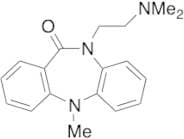
Dibenzepina é um antidepressivo tricíclico usado principalmente no tratamento da depressão e de certos transtornos de ansiedade. Funciona inibindo a recaptação de neurotransmissores, particularmente norepinefrina e serotonina, melhorando assim o humor e a estabilidade emocional. A estrutura química de Dibenzepina consiste em um núcleo de dibenzociclohepteno, que contribui para suas propriedades farmacológicas. É tipicamente administrado em forma oral e é conhecido por seus efeitos sedativos, tornando-o benéfico para pacientes com insônia associada à depressão. Dibenzepina tem uma meia-vida relativamente longa, o que permite a dosagem uma vez ao dia em muitos casos. No entanto, assim como outros antidepressivos tricíclicos, pode ter efeitos colaterais, incluindo boca seca, constipação e potenciais efeitos cardiovasculares, necessitando de monitoramento cuidadoso. Seu uso diminuiu com o advento de antidepressivos mais novos que muitas vezes têm perfis de efeitos colaterais mais favoráveis. No geral, Dibenzepina continua sendo uma opção relevante em cenários clínicos específicos, particularmente para pacientes que podem não responder a outros tratamentos.
Fórmula:C18H21N3O
InChI:InChI=1S/C18H21N3O/c1-19(2)12-13-21-17-11-7-6-10-16(17)20(3)15-9-5-4-8-14(15)18(21)22/h4-11H,12-13H2,1-3H3
Chave InChI:InChIKey=QPGGEKPRGVJKQB-UHFFFAOYSA-N
SMILES:C(CN(C)C)N1C=2C(N(C)C=3C(C1=O)=CC=CC3)=CC=CC2
Sinónimos:- 10-(2-Dimethylaminoethyl)-5,10-Dihydro-5-Methyldibenzo(B,E)(1,4)Diazepin-11-One
- 10-[2-(Dimethylamino)ethyl]-5,10-dihydro-5-methyl-11H-dibenzo[b,e][1,4]diazepin-11-one
- 10-[2-(dimethylamino)ethyl]-5-methyl-5,10-dihydro-11H-dibenzo[b,e][1,4]diazepin-11-one
- 11H-Dibenzo[b,e][1,4]diazepin-11-one, 10-[2-(dimethylamino)ethyl]-5,10-dihydro-5-methyl-
- Dibenzepine
- Hf 1927
- Victoril
- Dibenzepin
Ordenar por
Pureza (%)
0
100
|
0
|
50
|
90
|
95
|
100
3 produtos.
Dibenzepin
CAS:<p>Applications Antidepressant.<br> Not a dangerous good if item is equal to or less than 1g/ml and there is less than 100g/ml in the package<br>References Lehner, H., et al.: Arzneim.-Forsch., 17, 185 (1967), Egli, A., et al.: Anal. Profiles Drug Subs., 9, 181 (1980),<br></p>Fórmula:C18H21N3OCor e Forma:NeatPeso molecular:295.38Dibenzepin-d3
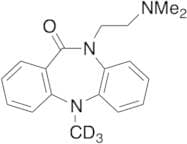
CAS:Produto Controlado<p>Applications Antidepressant.<br> Not a dangerous good if item is equal to or less than 1g/ml and there is less than 100g/ml in the package<br>References Lehner, H., et al.: Arzneim.-Forsch., 17, 185 (1967), Egli, A., et al.: Anal. Profiles Drug Subs., 9, 181 (1980),<br></p>Fórmula:C18D3H18N3OCor e Forma:NeatPeso molecular:298.397Dibenzepin
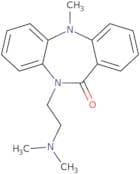
CAS:Produto Controlado<p>Dibenzepin is a tricyclic antidepressant drug that is used to treat depression, anxiety, and other mood disorders. Dibenzepin has been shown to increase the glomerular filtration rate in geriatric patients and can be used for the treatment of cardiac effects such as arrhythmia. Dibenzepin also has a linear calibration curve with an R2 value of 0.9996. This drug is metabolized by dextromethorphan via glucuronidation or sulfation, which are two common metabolic pathways. The therapeutic levels of this drug are determined by measuring serum prolactin levels or by using a linear calibration curve with an R2 value of 0.9996. The acute toxicities of dibenzepin can include bowel disease, locomotor activity, and heart rate changes in animals. These side effects can be avoided by performing sample preparation before analysis.</p>Fórmula:C18H21N3OPureza:Min. 95%Cor e Forma:Slightly Brown PowderPeso molecular:295.38 g/mol