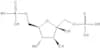
CAS 488-69-7
:Frutose 1,6-bisfosfato
Descrição:
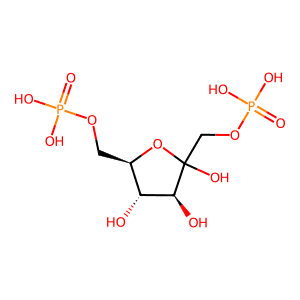
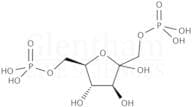
Frutose 1,6-bisfosfato (FBP) é um intermediário crucial na via glicolítica, desempenhando um papel significativo no metabolismo celular. É um açúcar fosforilado, especificamente uma hexose, derivado da frutose. O composto apresenta dois grupos fosfato ligados ao primeiro e ao sexto átomos de carbono, que são essenciais para sua função na produção de energia. FBP é um composto incolor e solúvel em água, e sua estrutura permite que participe de várias reações enzimáticas, particularmente aquelas catalisadas por aldolase e frutose-1,6-bisfosfatase. Atua como um regulador alostérico, influenciando a atividade de enzimas-chave nas vias metabólicas, desempenhando assim um papel na regulação da gluconeogênese e da glicólise. A presença dos grupos fosfato contribui para suas características de alta energia, tornando-o uma molécula vital nos processos de transferência de energia dentro das células. Além disso, FBP está envolvido na regulação do fluxo metabólico e é um jogador chave no equilíbrio entre a produção e o consumo de energia nos organismos vivos.
Fórmula:C6H14O12P2
InChI:InChI=1S/C6H14O12P2/c7-3(1-17-19(11,12)13)5(9)6(10)4(8)2-18-20(14,15)16/h3,5-7,9-10H,1-2H2,(H2,11,12,13)(H2,14,15,16)/t3-,5-,6-/m1/s1
Chave InChI:InChIKey=XPYBSIWDXQFNMH-UYFOZJQFSA-N
SMILES:[C@H]([C@@H](C(COP(=O)(O)O)=O)O)([C@@H](COP(=O)(O)O)O)O
Sinónimos:- 1,6-Bis(dihydrogenophosphate) de D-fructose
- 1,6-bis(dihidrogenofosfato) de D-fructosa
- 1,6-di-O-phosphono-D-fructofuranose
- 1,6-di-O-phosphono-D-fructose
- 1,6-di-O-phosphono-beta-D-fructofuranose
- 1,6-di-O-phosphonohex-2-ulofuranose
- 2,5-anhydro-1,6-di-O-phosphono-D-glucitol
- <span class="text-smallcaps">D</span>-Fructose 1,6-biphosphate
- <span class="text-smallcaps">D</span>-Fructose 1,6-bisphosphate
- <span class="text-smallcaps">D</span>-Fructose 1,6-diphosphate
- <span class="text-smallcaps">D</span>-Fructose, 1,6-bis(dihydrogen phosphate)
- D-Fructose 1,6-biphosphate
- D-Fructose 2,6-Diphosphate Di-Sodium Salt
- D-Fructose-1,6-bis(dihydrogenphosphat)
- D-fructose 1,6-bis(dihydrogen phosphate)
- D-fructose 1,6-bisphosphate
- Diphosphofructose
- Esafosfan
- Esafosfina
- F1,6diP
- FDP
- Fosfructose
- Fructose 1,6-bis(dihydrogen phosphate)
- Fructose 1,6-diphosphate
- Fructose Diphosphate
- Fructose, 1,6-bis(dihydrogen phosphate), <span class="text-smallcaps">D</span>-
- Fructose, 1,6-bis(dihydrogen phosphate), D-
- Fructose-1,6-Bisphosphate
- Harden-Young ester
- beta-D-fructofuranose-1,6-diphosphate
- Ver mais sinónimos
Ordenar por
Pureza (%)
0
100
|
0
|
50
|
90
|
95
|
100
10 produtos.
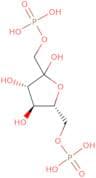
{[(3S,4S,5R)-2,3,4-trihydroxy-5-[(phosphonooxy)methyl]oxolan-2-yl]methoxy}phosphonic acid
CAS:Fórmula:C6H14O12P2Pureza:98.0%Cor e Forma:SolidPeso molecular:340.1157D-Fructose-1,6-diphosphate
CAS:D-Fructose-1,6-diphosphateFórmula:C6H14O12P2Pureza:95%Cor e Forma: cream solidPeso molecular:340.12g/molFosfructose
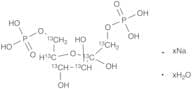
CAS:D-fructose-1,6-diphosphate (D-fructose-1,6-diphosphate), also known as Fosfructose, is a cytoprotective natural sugar phosphate.Fórmula:C6H14O12P2Pureza:99.84%Cor e Forma:SolidPeso molecular:340.12D-Fructose-13C6 1,6-Bisphosphate Sodium Salt Hydrate
CAS:Produto ControladoApplications Isotope labelled Fructose1,6-bisphosphate is an intermediate that lies within the glycolysis metabolic pathway and is also an allosteric activator of pyruvate kinase.
References Hinder, L.M., et al.: J. Endocriol., 216, 1 (2013); Takubo, K., et al.: Cell. Stem. Cell., 12, 49 (2013); Kalam, Y., et al.: Clin. Toxciol., 50, 546 (2012);Fórmula:C6H14O12P2•xH2O•xNaCor e Forma:NeatPeso molecular:346.06D-Fructose-1,6-diphosphate
CAS:D-Fructose-1,6-diphosphate is a chemical that is found in the cytosol of cells. It is an intermediate in the metabolism of fructose and also has an important role in the synthesis of fatty acids and phospholipids. D-Fructose-1,6-diphosphate is an effective inhibitor of sodium succinate dehydrogenase, which converts succinate to fumarate. D-Fructose-1,6-diphosphate has a neutral pH profile and is not affected by changes in pH levels. The optimum pH for this compound is between 6.5 and 7.5. D-Fructose-1,6-diphosphate binds to proteins with unsaturated alkyl chains such as creatine kinase and glutamate dehydrogenase. It has been shown to have hemolytic effects on erythrocytes (red blood cells) at high concentrations, which may be due to its ability to bindFórmula:C6H14O12P2Pureza:(¹H-Nmr) Min. 95 Area-%Cor e Forma:White PowderPeso molecular:340.12 g/molD-FRUCTOFURANOSE 1,6-BISPHOSPHATE
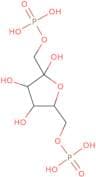
CAS:Fórmula:C6H14O12P2Pureza:≥98.0%Cor e Forma:Liquid, No data available.Peso molecular:339.996D-Fructose-2-13C2 1,6-Bisphosphate Tetrasodium Salt Hydrate
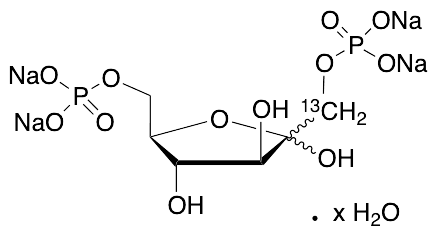
CAS:Produto ControladoApplications Isotope labelled Fructose1,6-bisphosphate is an intermediate that lies within the glycolysis metabolic pathway and is also an allosteric activator of pyruvate kinase.
References Hinder, L.M., et al.: J. Endocriol., 216, 1 (2013); Takubo, K., et al.: Cell. Stem. Cell., 12, 49 (2013); Kalam, Y., et al.: Clin. Toxciol., 50, 546 (2012);Fórmula:C513CH10Na4O12P2•xH2OCor e Forma:NeatPeso molecular:429.03D-Fructose-13C6-1,6-diphosphate sodium salt
CAS:D-Fructose-13C6-1,6-diphosphate sodium salt is a reactive compound used as a model in studies of metabolic disorders. It has been shown to have an inhibitory effect on the enzymes that catalyze the conversion of D-fructose 1,6 diphosphate to D-fructose 6 phosphate in the cytosol. The compound is also useful for determining the binding of calcium ions to proteins and for measuring the activity of carbon source enzymes.Fórmula:C6H10Na4O12P2·xH2OPureza:Min. 95%Cor e Forma:PowderPeso molecular:434 g/mol
![{[(3S,4S,5R)-2,3,4-trihydroxy-5-[(phosphonooxy)methyl]oxolan-2-yl]methoxy}phosphonic acid](/_next/image/?url=https%3A%2Fstatic.cymitquimica.com%2Fproducts%2FIN%2Fthumb%2FDA00393R.jpg&w=3840&q=75)