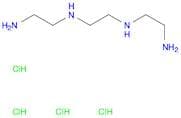
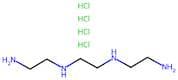
CAS 4961-40-4
:1,2-Etanodiamina, N1,N2-bis(2-aminoetil)-, cloridrato (1:4)
Descrição:
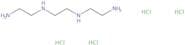
1,2-Etanodiamina, N1,N2-bis(2-aminoetil)-, cloridrato (1:4), comumente referido como um derivado da etilenodiamina, é um composto orgânico caracterizado por seus grupos funcionais de amina. Apresenta dois grupos de amina primária e é tipicamente encontrado como um sal de hidrocloreto, o que melhora sua solubilidade em água. Este composto é frequentemente utilizado em várias aplicações, incluindo como agente quelante, em produtos farmacêuticos e na síntese de outros compostos orgânicos. Sua estrutura permite múltiplas interações de ligação de hidrogênio, contribuindo para sua reatividade e potencial atividade biológica. A presença de múltiplos grupos amino torna-o um bloco de construção versátil na síntese orgânica e um candidato para várias reações químicas, incluindo acilação e alquilação. Além disso, devido à sua natureza básica, pode interagir com ácidos para formar sais estáveis, que muitas vezes são mais gerenciáveis em ambientes de laboratório. Considerações de segurança devem ser levadas em conta, uma vez que as aminas podem ser irritantes e podem representar riscos à saúde quando expostas.
Fórmula:C6H18N4·4ClH
InChI:InChI=1S/C6H18N4.4ClH/c7-1-3-9-5-6-10-4-2-8;;;;/h9-10H,1-8H2;4*1H
Chave InChI:InChIKey=OKHMDSCYUWAQPT-UHFFFAOYSA-N
SMILES:C(CNCCN)NCCN.Cl
Sinónimos:- Cuprior
- Triethylenetetramine, tetrahydrochloride
- Trientine tetrahydrochloride
- 1,2-Ethanediamine, N,N′-bis(2-aminoethyl)-, tetrahydrochloride
- 1,2-Ethanediamine, N1,N2-bis(2-aminoethyl)-, hydrochloride (1:4)
Ordenar por
Pureza (%)
0
100
|
0
|
50
|
90
|
95
|
100
9 produtos.
Triethylenetetramine Tetrahydrochloride
CAS:Fórmula:C6H18N4·4HClPureza:>60.0%(GC)Cor e Forma:White to Light yellow powder to crystalPeso molecular:292.07Triethylenetetramine tetrahydrochloride
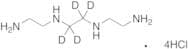
CAS:Fórmula:C6H22Cl4N4Pureza:97%Cor e Forma:SolidPeso molecular:292.0777Trientine-d4 TetraHCl (Triethylenetetramine-d4 TetraHCl)
CAS:Fórmula:C6H14D4N4·4HClCor e Forma:White To Off-White SolidPeso molecular:150.26 4*36.46Trientine TetraHCl (Triethylenetetramine TetraHCl)
CAS:Fórmula:C6H18N4·4HClPeso molecular:146.24 4*36.46N1,N1-(Ethane-1,2-Diyl)Bis(Ethane-1,2-Diamine) Tetrahydrochloride
CAS:N1,N1-(Ethane-1,2-Diyl)Bis(Ethane-1,2-Diamine) TetrahydrochloridePureza:≥97%Peso molecular:292.08g/molTRIETHYLENETETRAMINE TETRAHCL
CAS:Fórmula:C6H22Cl4N4Pureza:60.0%Cor e Forma:SolidPeso molecular:292.07Triethylenetetramine-d4 Tetrahydrochoride
CAS:Produto ControladoStability Hygroscopic
Applications Labelled analogue of Triethylenetetramine, a crosslinking agent.It is the labeled form of Triethylenetetramine Tetrahydrochoride (CAS#: 4961-40-4) used in preparation of Motuporamine derivatives, Cyclopentadecyl Polyamines and Cholic Acid derivatives as membrane-active antibiotic enhancers active against Gram-neg. multidrug-resistant species.
References Phanstiel, O., et al.: U.S. Pat. Appl. Publ., (2017);Fórmula:C6H14D4N4•4(HCl)Cor e Forma:NeatPeso molecular:150.2643646Triethylenetetramine Tetrahydrochloride
CAS:Triethylenetetramine tetrahydrochloride (TETA) is a drug that has been shown to have the ability to enhance the immune system. It was first synthesized in 1894 by German chemist Emil Fischer, and has been used as an immunomodulator in the treatment of autoimmune diseases. TETA enhances the immune system by inhibiting an enzyme that is responsible for destroying lymphocytes, which are a type of white blood cell. The drug inhibits hydrochloric acid production in the stomach, which can be beneficial for people with cancer or ulcers. TETA binds to human serum proteins and inhibits uv absorption, binding constants, and human serum protein-dependent enzymes. This drug also inhibits hepatic function and pancreatic function due to its effects on liver cells and pancreatic cells respectively. TETA is classified as a non-competitive inhibitor because it does not compete with other substrates for access to an enzyme’s active site but rather binds at some distanceFórmula:C6H18N4·4HClPureza:Min. 95%Peso molecular:292.07 g/mol