CAS 49678-02-6
:p-Clorocinamaldeído
Descrição:
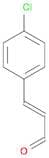
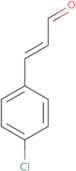
p-Clorocinamaldeído, com o número CAS 49678-02-6, é um composto orgânico caracterizado por sua estrutura aromática e grupos funcionais. Apresenta um grupo fenil clorado ligado a uma cadeia de trans-alqueno, culminando em um grupo funcional aldeído. Este composto geralmente aparece como um líquido amarelado a marrom com um odor distinto, reminiscentemente de canela. É conhecido por seu papel na síntese orgânica e como um potencial agente aromatizante devido às suas propriedades aromáticas. p-Clorocinamaldeído exibe solubilidade moderada em solventes orgânicos, enquanto sua solubilidade em água é limitada. O composto também é reconhecido por sua atividade biológica, incluindo propriedades antimicrobianas e antifúngicas, tornando-o de interesse em aplicações farmacêuticas e agrícolas. Além disso, pode sofrer várias reações químicas, como oxidação e redução, que são importantes para sua utilidade na química orgânica sintética. Precauções de segurança devem ser observadas ao manusear este composto, pois pode causar irritação na pele e nos olhos.
Fórmula:C9H7ClO
InChI:InChI=1/C9H7ClO/c10-9-5-3-8(4-6-9)2-1-7-11/h1-7H/b2-1+
Sinónimos:- (2E)-3-(4-Chlorophenyl)acrylaldehyde
- (2E)-3-(4-Chlorophenyl)prop-2-enal
- (2E)-3-(4-Chlorphenyl)prop-2-enal
- 2-propenal, 3-(4-chlorophenyl)-, (2E)-
- 4-Chlorocinnamaldehyde
- (E)-3-(4-Chlorophenyl)-2-propenal
Ordenar por
Pureza (%)
0
100
|
0
|
50
|
90
|
95
|
100
5 produtos.
(E)-3-(4-Chlorophenyl)acrylaldehyde
CAS:Fórmula:C9H7ClOPureza:95%Cor e Forma:SolidPeso molecular:166.6043(E)-3-(4-Chlorophenyl)acrylaldehyde
CAS:Fórmula:C9H7ClOPureza:95.0%Cor e Forma:Solid, Crystalline Powder or PowderPeso molecular:166.64-Chlorocinnamaldehyde
CAS:4-ChlorocinnamaldehydeFórmula:C9H7ClOPureza:96%Cor e Forma: white to off-white crystalline needlesPeso molecular:166.60g/mol4-Chlorocinnamaldehyde
CAS:4-Chlorocinnamaldehyde is a chemical that has been found to inhibit the growth of bacteria. It has been shown to have an inhibitory effect on biochemical reactions and is chemically stable at room temperature. 4-Chlorocinnamaldehyde inhibits bacterial tyrosinase activity by reacting with the active site cysteine residue, which also leads to cross-resistance. The compound's inhibitory effect on tyrosinase is reversible, making it an ideal candidate for use as a topical treatment for acne. It has also been found that 4-chlorocinnamaldehyde can induce apoptosis in rat cardiomyocytes, suggesting that it may be useful in treating heart disease. This chemical reacts with thiosemicarbazide to produce two products: 4-chlorothiophenol and 4-chlorophenylhydrazone. The reaction products are then hydrolyzed into chloride ions and phenol.Fórmula:C9H7ClOPureza:Min. 90%Peso molecular:166.6 g/mol(E)-3-(4-Chlorophenyl)acrylaldehyde
CAS:(E)-3-(4-Chlorophenyl)acrylaldehyde is a useful organic compound for research related to life sciences. The catalog number is T67458 and the CAS number is 49678-02-6.Fórmula:C9H7ClOCor e Forma:SolidPeso molecular:166.6