CAS 499-83-2
:Ácido 2,6-piridinedicarboxílico
Descrição:
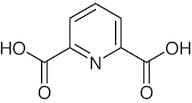
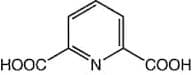
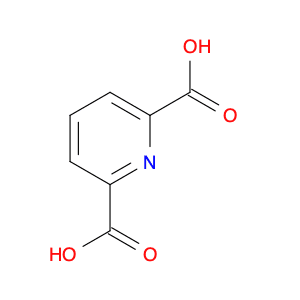
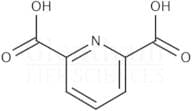
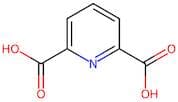
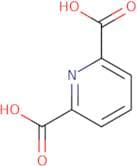
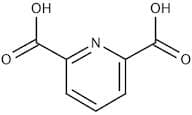
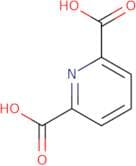
Ácido 2,6-piridinedicarboxílico, também conhecido como ácido dipicolínico, é um composto orgânico com a fórmula molecular C₆H₆N₂O₄. Apresenta um anel de piridina substituído por dois grupos ácidos carboxílicos nas posições 2 e 6. Este composto é um sólido cristalino branco que é solúvel em água e em solventes orgânicos polares. Exibe propriedades ácidas devido à presença dos grupos ácidos carboxílicos, que podem doar prótons em solução. O ácido dipicolínico é conhecido por seu papel em sistemas biológicos, particularmente na formação de esporas bacterianas, onde contribui para a resistência ao calor e à estabilidade. Além disso, pode formar quelatos com íons metálicos, tornando-o útil em várias aplicações analíticas e industriais. O composto também é estudado por seu potencial em química de coordenação e como um ligante em complexos metálicos. No geral, Ácido 2,6-piridinedicarboxílico é um composto versátil com relevância significativa em contextos biológicos e químicos.
Fórmula:C7H5NO4
InChI:InChI=1S/C7H5NO4/c9-6(10)4-2-1-3-5(8-4)7(11)12/h1-3H,(H,9,10)(H,11,12)
Chave InChI:InChIKey=WJJMNDUMQPNECX-UHFFFAOYSA-N
SMILES:C(O)(=O)C=1N=C(C(O)=O)C=CC1
Sinónimos:- 2,6-Dicarboxypyridine
- 2,6-Dipicolinic acid
- 2,6-Pyridine Dicarboxylic Acid
- 2.6-Pyridine Carboxylic Acid
- 6-Carboxypicolinic acid
- Acide pyridine-2,6-dicarboxylique
- Acido Piridina-2,6-Dicarboxilico
- DPA
- DPAc
- Dipicoline acid
- Dipicolinic acid
- Nsc 176
- Pyridin-2,6-dicarbonsaure
- Pyridine-2,6-Dicarboxylate
- Pyridine-2,6-Dicarboxylic Acid
- Pyridine-2,6-diformic acid
- Ver mais sinónimos
Ordenar por
Pureza (%)
0
100
|
0
|
50
|
90
|
95
|
100
9 produtos.
2,6-Pyridinedicarboxylic Acid
CAS:Fórmula:C7H5NO4Pureza:>98.0%(GC)(T)Cor e Forma:White to Almost white powder to crystalinePeso molecular:167.12Pyridine-2,6-dicarboxylic acid, 98%
CAS:Pyridine-2,6-dicarboxylic acid is used in the preparation of dipicolinato ligated lanthanide and transition metal complexes. It acts as a chelating agent for chromium, zinc, manganese, copper, iron and molybdenum. Its calcium-dipcolinic acid complex is used to protect deoxyribonucleic acid (DNA) frFórmula:C7H5NO4Pureza:98%Cor e Forma:White to pale cream, Crystals or powder or crystalline powderPeso molecular:167.12Ref: IN-DA0035JT
25kgA consultar50kgA consultar10g20,00€25g29,00€50g31,00€100g42,00€250g64,00€500g124,00€1kg181,00€2,6-Pyridinedicarboxylic acid
CAS:Fórmula:C7H5NO4Pureza:≥ 98.0%Cor e Forma:White powderPeso molecular:167.12Pyridine-2,6-dicarboxylic acid
CAS:Pyridine-2,6-dicarboxylic acidFórmula:C7H5NO4Pureza:98%Cor e Forma: white crystalline powderPeso molecular:167.12g/mol2,6-Dipicolinic Acid
CAS:Fórmula:C7H5NO4Pureza:95%Cor e Forma:Solid, Crystalline Powder or PowderPeso molecular:167.122,6-Pyridinedicarboxylic acid
CAS:2,6-Pyridinedicarboxylic acid is a chemical compound that is mainly used as an antimicrobial agent. It binds to DNA by hydrogen bonding interactions and alters the polymerase chain reaction (PCR) process. This leads to inhibition of DNA synthesis and cell death. 2,6-Pyridinedicarboxylic acid has been shown to have synergistic effects when combined with sodium salts. It also inhibits transfer reactions in bacteria, which may be due to its ability to bind to picolinic acid. The structural analysis of 2,6-pyridinedicarboxylic acid showed that it contains a pyridine ring fused with two carboxyl groups. 2,6-Pyridinedicarboxylic acid reacts with picolinic acid in the presence of sodium salts and undergoes a series of reactions leading to the formation of picolinamide, which may explain its inhibitory properties.Fórmula:C7H5NO4Pureza:Min. 95%Cor e Forma:PowderPeso molecular:167.12 g/molPyridine-2,6-Dicarboxylic Acid extrapure, 99%
CAS:Fórmula:C7H5NO4Pureza:min. 99%Cor e Forma:White to pale pink, Powder, Clear, Colourless to pale pinkPeso molecular:167.122,6-Pyridinedicarboxylic acid
CAS:2,6-Pyridinedicarboxylic acid is a synthetic building block that can be used in the synthesis of many organic compounds. It has been shown to be a useful intermediate in the synthesis of complex compounds and is also a versatile building block for the synthesis of speciality chemicals. This chemical has been shown to have a high quality and is also a reagent or research chemical. 2,6-Pyridinedicarboxylic acid can be used as an intermediate for the production of other chemicals, such as pharmaceuticals, food additives, and dyes.This compound belongs to CAS No. 499-83-2.
Fórmula:C7H5NO4Peso molecular:167.12 g/mol