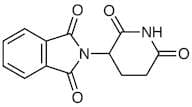
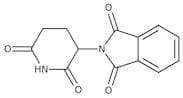
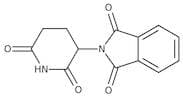
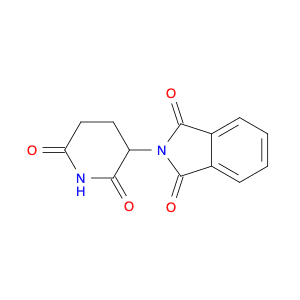
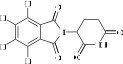
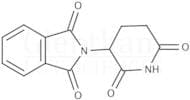
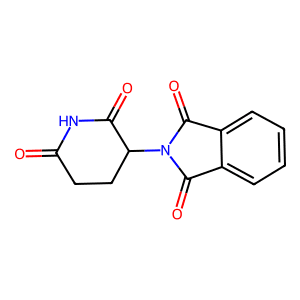
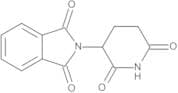
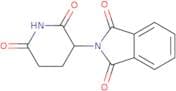
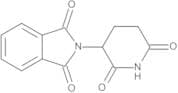
CAS 50-35-1
:Talidomida
- 1,3-Dioxo-2-(2,6-dioxopiperidin-3-yl)isoindoline
- 1H-Isoindole-1,3(2H)-dione, 2-(2,6-dioxo-3-piperidinyl)-
- 2-(2,6-Dioxo-3-Piperidinyl)-1H-Isoindole-1,3(2H)-Dione
- 2-(2,6-Dioxo-piperidin-3-yl)-isoindole-1,3-dione
- 2-(2,6-Dioxopiperidin-3-yl)-2,3-dihydro-1H-isoindole-1,3-dione
- 2-(2,6-Dioxopiperidin-3-yl)isoindole-1,3-dione
- 2-(2,6-Dioxopiperidin-3-yl)isoindoline-1,3-dione
- 2-(2,6-dioxopiperidin-3-yl)-1H-isoindole-1,3(2H)-dione
- 2-Phthalimidoglutarimide
- 3-Phthalimidoglutarimide
- Celgene
- Contergan
- Distaval
- Immunoprin
- K 17
- Kevadon
- Myrin
- N-(2,6-Dioxo-3-piperidinyl)phthalimide
- N-(2,6-Dioxo-3-piperidyl)phthalimide
- N-Phthaloylglutamimide
- Neurosedyn
- Nsc 527179
- Nsc 66847
- Pantosediv
- Pharmion
- Phthalimide, N-(2,6-dioxo-3-piperidyl)-
- Quetimid
- Sauramide
- Sedalis
- Sedoval
- Softenil
- Softenon
- Suaramide
- Synovir
- Talidomida
- Talimol
- Talinol
- Thaled
- Thalidomid
- Thalomid
- α-(N-Phthalimido)glutarimide
- α-N-Phthalylglutaramide
- Ver mais sinónimos
(±)-Thalidomide
CAS:Fórmula:C13H10N2O4Pureza:>98.0%(HPLC)(N)Cor e Forma:White to Almost white powder to crystalPeso molecular:258.23(+/-)-Thalidomide, 99+%
CAS:Teratogenic compound found to inhibit HIV-1 replication and FGF-induced angiogenesisFórmula:C13H10N2O4Pureza:99+%Cor e Forma:White to cream, PowderPeso molecular:258.23Thalidomide
CAS:Teratogenic compound found to inhibit HIV-1 replication and FGF-induced angiogenesisFórmula:C13H10N2O4Peso molecular:258.23Thalidomide
CAS:Imides and their derivatives (excluding sacharin), and salts thereofFórmula:C13H10N2O4Cor e Forma:White Off-White PowderPeso molecular:258.06406Thalidomide
CAS:Thalidomide, a glutamic acid derivative, has teratogenic and immunomodulatory effects.Fórmula:C13H10N2O4Pureza:98.88% - 99.88%Cor e Forma:White SolidPeso molecular:258.23Thalidomide
CAS:Fórmula:C13H10N2O4Pureza:≤ 0.1%Cor e Forma:White to off-white powderPeso molecular:258.23(+/-)-Thalidomide - Bio-X ™
CAS:Produto ControladoThalidomide is a piperidinyl isoindole drug that is used to treat various cancers such as myeloma and erythema nodosum leprosum. This drug is immunosuppressive and has anti-angiogenic activity. Thalidomide’s mechanism of action is not fully understood however it is thought to block the activity of tumor necrosis factor-alpha (TNF-α).Fórmula:C13H10N2O4Pureza:Min. 95%Cor e Forma:PowderPeso molecular:258.23 g/mol(+/-)-Thalidomide
CAS:Produto ControladoClassified as immunomodulatory drug, thalidomide suppresses the expression of tumor necrosis factor-alpha (TNF-α), interferes with a cascade of pro-inflammatory cytokines, and interferes with the secretion of vascular endothelial growth factor (VEGF) and beta fibroblast growth factor (bFGF). Similarly to apremilast, thalidomide carries a phthalimide ring, together with a glutarimide ring that is specifically recognized by the target molecule cereblon. Thanks to its ability to contrast neoangiogenesis and the modifications of the bone marrow stromal microenvironment, thalidomide is a powerful tool to fight hematologic cancers. In the treatment of SARS-CoV-2, the immunomodulatory and anti-inflammatory action of thalidomide has and has proved beneficial when combined with a low-dose glucocorticoid.
Fórmula:C13H10N2O4Pureza:Min. 95%Cor e Forma:White PowderPeso molecular:258.23 g/mol(+/-)-Thalidomide
CAS:M02554 - (+/-)-Thalidomide
Fórmula:C13H10N2O4Pureza:98%Cor e Forma:SolidPeso molecular:258.233Thalidomide
CAS:Produto ControladoApplications Inhibits FGF-induced angiogenesis. Inhibits replication of human immunodeficiency virus type 1. Teratogenic sedative. There is now a growing clinical interest in Thalidomide, and it is introduced as an immunomodulatory agent used primarily in combination with dexamethasone to treat multiple myeloma.
Not a dangerous good if item is equal to or less than 1g/ml and there is less than 100g/ml in the package
References D’Amato, r.J., et al.: Proc. Natl. Acad. Sci. USA, 91, 4082 (1994), Makonkawkeyoon, S., et al.: Proc. Natl. Acad. Sci. USA, 90, 5974 (1993), Schumacher, H., et al.: J. Pharmacol. Exp. Therap., 160, 189 (1968)Fórmula:C13H10N2O4Cor e Forma:NeatPeso molecular:258.23