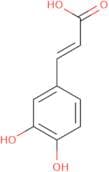
CAS 501-16-6
:Ácido cafeico
Descrição:
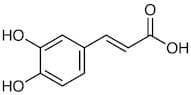
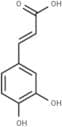
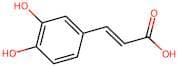
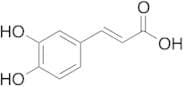
Ácido cafeico, com o número CAS 501-16-6, é um composto fenólico que ocorre naturalmente e pertence à classe dos ácidos hidroxicinâmicos. É caracterizado por sua configuração trans, que se refere à disposição de sua dupla ligação entre os átomos de carbono na cadeia lateral. Este composto é comumente encontrado em várias plantas, particularmente em café, frutas e vegetais, e é conhecido por suas propriedades antioxidantes. Ácido cafeico exibe uma cor marrom-amarelada e é solúvel em água e em solventes orgânicos como etanol e metanol. Sua fórmula molecular é C9H8O4, e tem um peso molecular de aproximadamente 180,17 g/mol. O composto desempenha um papel significativo no metabolismo das plantas e tem sido estudado por seus potenciais benefícios à saúde, incluindo efeitos anti-inflamatórios e antimicrobianos. Além disso, Ácido cafeico é frequentemente utilizado nas indústrias alimentícia e cosmética devido às suas qualidades conservantes e à sua capacidade de melhorar a estabilidade dos produtos.
Fórmula:C9H8O4
InChI:InChI=1S/C9H8O4/c10-7-3-1-6(5-8(7)11)2-4-9(12)13/h1-5,10-11H,(H,12,13)/b4-2+
Chave InChI:InChIKey=QAIPRVGONGVQAS-DUXPYHPUSA-N
SMILES:C(=C/C(O)=O)\C1=CC(O)=C(O)C=C1
Sinónimos:- (2E)-(3,4-Dihydroxyphenyl)-2-propenoic acid
- (2E)-3-(3,4-Dihydroxyphenyl)-2-propenoic acid
- (E)-3,4-Dihydroxycinnamic acid
- (E)-3-(3,4-Dihydroxyphenyl)-2-propenoic acid
- (E)-3-(3,4-Dihydroxyphenyl)acrylic acid
- (E)-Caffeic acid
- 2-Propenoic acid, 3-(3,4-dihydroxyphenyl)-, (E)-
- 2-Propenoicacid, 3-(3,4-dihydroxyphenyl)-, (E)-
- 3,4-Dihydroxy-trans-cinnamic acid
- Cinnamic acid, 3,4-dihydroxy-, (E)-
- Cinnamic acid, 3,4-dihydroxy-, (E)-(8CI)
- Cinnamic acid, 3,4-dihydroxy-, trans-
- Cinnamic acid, 3,4-dihydroxy-, trans- (7CI)
- Zinc 00058172
- trans-3,4-Dihydroxycinnamic acid
- trans-Caffeic acid
- 2-Propenoic acid, 3-(3,4-dihydroxyphenyl)-, (2E)-
- AKOS B004050
- 3,4-Dihydroxy-trans-cinnamate
- 3-(3,4-DIHYDROXYPHENYL)ACRYLIC ACID
- 3-(3,4-DIHYDROXYPHENYL)-2-PROPENOIC ACID
- TIMTEC-BB SBB006475
- CAFFEIC ACID
- LABOTEST-BB LT00233168
- 3,4-DIHYDROXYCINNAMIC ACID
- RARECHEM BK HC T335
- Ver mais sinónimos
Ordenar por
Pureza (%)
0
100
|
0
|
50
|
90
|
95
|
100
8 produtos.
Caffeic Acid
CAS:Fórmula:C9H8O4Pureza:>98.0%(T)(HPLC)Cor e Forma:White to Orange to Green powder to crystalPeso molecular:180.16Trans-caffeic acid
CAS:Trans-caffeic acid can be used as a highly sensitive fluorescent probe for the detection of laccase in food and can also stimulate the growth of germ tissue.Fórmula:C9H8O4Pureza:98.37%Cor e Forma:SolidPeso molecular:180.16(E)-3-(3,4-Dihydroxyphenyl)Acrylic Acid
CAS:(E)-3-(3,4-Dihydroxyphenyl)Acrylic AcidPureza:95%Peso molecular:180.16g/molTrans-caffeic acid
CAS:Carboxylic acid with phenol functionFórmula:C9H8O4Pureza:≥ 98.0 % (HPLC)Cor e Forma:PowderPeso molecular:180.16trans-Caffeic Acid
CAS:Applications trans-Caffeic Acid is a useful synthetic intermediate. It was used as a reactant to synthesize N-caffeoylphenalkylamide derivatives as bacterial efflux pump inhibitors. It is also used to prepare caffeic acid phenethyl ester analogs with antitumor structures.
References Michalet, S., et al.: Bioorg. Med. Chem. Lett., 17, 1755 (2007); Nagaoka, T., et al.: Bioorg. Med. Chem., 10, 3351 (2002)Fórmula:C9H8O4Cor e Forma:NeatPeso molecular:180.16trans-Caffeic acid
CAS:Caffeic acid is a phenolic compound that belongs to the hydroxybenzoic acid family. It is found in many plants, including coffee beans, green tea leaves, and white tea. Caffeic acid is an intermediate in the synthesis of other phenolic compounds such as p-coumaric acid, ferulic acid, 3-o-caffeoylquinic acid, and 4-o-caffeoylquinic acid. Caffeic acid has been shown to have biological properties that are related to melanogenesis, acetate extract sesquiterpene lactones (taraxasterol acetate), camp levels (protocatechuic acid), and phenolic acids (chromatographic).Fórmula:C9H8O4Pureza:Min. 95%Peso molecular:180.16 g/mol