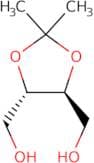
CAS 50622-09-8
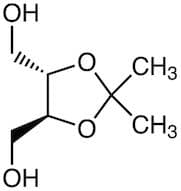
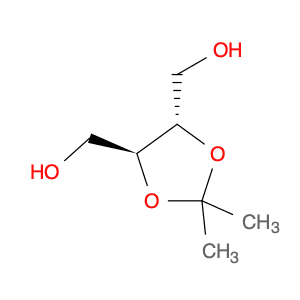
:(4S,5S)-2,2-Dimetil-1,3-dioxolano-4,5-dimetanol
Descrição:
(4S,5S)-2,2-Dimetil-1,3-dioxolano-4,5-dimetanol é um composto químico caracterizado por sua estrutura única de anel de dioxolano, que apresenta dois grupos hidroximetila nas posições 4 e 5 e dois grupos metila na posição 2. Este composto é uma molécula quiral, com uma estereoquímica específica denotada pela configuração (4S,5S), indicando a disposição espacial de seus átomos. A presença do anel de dioxolano contribui para sua estabilidade e reatividade, tornando-o um candidato potencial para várias reações químicas, incluindo aquelas em síntese orgânica. Os grupos hidroximetila aumentam sua solubilidade em solventes polares e podem participar de ligações de hidrogênio, influenciando suas propriedades físicas, como ponto de ebulição e ponto de fusão. Além disso, a estrutura do composto sugere aplicações potenciais em produtos farmacêuticos ou como intermediários na síntese orgânica devido aos grupos funcionais presentes. No geral, (4S,5S)-2,2-Dimetil-1,3-dioxolano-4,5-dimetanol é notável por sua estereoquímica e versatilidade funcional em reações químicas.
Fórmula:C7H14O4
InChI:InChI=1S/C7H14O4/c1-7(2)10-5(3-8)6(4-9)11-7/h5-6,8-9H,3-4H2,1-2H3/t5-,6-/m0/s1
Chave InChI:InChIKey=INVRLGIKFANLFP-WDSKDSINSA-N
SMILES:C(O)[C@H]1[C@H](CO)OC(C)(C)O1
Sinónimos:- (+)-2,3-O-Isopropylidene-<span class="text-smallcaps">L</span>-threitol
- (+)-2,3-O-Isopropylidene-L-Threitol
- (2,2-Dimethyl-1,3-dioxolane-4,5-diyl)dimethanol
- (4S,5S)-2,2-Dimethyl-1,3-dioxolane-4,5-dimethanol
- (4S,5S)-4,5-Bis(hydroxymethyl)-2,2-dimethyl-1,3-dioxolane
- 1,3-Dioxolane-4,5-Dimethanol, 2,2-Dimethyl-
- 1,3-Dioxolane-4,5-dimethanol, 2,2-dimethyl-, (4S,5S)-
- 1,3-Dioxolane-4,5-dimethanol, 2,2-dimethyl-, (4S-trans)-
- 256-658-6
- [(4S,5S)-2,2-dimethyl-1,3-dioxolane-4,5-diyl]dimethanol
Ordenar por
Pureza (%)
0
100
|
0
|
50
|
90
|
95
|
100
9 produtos.
(+)-2,3-O-Isopropylidene-L-threitol
CAS:Fórmula:C7H14O4Pureza:>97.0%(GC)Cor e Forma:White or Colorless to Light yellow powder to lump to clear liquidPeso molecular:162.191,3-Dioxolane-4,5-dimethanol, 2,2-dimethyl-, (4S,5S)-
CAS:Fórmula:C7H14O4Pureza:98%Cor e Forma:SolidPeso molecular:162.18372,3-O-Isoproylidene-L-threitol
CAS:Fórmula:C7H14O4Pureza:(GC) ≥ 97.0%Cor e Forma:Conflicting attributes definedPeso molecular:162.19(+)-2,3-O-Isopropylidene-L-threitol
CAS:(+)-2,3-O-Isopropylidene-L-threitolPureza:99%Peso molecular:162.18g/mol2,3-O-Isopropylidene-L-threitol
CAS:Produto ControladoApplications 2,3-O-Isopropylidene-L-threitol is an intermediate in the synthesis of versicolactone compounds.
References Wang, L., et al.: Tetrahedron. Lett., 54, 6729 (2013);Fórmula:C7H14O4Cor e Forma:NeatPeso molecular:162.18((4S,5S)-2,2-Dimethyl-1,3-dioxolane-4,5-diyl)dimethanol
CAS:Fórmula:C7H14O4Pureza:99%+(GC-MS);RGCor e Forma:No data available.Peso molecular:162.1852,3-O-Isopropylidene-L-threitol
CAS:2,3-O-Isopropylidene-L-threitol is a chiral sugar alcohol that is a new type of HDAC inhibitor. It has been shown to be an effective inhibitor of histone deacetylase (HDAC) and can be used in the treatment of certain cancers. 2,3-O-Isopropylidene-L-threitol is considered to be enantiomerically pure because it contains only one stereoisomer. It is also synthesized via a dehydrogenative process, which starts with the addition of 2 equivalents of phenol to diphenol followed by the addition of 4 equivalents of biphenyl. This product can also be used to make polycarbonates with functional groups such as epoxy or vinyl groups.Fórmula:C7H14O4Pureza:Min. 95%Cor e Forma:Yellow PowderPeso molecular:162.18 g/mol