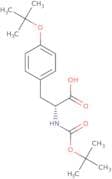
CAS 507276-74-6
:Boc-D-Tyr(tBu)-OH
Descrição:
Boc-D-Tyr(tBu)-OH, também conhecido como Boc-D-Tirosina(t-butil), é uma forma protegida do aminoácido tirosina, que é comumente utilizada na síntese de peptídeos e na química orgânica. O grupo "Boc" (tert-butiloxicarbonila) serve como um grupo protetor para a funcionalidade amino, permitindo reações seletivas sem interferência da amina. O "D" indica que a tirosina está em sua forma enantiomérica D, o que é importante em estudos envolvendo estereoquímica e atividade biológica. O grupo "tBu" (tert-butil) ligado ao hidroxilo fenólico da tirosina aumenta a lipofilicidade e estabilidade do composto, tornando-o útil em várias aplicações sintéticas. Este composto é tipicamente um sólido branco a off-white e é solúvel em solventes orgânicos, como diclorometano e dimetilsulfóxido, mas menos solúvel em água. Suas aplicações se estendem à síntese de peptídeos e outras moléculas bioativas, onde a proteção de grupos funcionais é crucial para alcançar a reatividade e seletividade desejadas em transformações químicas.
Ordenar por
Pureza (%)
0
100
|
0
|
50
|
90
|
95
|
100
4 produtos.
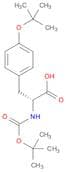
N-[(1,1-Dimethylethoxy)carbonyl]-O-(1,1-dimethylethyl)-D-tyrosine
CAS:N-[(1,1-Dimethylethoxy)carbonyl]-O-(1,1-dimethylethyl)-D-tyrosinePureza:99%Peso molecular:337.41g/molN-[(1,1-Dimethylethoxy)carbonyl]-O-(1,1-dimethylethyl)-D-tyrosine
CAS:Pureza:97%Peso molecular:337.4159851Boc-D-Tyr(tBu)-OH
CAS:Boc-D-Tyr(tBu)-OH is a natural product that is an amphipathic molecule with a cyclic structure. It has been shown to be able to inhibit the growth of bacteria, such as Staphylococcus aureus and Escherichia coli, by acting as an antibiotic. Boc-D-Tyr(tBu)-OH inhibits the synthesis of peptides by binding to the ribosome and blocking peptide elongation. This molecule also inhibits peptide synthesis by interacting with the aminoacyl site on the ribosome and preventing it from binding with amino acids. Boc-D-Tyr(tBu)-OH is synthesized in two stages: solid phase peptide synthesis and nucleophilic activation. The decapeptides are then purified and characterized based on their function.Fórmula:C18H27NO5Pureza:Min. 95%Cor e Forma:PowderPeso molecular:337.41 g/mol

![N-[(1,1-Dimethylethoxy)carbonyl]-O-(1,1-dimethylethyl)-D-tyrosine](/_next/image/?url=https%3A%2Fstatic.cymitquimica.com%2Fproducts%2F54%2Fthumb%2FOR95967.jpg&w=3840&q=75)

![N-[(1,1-Dimethylethoxy)carbonyl]-O-(1,1-dimethylethyl)-D-tyrosine](/_next/image/?url=https%3A%2Fstatic.cymitquimica.com%2Fproducts%2F10%2Fthumb%2FF636873.jpg&w=3840&q=75)