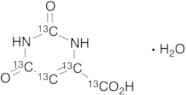
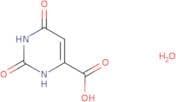
CAS 50887-69-9
:Ácido 4-pirimidinocarboxílico, 1,2,3,6-tetrahidro-2,6-dioxo-, hidrato (1:1)
Descrição:
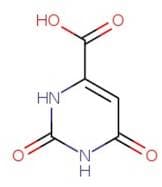
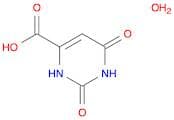
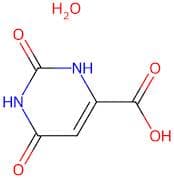
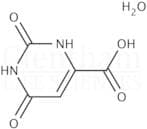
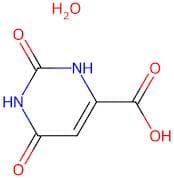
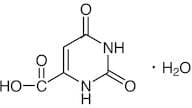
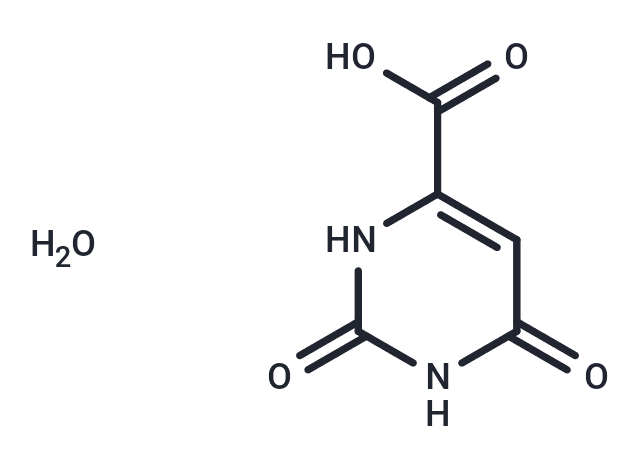
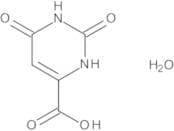
Ácido 4-pirimidinocarboxílico, 1,2,3,6-tetrahidro-2,6-dioxo-, hidrato (1:1), com número CAS 50887-69-9, é um composto orgânico heterocíclico caracterizado por sua estrutura de anel de pirimidina, que é um anel aromático de seis membros contendo dois átomos de nitrogênio nas posições 1 e 3. Este composto apresenta um grupo funcional ácido carboxílico, contribuindo para suas propriedades ácidas. A presença da estrutura de tetrahidro indica que passou por uma saturação parcial, o que pode influenciar sua reatividade e estabilidade. Os grupos dioxo sugerem a presença de duas funcionalidades carbonila, aumentando seu potencial para várias reações químicas, como ataques nucleofílicos. Como um hidrato, contém moléculas de água em sua forma cristalina, o que pode afetar sua solubilidade e propriedades físicas. Este composto pode ser de interesse na química farmacêutica e agrícola devido à sua potencial atividade biológica e aplicações em síntese. Suas características específicas, como ponto de fusão, solubilidade e reatividade, dependeriam das condições sob as quais é estudado.
Fórmula:C5H4N2O4·H2O
InChI:InChI=1S/C5H4N2O4.H2O/c8-3-1-2(4(9)10)6-5(11)7-3;/h1H,(H,9,10)(H2,6,7,8,11);1H2
Chave InChI:InChIKey=YXUZGLGRBBHYFZ-UHFFFAOYSA-N
SMILES:C(O)(=O)C1=CC(=O)NC(=O)N1.O
Sinónimos:- 2,6-Dioxo-1,2,3,6-Tetrahydropyrimidine-4-Carboxylate
- 2,6-Dioxo-1,2,3,6-Tetrahydropyrimidine-4-Carboxylic Acid Hydrate
- 2,6-Dioxo-1,2,3,6-tetrahydro-4-pyrimidinecarboxylic acid
- 2,6-Dioxo-1,2,3,6-tetrahydro-4-pyrimidinecarboxylic acid hydrate
- 2.4-Dihydroxypyrimidine-6-carboxylic acid hydrate
- 4-Pyrimidinecarboxylic acid, 1,2,3,6-tetrahydro-2,6-dioxo-, hydrate (1:1)
- 4-Pyrimidinecarboxylic acid, 1,2,3,6-tetrahydro-2,6-dioxo-, monohydrate
- Orotic Acid Monohydrate
Ordenar por
Pureza (%)
0
100
|
0
|
50
|
90
|
95
|
100
11 produtos.
Orotic acid monohydrate
CAS:Fórmula:C5H6N2O5Pureza:95%Cor e Forma:Solid, White powderPeso molecular:174.112Orotic acid hydrate, 98%
CAS:Orotic acid hydrate is used in cosmetic and food industry. It is also used as a pharmaceutical intermediate. This Thermo Scientific Chemicals brand product was originally part of the Alfa Aesar product portfolio. Some documentation and label information may refer to the legacy brand. The original Al
Fórmula:C5H4N2O4Pureza:98%Cor e Forma:White to pale cream, Crystals or powder or crystalline powderPeso molecular:156.102,6-Dioxo-1,2,3,6-tetrahydropyrimidine-4-carboxylic acid monohydrate
CAS:2,6-Dioxo-1,2,3,6-tetrahydropyrimidine-4-carboxylic acid monohydrateFórmula:C5H4N2O4·H2OPureza:98%Cor e Forma: white to off-white powderPeso molecular:174.11154g/molOrotic acid monohydrate
CAS:Fórmula:C5H4N2O4xH2OCor e Forma:White powder to crystalsPeso molecular:156.10Orotic Acid Monohydrate
CAS:Fórmula:C5H4N2O4·H2OPureza:>98.0%(T)(HPLC)Cor e Forma:White powder to crystalPeso molecular:174.12Orotic acid monohydrate
CAS:Orotic acid monohydrate is an intermediate product in pyrimidine metabolism.Fórmula:C5H6N2O5Pureza:99.30%Cor e Forma:White Crystalline PowderPeso molecular:174.11Orotic Acid Monohydrate
CAS:Produto ControladoApplications Orotic Acid is used in the preparation of therapeutic agents for chronic obstructive pulmonary disease (COPD) treatment.
Fórmula:C5H4N2O4·H2OCor e Forma:NeatPeso molecular:174.11Orotic Acid-13C5 Monohydrate
CAS:Produto ControladoApplications Orotic acid-13C5 monohydrate is a labelled analogue of Orotic acid monohydrate (O691500).
Fórmula:C5H3N2O4·H2OCor e Forma:NeatPeso molecular:178.067Orotic acid hydrate
CAS:Orotic acid hydrate is a synthetic compound that is designed to be a growth regulator. Orotic acid hydrate is synthesized by reacting the orotate with pyridoxine hydrochloride, followed by crystallizing the product. Hydrogen bonds form between the water molecules and fatty acids in the crystals of OA hydrate. These hydrogen bonds stabilize the crystal structure and allow for its use as a growth regulator. The stability of this molecule can also be attributed to its ability to form hydrogen bonds with other molecules such as α-tocopherol, calcium carbonate, and synthetic cannabinoids. Orotic acid hydrate has been shown to have an effect on cancer cells because it reacts with daunorubicin in solution and inhibits DNA synthesis, inhibiting cell growth.Fórmula:C5H4N2O4·H2OPureza:Min. 95 Area-%Cor e Forma:PowderPeso molecular:174.11 g/mol