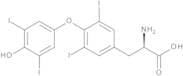
CAS 51-49-0
:D-Tiroxina
Descrição:
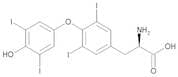
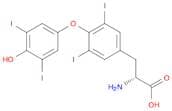
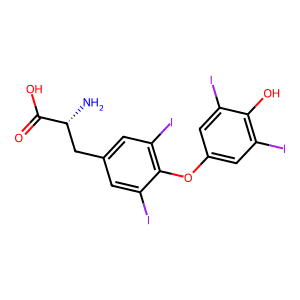
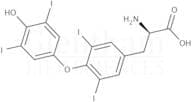
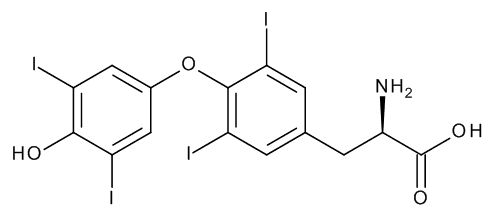
D-Tiroxina, também conhecido como L-tiroxina ou T4, é um hormônio produzido pela glândula tireoide que desempenha um papel crucial na regulação do metabolismo, crescimento e desenvolvimento no corpo. É uma forma sintética do hormônio que ocorre naturalmente e é comumente usada no tratamento do hipotireoidismo. A fórmula química de D-Tiroxina é C15H11I4N0, e tem um peso molecular de aproximadamente 776,87 g/mol. D-Tiroxina é caracterizado por sua estrutura cristalina, que é tipicamente branca a off-white em aparência. É solúvel em água e álcool, mas tem solubilidade limitada em solventes orgânicos. A substância é estável em condições normais, mas pode se degradar quando exposta à luz, calor ou umidade. Seu mecanismo de ação envolve a ligação aos receptores de hormônios tireoidianos, influenciando a expressão gênica e os processos metabólicos. Devido aos seus efeitos fisiológicos significativos, D-Tiroxina deve ser administrado com cautela, e sua dosagem é cuidadosamente monitorada em ambientes clínicos para evitar possíveis efeitos colaterais associados ao desequilíbrio hormonal da tireoide.
Fórmula:C15H11I4NO4
InChI:InChI=1S/C15H11I4NO4/c16-8-4-7(5-9(17)13(8)21)24-14-10(18)1-6(2-11(14)19)3-12(20)15(22)23/h1-2,4-5,12,21H,3,20H2,(H,22,23)/t12-/m1/s1
Chave InChI:InChIKey=XUIIKFGFIJCVMT-GFCCVEGCSA-N
SMILES:O(C1=CC(I)=C(O)C(I)=C1)C2=C(I)C=C(C[C@H](C(O)=O)N)C=C2I
Sinónimos:- (R)-2-Amino-3-(4-(4-hydroxy-3,5-diiodophenoxy)-3,5-diiodophenyl)propanoicacid
- 3,3',5,5'-Tetraiodo-D-thyronine
- 3,3′,5,5′-Tetraiodo-<span class="text-smallcaps">D</span>-thyronine
- <span class="text-smallcaps">D</span>-T<sub>4</sub>
- <span class="text-smallcaps">D</span>-Thyroxine
- <span class="text-smallcaps">D</span>-Tyrosine, O-(4-hydroxy-3,5-diiodophenyl)-3,5-diiodo-
- D-4-(4-Hydroxy-3,5-diiodphenoxy)-3,5-diiodbenzylalanin
- D-4-(4-hidroxi-3,5-diiodofenoxi)-3,5-diiodobencilalanina
- D-4-(4-hydroxy-3,5-diiodophenoxy)-3,5-diiodobenzylalanine
- D-T4
- D-Tyrosine, O-(4-hydroxy-3,5-diiodophenyl)-3,5-diiodo-
- D-thyroxine free acid
- Dextrothyroxine
- O-(4-Hydroxy-3,5-diiodophenyl)-3,5-diiodo-<span class="text-smallcaps">D</span>-tyrosine
- O-(4-hydroxy-3,5-diiodophenyl)-3,5-diiodo-D-tyrosine
- O-(4-hydroxy-3,5-diiodophenyl)-3,5-diiodotyrosine
- Thyroxine, <span class="text-smallcaps">D</span>-
- Thyroxine, D-
- Ver mais sinónimos
Ordenar por
Pureza (%)
0
100
|
0
|
50
|
90
|
95
|
100
11 produtos.
(R)-2-Amino-3-(4-(4-hydroxy-3,5-diiodophenoxy)-3,5-diiodophenyl)propanoic acid
CAS:Fórmula:C15H11I4NO4Pureza:95%Cor e Forma:SolidPeso molecular:776.8700D-Thyroxine
CAS:D-Thyroxine (Dextroxin) could lower cholesterol and also increases hepatic lipase which in turn improves utilization of triglycerides.Fórmula:C15H11I4NO4Pureza:97.03% - >99.99%Cor e Forma:SolidPeso molecular:776.87D-Thyroxine
CAS:D-ThyroxineFórmula:C15H11I4NO4Pureza:97%Cor e Forma: off-white solidPeso molecular:776.87g/molD-Thyroxine
CAS:Produto ControladoApplications One of the thyroid hormones involved in the maintenance of metabolic homeostasis. Synthesized and stored as amino acid residues of thyroglobulin, the major protein component of the thyroid follicular colloid. Synthesis and secretion are regulated by the pituitary hormone (TSH). Deiodinated in peripheral tissues to the active metabolite, liothyronine. The D-form has very little activity as a thyroid hormone, but has been used to treat hyperlipidemia.
References Post, A., et al.: Anal. Profiles Drug Subs., 5, 225 (1976), Nelson, J.C., et al.: Clin. Chem., 34, 1737 (1988), Fischer, D.A., et al.: Clin. Chem., 42, 135 (1996), Cavalieri, R.R., et al.: Thyroid, 7, 177 (1997),Fórmula:C15H11I4NO4Cor e Forma:Off-White To BeigePeso molecular:776.87