CAS 512-15-2
:Ciclopentolato
Descrição:
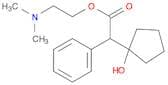
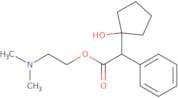
Ciclopentolato é uma amina terciária e um derivado do ácido trópico, utilizado principalmente como agente midriático em oftalmologia para dilatar as pupilas durante os exames oculares. É caracterizado por sua capacidade de bloquear a ação da acetilcolina nos receptores muscarínicos do músculo esfíncter da íris, levando à dilatação da pupila. Ciclopentolato é tipicamente administrado como uma solução em gotas para os olhos e tem um início de ação rápido, com efeitos que duram várias horas. O composto é conhecido por sua relativamente baixa absorção sistêmica, o que minimiza os efeitos colaterais. Em termos de propriedades físicas, Ciclopentolato é um pó cristalino branco a off-white que é solúvel em água e apresenta um perfil de solubilidade dependente do pH. Sua estrutura química inclui um anel de ciclopentano, contribuindo para suas propriedades farmacológicas únicas. Assim como qualquer medicamento, é essencial considerar os potenciais efeitos colaterais, incluindo aumento da pressão intraocular e sensibilidade à luz, particularmente em indivíduos suscetíveis.
Fórmula:C17H25NO3
InChI:InChI=1S/C17H25NO3/c1-18(2)12-13-21-16(19)15(14-8-4-3-5-9-14)17(20)10-6-7-11-17/h3-5,8-9,15,20H,6-7,10-13H2,1-2H3
Chave InChI:InChIKey=SKYSRIRYMSLOIN-UHFFFAOYSA-N
SMILES:C(C(OCCN(C)C)=O)(C1(O)CCCC1)C2=CC=CC=C2
Sinónimos:- 1-Hydroxy-α-phenylcyclopentaneacetic acid, 2-(dimethylamino)ethyl ester
- 2-(Dimethylamino)Ethyl (1-Hydroxycyclopentyl)(Phenyl)Acetate
- 2-(Dimethylamino)ethyl 2-(1-hydroxycyclopentyl)-2-phenylacetate
- 2-Dimethylaminoethyl 1-hydroxy-α-phenylcyclopentaneacetate
- 2-Dimethylaminoethyl 2-(1-Hydroxycyclopentyl)-2-Phenylacetate
- <span class="text-smallcaps">DL</span>-Cyclopentolate
- Benzeneacetic acid, α-(1-hydroxycyclopentyl)-, 2-(dimethylamino)ethyl ester
- Ciclopentolato
- Cyclogyl
- Cyclopentaneacetic acid, 1-hydroxy-α-phenyl-, 2-(dimethylamino)ethyl ester
- Cyclopentoiate
- Cyclopentolat
- Cyclopentylate
- DL-Cyclopentolate
- Tsiklopentolat
- β-Dimethylaminoethyl (1-hydroxycyclopentyl)phenylacetate
- Mydrilate
- 2-Dimethylaminoethyl 1-hydroxy-alpha-phenylcyclopentaneacetate
- 2-dimethylaminoethyl 2-(1-hydroxycyclopentyl)-2-phenyl-ethanoate
- CYCLOPENTOLATE
- Benzeneacetic acid, a-(1-hydroxycyclopentyl)-, 2-(dimethylamino)ethylester
- 1-Hydroxy-alpha-phenylcyclopentaneacetic acid, 2-(dimethylamino)ethyl ester
- 2-(1-hydroxycyclopentyl)-2-phenyl-acetic acid 2-dimethylaminoethyl ester
- yclopentolate
- Benzeneacetic acid, alpha-(1-hydroxycyclopentyl)-, 2-(dimethylamino)ethyl ester
- α-(1-Hydroxycyclopentyl)benzeneacetic acid 2-(dimethylamino)ethyl
- beta-(Dimethylamino)ethyl (1-hydroxycyclopentyl)phenylacetate
- Cyplegin
- Ver mais sinónimos
Ordenar por
Pureza (%)
0
100
|
0
|
50
|
90
|
95
|
100
3 produtos.
2-(Dimethylamino)ethyl 2-(1-hydroxycyclopentyl)-2-phenylacetate
CAS:Fórmula:C17H25NO3Peso molecular:291.38532-(Dimethylamino)ethyl 2-(1-hydroxycyclopentyl)-2-phenylacetate
CAS:Fórmula:C17H25NO3Pureza:95.0%Peso molecular:291.391Cyclopentolate
CAS:Produto ControladoCyclopentolate is a muscarinic antagonist and is used as an ophthalmic drug to produce mydriasis. Cyclopentolate inhibits the metabolism of cyclopentyl-CoA via the 3-hydroxyacyl-CoA dehydrogenase, which leads to the accumulation of cyclopentyl-CoA in cells. This inhibition can cause metabolic disorders such as hyperlipidemia and diabetes mellitus, which are characterized by increased acid formation and reduced glucose uptake. Cyclopentolate also binds to DNA, inhibiting transcription, replication, and repair of DNA. The binding affinity of cyclopentolate to DNA is approximately 2500 times higher than that of other drugs in its class. Cyclopentolate has been shown to inhibit leukemia inhibitory factor (LIF) and the production of acid from fluorescein angiographyFórmula:C17H25NO3Pureza:Min. 95%Cor e Forma:White/Off-White SolidPeso molecular:291.39 g/mol