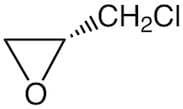
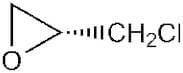
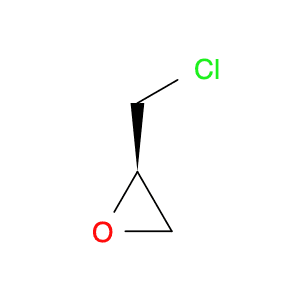
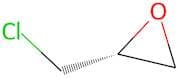
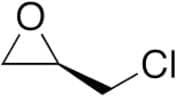
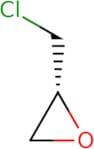
CAS 51594-55-9
:(-)-Epicloridrina
Descrição:
(-)-Epicloridrina, com o número CAS 51594-55-9, é um líquido incolor a amarelo pálido que se caracteriza pelo seu forte e penetrante odor. É um composto epóxido, especificamente uma cloridrina, e é conhecido por sua reatividade devido à presença de um grupo epóxido e um átomo de cloro. Este composto é solúvel em água e solventes orgânicos, tornando-o versátil em várias aplicações químicas. É utilizado principalmente como intermediário na síntese de resinas epóxicas, que são amplamente utilizadas em revestimentos, adesivos e materiais compósitos. (-)-Epicloridrina também é empregado na produção de glicerol e outros derivados químicos. Devido à sua natureza reativa, pode participar de várias reações químicas, incluindo reações de abertura de anel e substituições nucleofílicas. No entanto, é importante manusear esta substância com cuidado, pois é classificada como material perigoso, com potenciais riscos à saúde em caso de exposição. Medidas de segurança adequadas devem ser tomadas ao trabalhar com (-)-Epicloridrina em ambientes laboratoriais ou industriais.
Fórmula:C3H5ClO
InChI:InChI=1S/C3H5ClO/c4-1-3-2-5-3/h3H,1-2H2/t3-/m0/s1
Chave InChI:InChIKey=BRLQWZUYTZBJKN-VKHMYHEASA-N
SMILES:C(Cl)[C@H]1CO1
Sinónimos:- (-)-2-(Chloromethyl)oxirane
- (-)-Epichlorohydrin
- (2R)-2-(chloromethyl)oxirane
- (R)-(-)-2-(Chloromethyl)oxirane
- (R)-(Chloromethyl)oxirane
- (R)-1-Chloro-2,3-epoxypropane
- (R)-3-Chloro-1,2-epoxypropane
- Oxirane, (chloromethyl)-, (2R)-
- Oxirane, (chloromethyl)-, (R)-
- Oxirane, 2-(chloromethyl)-, (2R)-
- (R)-(-) Epichlorohydrin
- (R)-(-)-Epichlorohydrin
- Ver mais sinónimos
Ordenar por
Pureza (%)
0
100
|
0
|
50
|
90
|
95
|
100
10 produtos.
(R)-Epichlorohydrin
CAS:Fórmula:C3H5ClOPureza:>98.0%(GC)Cor e Forma:Colorless to Light yellow clear liquidPeso molecular:92.52(R)-(-)-Epichlorohydrin, 98+%
CAS:This Thermo Scientific Chemicals brand product was originally part of the Alfa Aesar product portfolio. Some documentation and label information may refer to the legacy brand. The original Alfa Aesar product / item code or SKU reference has not changed as a part of the brand transition to Thermo SciFórmula:C3H5ClOPureza:98+%Cor e Forma:Clear colorless, LiquidPeso molecular:92.52(2R)-(-)-3-Chloro-1,2-propenoxide
CAS:(2R)-(-)-3-Chloro-1,2-propenoxideFórmula:C3H5ClOPureza:99%Cor e Forma: clear. almost colourless liquidPeso molecular:92.52g/mol(R)-Epichlorohydrin
CAS:Produto ControladoApplications R-enantiomer of Epichlorohydrin, an important industrial chemical, is a bifunctional alkylating agent with the potential to form DNA cross-links. It is used as a solvent for natural and synthetic resins, gums, cellulose esters and ethers, paints, varnishes, nail enamels and lacquers, cement for Celluloid. Also, it is used as stabilizer.
Not a dangerous good if item is equal to or less than 1g/ml and there is less than 100g/ml in the package
References Romano, K.P. et al.: Chem. Res. Toxicol., 20, 832 (2007); Smyth, H.F., et al.: J. Ind. Hyg. Toxicol., 30, 63 (1948);Fórmula:C3H5ClOCor e Forma:NeatPeso molecular:92.52(R)-Epichlorohydrin
CAS:(R)-Epichlorohydrin is an organic compound with the chemical formula (CHClO). It is a colorless liquid with a sweet odor. It has been used as an industrial solvent and in the production of other chemicals. It can also be used to inhibit microbial growth by reacting with sulfhydryl groups, which are necessary for some enzymes to function. (R)-Epichlorohydrin is synthesized from dichloroethane by chlorination followed by oxidation: The reaction mechanism proceeds through chlorination of the ethylene molecule followed by a stepwise oxidation of the resultant chlorine atoms to form epichlorohydrin: The first step involves conversion of dichloroethane into dichloroethylene, which reacts with chlorine gas to produce ethyl chloride: This intermediate then reacts with hydrogen peroxide (HOOH) to form chloroethanol, which in turn reacts with oxygen gas (O2) toFórmula:C3H5ClOPureza:Min. 98%Cor e Forma:Colorless Clear LiquidPeso molecular:92.52 g/mol