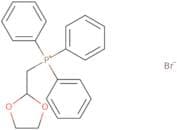
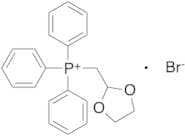
CAS 52509-14-5
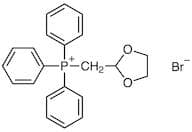
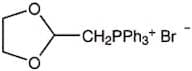
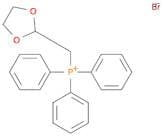
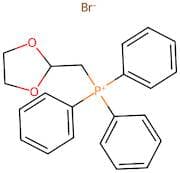
:(1,3-Dioxolan-2-ilmetil)trifenilfosfônio brometo
Descrição:
(1,3-Dioxolan-2-ilmetil)trifenilfosfônio brometo é um sal de amônio quaternário caracterizado pelo seu cátion triphenylphosphonium e um moiety de dioxolano. Este composto geralmente aparece como um sólido branco a off-white e é solúvel em solventes orgânicos polares, o que facilita seu uso em várias reações químicas. A presença do anel de dioxolano contribui para sua estabilidade e reatividade, tornando-o um intermediário útil na síntese orgânica, particularmente na formação de ligações carbono-carbono. O grupo triphenylphosphonium aumenta a lipofilicidade, permitindo uma melhor permeabilidade da membrana em sistemas biológicos. Além disso, o ânion brometo atua como um contra-íon, que pode influenciar a reatividade e solubilidade do composto. Esta substância é frequentemente utilizada em química orgânica sintética, incluindo aplicações na síntese de ylidos de fosfonio e outros derivados. Precauções de segurança devem ser observadas ao manusear este composto, assim como com muitos compostos organofosforados, devido à potencial toxicidade e reatividade.
Fórmula:C22H22BrO2P
InChI:InChI=1/C22H22O2P.BrH/c1-4-10-19(11-5-1)25(18-22-23-16-17-24-22,20-12-6-2-7-13-20)21-14-8-3-9-15-21;/h1-15,22H,16-18H2;1H/q+1;/p-1
Chave InChI:InChIKey=FRHRVQQUICVJDG-UHFFFAOYSA-M
SMILES:[P+](CC1OCCO1)(C2=CC=CC=C2)(C3=CC=CC=C3)C4=CC=CC=C4.[Br-]
Sinónimos:- (1,3-Dioxolane-2-Yl Methyl) Triphenyl Phosphonium Bromide
- 1,3-Dioxylany-2-yl)triphenylphosphonium bromide
- 2-[(1,3)-Dioxolane-2-Yl]-Methyltriphenylphosphonium Bromide
- Labotest-Bb Lt00233112
- Phosphonium, (1,3-Dioxolan-2-Ylmethyl)Triphenyl-, Bromide
- Phosphonium, (1,3-dioxolan-2-ylmethyl)triphenyl-, bromide (1:1)
- Triphenyl-1,3-Dioxolan-2-Ylmethyl-Phosphonium Bromide
- [(1,3-Dioxolan-2-yl)methyl]triphenylphosphanium bromide
- (1,3-Dioxolan-2-ylmethyl)triphenylphosphonium bromide
- (1,3-Dioxolan-2-ylmethyl)triphenylphosphonium bromide, 98 %
- 1,3-Dioxolan-2-ylmethyl-triphenylphosphanium bromide
- (1,3-DIOXOLAN-2-YLMETHYL)TRIPHENYLPHOSPHONIUM BROMIDE 98%
- Ver mais sinónimos
Ordenar por
Pureza (%)
0
100
|
0
|
50
|
90
|
95
|
100
8 produtos.
(1,3-Dioxolan-2-yl)methyltriphenylphosphonium Bromide
CAS:Fórmula:C22H22BrO2PPureza:>97.0%(T)Cor e Forma:White to Light yellow to Light orange powder to crystalPeso molecular:429.29(1,3-Dioxolan-2-ylmethyl)triphenylphosphonium bromide, 98%
CAS:It finds its applications as a reagent for Wittig olefinations with introduction of a 1,3-dioxolane moiety. It is applied as a reactant for the preparation of a ratiometric fluorescent probe for specific detection of cysteine over homocysteine and glutathione, for microwave-assisted synthesis of KN-Fórmula:C22H22BrO2PPureza:98%Cor e Forma:White to cream, Crystals or powder or crystalline powderPeso molecular:429.29(1,3-Dioxolan-2-ylmethyl)triphenylphosphonium bromide
CAS:Fórmula:C22H22BrO2PPureza:97%Cor e Forma:SolidPeso molecular:429.2866(1,3-Dioxolan-2-ylmethyl)(triphenyl)phosphonium bromide
CAS:(1,3-Dioxolan-2-ylmethyl)(triphenyl)phosphonium bromideFórmula:C22H22O2P·BrPureza:98%Cor e Forma: off-white solidPeso molecular:429.29g/mol(1,3-Dioxolan-2-yl)methyltriphenylphosphonium Bromide
CAS:(1,3-Dioxolan-2-yl)methyltriphenylphosphonium Bromide is a synthetic reagent that is used in the Wittig reaction. It is prepared by reacting p-toluenesulfonic acid with methylene chloride and methoxybenzene. This reagent can be used to synthesize β-unsaturated aldehydes from alkenes and hydroxylamine. The preparation of this reagent involves recrystallizing it from ethanol or ethyl acetate and then hydrogenating it to give (1,3-dioxolan-2-yl)methyl triphenylphosphonium bromide.Fórmula:C22H22BrO2PPureza:Min. 95%Cor e Forma:PowderPeso molecular:429.29 g/mol(1,3-Dioxolan-2-ylmethyl)triphenylphosphonium bromide
CAS:Fórmula:C22H22BrO2PPureza:97%Cor e Forma:Solid, PowderPeso molecular:429.294(1,3-Dioxolan-2-ylmethyl)triphenylphosphonium Bromide
CAS:Produto ControladoApplications (1,3-Dioxolan-2-ylmethyl)triphenylphosphonium Bromide is used as a reactant in the synthesis of ketolides methyloxoerythromycins with antibacterial activity as highly potent against macrolide-resistant and susceptible respiratory pathogens.
References Agouridas, C., et al.: J. Med. Chem., 41, 4080 (1998);Fórmula:C22H22O2P·BrCor e Forma:NeatPeso molecular:429.3