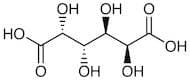
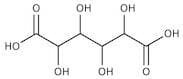
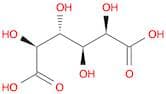
CAS 526-99-8
:Ácido múcico
Descrição:
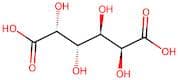
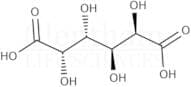
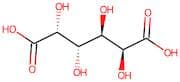
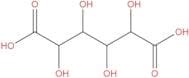
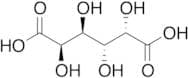
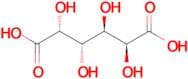
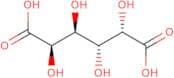
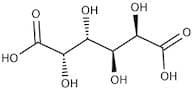
Ácido múcico, também conhecido como ácido galactárico, é um ácido dicarboxílico com a fórmula química C6H10O8. É um sólido cristalino branco que é solúvel em água e apresenta um sabor ligeiramente doce. Ácido múcico é derivado da oxidação de açúcares, particularmente galactose, e é comumente encontrado em certos materiais vegetais. Sua estrutura apresenta dois grupos de ácido carboxílico (-COOH) ligados a uma cadeia de seis carbonos, o que contribui para sua acidez e reatividade. Ácido múcico é utilizado em várias aplicações, incluindo como precursor na síntese orgânica e na produção de certos fármacos. Além disso, tem usos potenciais na indústria alimentícia como agente aromatizante ou conservante. O composto é geralmente considerado seguro, mas, como muitos ácidos orgânicos, deve ser manuseado com cuidado para evitar irritações. Seu número CAS, 526-99-8, é um identificador único que facilita a identificação e regulamentação deste químico em vários contextos.
Fórmula:C6H10O8
InChI:InChI=1/C6H10O8/c7-1(3(9)5(11)12)2(8)4(10)6(13)14/h1-4,7-10H,(H,11,12)(H,13,14)/t1-,2+,3+,4-
Chave InChI:InChIKey=DSLZVSRJTYRBFB-DUHBMQHGNA-N
SMILES:[C@H]([C@H]([C@@H](C(O)=O)O)O)([C@H](C(O)=O)O)O
Sinónimos:- (2R,3S,4R,5S)-2,3,4,5-tetrahydroxyhexanedioate (non-preferred name)
- (2S,3R,4R,5S)-2,3,4,5-tetrahydroxyhexanedioate (non-preferred name)
- (2S,3R,4S,5S)-2,3,4,5-tetrahydroxyhexanedioate (non-preferred name)
- 2,2,3,3-Tetrahydroxyhexanedioic Acid
- D-galactaric acid
- Galactaric acid
- Galactaric acid~Tetrahydroxyadipic acid
- Galactosaccharic acid
- Hexaric Acid
- NSC 8127
- Saccharolactic acid
- galacto-Hexaric acid
- Ver mais sinónimos
Ordenar por
Pureza (%)
0
100
|
0
|
50
|
90
|
95
|
100
13 produtos.
Mucic Acid
CAS:Fórmula:C6H10O8Pureza:>97.0%(T)Cor e Forma:White to Almost white powder to crystalPeso molecular:210.14Mucic acid, 98%
CAS:Mucic acid is used to replace tartaric acid in self-rising flour or fizzies. It is also used as a precursor of adipic acid en route to nylon by a rhenium-catalyzed deoxydehydration reaction. It replaces potassium bitartrate in baking powder and also used for manufacture of granular effervescing salt
Fórmula:C6H10O8Pureza:98%Cor e Forma:Crystalline powder, White to pale creamPeso molecular:210.14Mucic Acid
CAS:Mucic Acid (Tetrahydroxyadipic acid) is an aldaric acid obtained by nitric acid oxidation of galactose or galactose-containing compounds.Fórmula:C6H10O8Pureza:99.31%Cor e Forma:Crystalline Powder SolidPeso molecular:210.14Mucic acid
CAS:Fórmula:C6H10O8Pureza:≥ 97.0%Cor e Forma:White to off-white powderPeso molecular:210.14(2S,3R,4S,5R)-2,3,4,5-Tetrahydroxyadipic acid
CAS:(2S,3R,4S,5R)-2,3,4,5-Tetrahydroxyadipic acidFórmula:C6H10O8Pureza:97%Cor e Forma: fine white crystalline powderPeso molecular:210.14g/mol(2R,3S,4R,5S)-2,3,4,5-Tetrahydroxyhexanedioic acid
CAS:Pureza:95.0%Cor e Forma:Solid, White to very pale yellow powderPeso molecular:210.13800048828125Mucic acid
CAS:Mucic acid is a metal chelate that stimulates the metabolism of carbohydrates, fats and proteins. It also plays a role in the production of energy in the body. Mucic acid has been shown to have a protective effect against infectious diseases, as it activates toll-like receptor 2 (TLR2) and TLR4, which are molecules involved in innate immunity. Mucic acid has been shown to protect against influenza virus infection by increasing the expression of interferon-gamma (IFN-γ) and IL-12, which are cytokines that inhibit viral replication. Mucic acid can be used as a fluorescence probe for detection of polymorphonuclear leucocytes in blood samples.Fórmula:C6H10O8Pureza:Min. 95%Cor e Forma:White PowderPeso molecular:210.14 g/molMucic Acid extrapure, 99%
CAS:Fórmula:C6H10O8Pureza:min. 99%Cor e Forma:White to off white, Crystalline powder, Clear, ColourlessPeso molecular:210.14