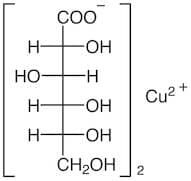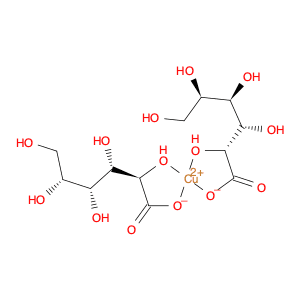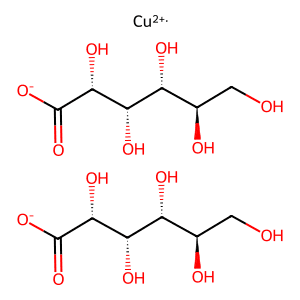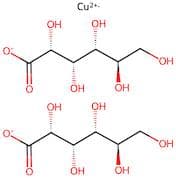
CAS 527-09-3
:Bis(D-gluconato-κO1,κO2)cobre
- <span class="text-smallcaps">D</span>-Gluconic acid, copper complex
- <span class="text-smallcaps">D</span>-Gluconic acid, copper(2+) salt
- Bis(<span class="text-smallcaps">D</span>-gluconato-κO<sup>1</sup>,κO<sup>2</sup>)copper
- Chelates of copper gluconate
- Copper gluconate
- Copper(II) gluconate
- Copper, bis(<span class="text-smallcaps">D</span>-gluconato-O<sup>1</sup>,O<sup>2</sup>)-
- Copper, bis(<span class="text-smallcaps">D</span>-gluconato-κO<sup>1</sup>,κO<sup>2</sup>)-
- Cupric gluconate
- Gluconic acid, copper(2+) salt
- Gluconic acid, copper(2+) salt (2:1), <span class="text-smallcaps">D</span>-
- Helshas Cu
- Labicuper
- bis[[(2R,3S,4R,5R)-2,3,4,5,6-pentahydroxyhexanoyl]oxy]copper
- copper di-D-gluconate
- Gluconic acid, copper(2+) salt (2:1), D-
- Copper, bis(D-gluconato-κO1,κO2)-
- D-Gluconic acid copper(II) salt
- D-Gluconic acid, copper complex
- Copper, bis(D-gluconato-O1,O2)-
- Ver mais sinónimos
Copper(II) Gluconate
CAS:Fórmula:C12H22CuO14Pureza:>97.0%(T)Cor e Forma:Green to Blue powder to crystalPeso molecular:453.84Copper(II) gluconate
CAS:Copper(II) gluconate is used in dietary supplement. It is also used to treat acne vulgaris, common cold, hypertension, premature labor, leishmaniasis and visceral postoperative complications. Further, it is used in oral deodorants and feed additives. In addition to this, it is used as a synergist anFórmula:C12H22CuO14Cor e Forma:Blue to blue-green, PowderPeso molecular:453.84Copper(II) D-gluconate
CAS:Fórmula:C12H22CuO14Pureza:98.0 - 102.0 %Cor e Forma:Light-blue to blue powderPeso molecular:453.85Copper(II) D-gluconate
CAS:Copper(II) D-gluconatePureza:97%Cor e Forma:PowderPeso molecular:453.84g/molCopper(II) gluconate
CAS:Copper(II) gluconate is a non-toxic copper supplement. As a precursor catalyst, it can be used for photoinduced polymerization of acrylates.
Fórmula:C12H22CuO14Pureza:99.98%Cor e Forma:SolidPeso molecular:453.84D-Gluconic acid copper (II) salt
CAS:D-Gluconic acid copper (II) salt is a copper complex that has been shown to have an effect on iron homeostasis and fatty acid metabolism. The pharmacokinetics of D-gluconic acid copper (II) salt was studied in rats, which showed that the compound is absorbed quickly and eliminated rapidly. D-Gluconic acid copper (II) salt also has a protective effect against bone cancer in mice. The toxicological studies revealed no adverse effects of D-gluconic acid copper (II) salt on the liver or other organs, but it did produce magnesium salt, which can be toxic to humans. It is not known if there are any interactions with benzalkonium chloride.
Fórmula:C6H11O7CuCor e Forma:Blue PowderPeso molecular:226.93 g/mol