CAS 533-67-5
:Desoxirribose
Descrição:
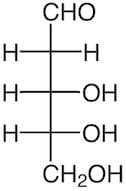
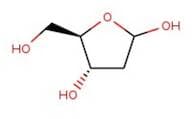
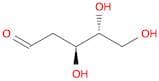
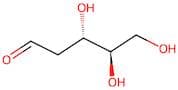
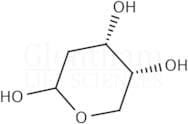
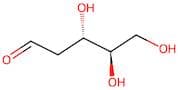
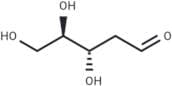
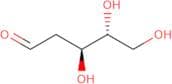
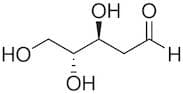
Desoxirribose é um açúcar de cinco carbonos, classificado especificamente como uma pentose, e é um componente crucial dos ácidos nucleicos, particularmente do DNA. Sua fórmula química é C5H10O4, e é caracterizado pela ausência de um átomo de oxigênio na posição 2' do açúcar ribose, o que o distingue da ribose. Essa diferença estrutural contribui para a estabilidade do DNA em comparação com o RNA. Desoxirribose existe em forma linear e em forma cíclica, sendo a forma cíclica predominante em sistemas biológicos. Desempenha um papel vital na formação de nucleotídeos, que são os blocos de construção do DNA, ligando-se a grupos fosfato e bases nitrogenadas para formar a espinha dorsal do DNA. Desoxirribose é tipicamente encontrado em forma hidratada em contextos biológicos e é solúvel em água. Seu número CAS, 533-67-5, é usado para identificação em bancos de dados químicos. No geral, Desoxirribose é essencial para o armazenamento e transmissão de informações genéticas em organismos vivos.
Fórmula:C5H10O4
InChI:InChI=1S/C5H10O4/c6-2-1-4(8)5(9)3-7/h2,4-5,7-9H,1,3H2/t4-,5+/m0/s1
Chave InChI:InChIKey=ASJSAQIRZKANQN-CRCLSJGQSA-N
SMILES:[C@@H]([C@@H](CO)O)(CC=O)O
Sinónimos:- (3S,4R)-3,4,5-Trihydroxypentanal
- 2-Deoxy-<span class="text-smallcaps">D</span>-arabinose
- 2-Deoxy-<span class="text-smallcaps">D</span>-erythro-pentose
- 2-Deoxy-<span class="text-smallcaps">D</span>-ribose
- 2-Deoxy-D-arabinose
- 2-Deoxy-D-erythro-pentose
- 2-Deoxy-beta-D-erythro-pentose
- 2-Desoxy-D-ribose
- 2-deoxy-D-erythro-pentofuranose
- 2-deoxy-D-erythro-pentopyranose
- 2-deoxy-D-erythropentose
- 2-deoxy-D-threo-pentose
- 2-deoxy-L-threo-pentose
- 2-deoxy-alpha-D-erythro-pentofuranose
- 2-deoxy-alpha-D-erythro-pentopyranose
- 2-desoxi-D-ribosa
- <span class="text-smallcaps">D</span>-(-)-2-Deoxyribose
- <span class="text-smallcaps">D</span>-Ribose, 2-deoxy-
- <span class="text-smallcaps">D</span>-erythro-Pentose, 2-deoxy-
- D-(-)-2-Deoxyribose
- D-Ribose, 2-deoxy-
- D-erythro-Hexose, 2,5-dideoxy-
- D-erythro-Pentose, 2-deoxy-
- Deoxyribose
- Thyminose
- Ver mais sinónimos
Ordenar por
Pureza (%)
0
100
|
0
|
50
|
90
|
95
|
100
15 produtos.
2-Deoxy-D-ribose
CAS:Fórmula:C5H10O4Pureza:>98.0%(HPLC)Cor e Forma:White to Almost white powder to crystalPeso molecular:134.132-Deoxy-D-ribose, 99%
CAS:2-Deoxy-D-ribose is used as a precursor to deoxyribonucleic acid. It induces apoptosis by inhibiting the synthesis and increasing the efflux of glutathione. Further, it is used in the synthesis of optically active dipyrrolyl alkanols from pyrroles on the surface of montmorillonite KSF clay. This TheFórmula:C5H10O4Pureza:99%Cor e Forma:White to cream or pale yellow, PowderPeso molecular:134.132-Deoxy-D-ribose
CAS:Fórmula:C5H10O4Pureza:≥ 98.0%Cor e Forma:White to almost white powder or crystalsPeso molecular:134.132-Deoxy-D-riboside
CAS:2-Deoxy-D-ribosideFórmula:C5H10O4Pureza:98%Cor e Forma: white to almost white crystal to powderPeso molecular:134.13049g/molThyminose
CAS:Thyminose (2-Deoxy-D-arabinose) induces Apoptosis by inhibiting the synthesis and increasing the efflux of glutathione.Fórmula:C5H10O4Pureza:99.69%Cor e Forma:SolidPeso molecular:134.132-Deoxy-D-ribose
CAS:Produto ControladoApplications 2-Deoxy-D-ribose induces apoptosis by inhibiting the synthesis and increasing the efflux of glutathione.
References Fico, A., et al.: Free Radical Biology & Medicine, 45, 211 (2008),Fórmula:C5H10O4Cor e Forma:NeatPeso molecular:134.132-Deoxy-D-ribose
CAS:High purity grade. Used in synthetic organic chemistry and natural product synthesis. Induces apoptosis by inhibiting the synthesis and increasing the efflux of glutathione. It is used for synthesis of optically active dipyrrolyl alkanols from pyrroles on the surface of montmorillonite KSF clay.Due to its integral role in the formation of DNA, 2-Deoxy-D-ribose is critical in studies of genetic expression, DNA repair mechanisms, and the synthesis of nucleotides. Researchers utilize it extensively in molecular biology and biochemistry to understand cell replication and gene function, and it serves as a standard in research pertaining to oxidative stress, where its degradation may indicate the presence of reactive oxygen species. Additionally, it is involved in the development of various pharmacological agents, particularly those targeting cancer and viral infections, where the synthesis and function of DNA are pivotal aspects of pathogenesis and treatment response.Fórmula:C5H10O4Pureza:Min. 99.0 Area-%Peso molecular:134.13 g/mol2-Deoxy-D-Ribose extrapure
CAS:Fórmula:C5H10O4Cor e Forma:White to off-white, Crystalline powder, Clear, Colourless to pale yellowPeso molecular:134.132-Deoxy-D-ribose
CAS:Used in synthetic organic chemistry and natural product synthesis. Induces apoptosis by inhibiting the synthesis and increasing the efflux of glutathione. It is used for synthesis of optically active dipyrrolyl alkanols from pyrroles on the surface of montmorillonite KSF clay.
Fórmula:C5H10O4Pureza:Min. 99.0 Area-%Peso molecular:134.13 g/mol2-Deoxy-D-ribose
CAS:Used in synthetic organic chemistry and natural product synthesis. Induces apoptosis by inhibiting the synthesis and increasing the efflux of glutathione. It is used for synthesis of optically active dipyrrolyl alkanols from pyrroles on the surface of montmorillonite KSF clay.
Fórmula:C5H10O4Pureza:Min. 98 Area-%Cor e Forma:White PowderPeso molecular:134.13 g/mol