CAS 535-34-2
:cistationina
Descrição:
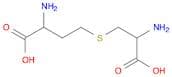
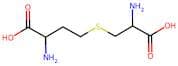
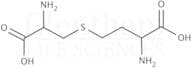
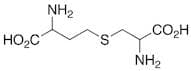
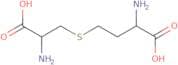
cistationina é um aminoácido que ocorre naturalmente e um intermediário chave na via de transulfuração, que está envolvida no metabolismo de aminoácidos que contêm enxofre, particularmente metionina e cisteína. É um dipeptídeo formado pela condensação de homocisteína e serina, e desempenha um papel crucial na síntese de cisteína. cistationina é caracterizado por sua fórmula estrutural, que inclui uma ligação tioéter e um grupo ácido carboxílico, contribuindo para sua reatividade e funções biológicas. Existe em duas formas estereoisoméricas, sendo a forma L a biologicamente ativa. Em termos de solubilidade, cistationina é solúvel em água, o que facilita suas interações biológicas. Níveis elevados de cistationina no corpo podem ser indicativos de certos distúrbios metabólicos, incluindo homocistinúria. Além disso, cistationina pode estar envolvido em várias vias bioquímicas, influenciando processos celulares e contribuindo para a regulação do estresse oxidativo. Seu número CAS, 535-34-2, é usado para identificação em bancos de dados químicos e contextos regulatórios.
Fórmula:C7H14N2O4S
InChI:InChI=1/C7H14N2O4S/c8-4(6(10)11)1-2-14-3-5(9)7(12)13/h4-5H,1-3,8-9H2,(H,10,11)(H,12,13)/t4-,5?/m0/s1
Chave InChI:InChIKey=ILRYLPWNYFXEMH-UHFFFAOYSA-N
SMILES:C(CCSCC(C(O)=O)N)(C(O)=O)N
Sinónimos:- (3Alpha,5Alpha,17Alpha)-Androstane-3,17-Diol
- 2-Amino-4-[(2-amino-2-carboxyethyl)sulfanyl]butanoic acid
- 2-Azaniumyl-4-(2-azaniumyl-2-carboxylatoethyl)sulfanylbutanoate
- <span class="text-smallcaps">DL</span>-Allocystathionine
- <span class="text-smallcaps">DL</span>-Cystathionine
- <span class="text-smallcaps">DL</span>-Homocysteine, S-(2-amino-2-carboxyethyl)-
- Butyric acid, α-amino-γ-(2-amino-2-carboxyethylmercapto)-
- Cystathionine, <span class="text-smallcaps">DL</span>-
- Cystathionine, DL-
- DL-Allocystathionine
- DL-Cystathionine
- DL-Homocysteine, S-(2-amino-2-carboxyethyl)-
- Homocysteine, S-(2-amino-2-carboxyethyl)-
- NSC 118379
- S-(2-Amino-2-carboxyethyl)-DL-homocysteine
- S-(2-Amino-2-carboxyethyl)homocysteine
- S-(2-amino-2-carboxyethyl)-L-homocysteine
- S-[(2R)-2-amino-2-carboxyethyl]-L-homocysteine
- DL,DL-allo-Cystathionine, S-(2-Amino-2-carboxyethyl)homocysteine
- CYSTATHIONINE
- dl,dl-allo-cystathionine
- -2-Amino-4-((2-amino-2-carboxyethyl)
- 2-amino-4-[(2-amino-3-hydroxy-3-keto-propyl)thio]butyric acid
- 2-amino-4-(2-amino-3-hydroxy-3-oxopropyl)sulfanylbutanoic acid
- D,L-CYSTATHIONINE
- 2-aMino-4-((2-aMino-2-carboxyethyl)thio)butanoic acid
- 2-azanyl-4-(2-azanyl-3-hydroxy-3-oxo-propyl)sulfanyl-butanoic acid
- Allocystathionine
- Ver mais sinónimos
Ordenar por
Pureza (%)
0
100
|
0
|
50
|
90
|
95
|
100
6 produtos.
(2S)-2-Amino-4-((2-amino-2-carboxyethyl)thio)butanoic acid
CAS:Fórmula:C7H14N2O4SPureza:97%Cor e Forma:SolidPeso molecular:222.2621D,L-Cystathionine
CAS:Fórmula:C7H14N2O4SPureza:(HPLC) ≥ 90.0%Cor e Forma:White to off-white powderPeso molecular:222.30D,L-Cystathionine
CAS:Produto ControladoApplications Intermediate for transsulfuration whereby a mammal transfers the sulfur of methionine via homocysteine to cysteine.
References Thompson, J.W., et al.: J. Biol. Chem., 266, 17011 (1991), Yoshida, Y., et al.: Microbiol., 148, 3961 (2002), Jiracek, J., et al.: J. Med. Chem., 49, 3982 (2006),Fórmula:C7H14N2O4SCor e Forma:NeatPeso molecular:222.26D,L-Cystathionine
CAS:Cystathionine is a sulfur-containing amino acid that is the precursor of cysteine. Cystathionine synthase, the enzyme that catalyzes the formation of cystathionine, is inhibited by L-cysteine and glutathione. Cystathionine has been shown to be an important growth factor for fibroblasts and osteoblasts in culture as well as a regulator of gene expression. It also has been shown to be essential for iron homeostasis, as it increases iron absorption from the gut and reduces iron excretion in bile. Cystathionine is a highly reactive molecule with a high redox potential and can cause oxidative injury to cells, which may contribute to bowel disease. Cystathionine has been shown to have receptor activity in neurons, and its physiological effects are similar to those of glutamate.Fórmula:C7H14N2O4SPureza:Min. 95%Cor e Forma:PowderPeso molecular:222.26 g/mol