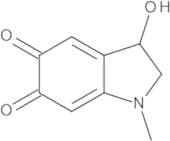
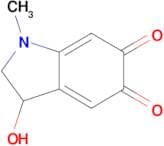
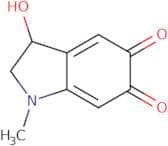
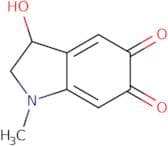
CAS 54-06-8
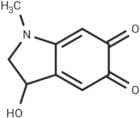
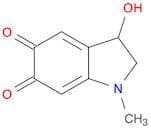
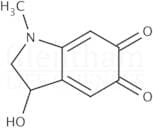
:Adrenocromo
- 1-Methyl-3-hydroxy-5,6-dioxo-2,3,5,6-tetrahydroindole
- 1H-Indole-5,6-dione, 2,3-dihydro-3-hydroxy-1-methyl-
- 2,3-Dihydro-3-hydroxy-1-methyl-1H-indole-5,6-dione
- 2,3-Dihydro-3-hydroxy-N-methylindole-5,6-quinone
- 3-Hydroxy-1-Methyl-2,3-Dihydroindole-5,6-Dione
- 3-Hydroxy-1-Methylindoline-5,6-Dione
- 3-Hydroxy-1-methyl-2,3,5,6-tetrahydro-1H-indole-5,6-dione
- 3-Hydroxy-1-methyl-5,6-indolinedione
- 3-hydroxy-1-methyl-2,3-dihydro-1H-indole-5,6-dione
- 5,6-Indolinedione, 3-hydroxy-1-methyl-
- Adraxone
- Ver mais sinónimos
Adrenochrome
CAS:Adrenochrome (Adraxone), an epinephrine derivative, is cytotoxic, has cardiotoxic effects, and may aid neuro-disease research.Fórmula:C9H9NO3Pureza:98.72%Cor e Forma:SolidPeso molecular:179.17D,L-Adrenochrome
CAS:Produto ControladoStability Light Senstiive
Applications D,L-Adrenochrome is the substance mainly responsible for the red colours produced during the mild oxidation of adrenaline
References Costa, V., et al.: Chem. Res. Toxicol., 20, 1183 (2007), Sotomayor-Zarate, R., et al.: Biol Reproduc., 78, 673 (2008),Fórmula:C9H9NO3Cor e Forma:NeatPeso molecular:179.1727D,L-Adrenochrome - 98%
CAS:D,L-adrenochrome is a chemical species that is not found in nature. It is synthesized by the oxidation of adrenochrome by sodium citrate and purified by recrystallization. D,L-adrenochrome has been shown to be a potent cytotoxic agent against rat cardiomyocytes. It has also been shown to inhibit the growth of cells in culture, which may be due to its ability to interfere with the uptake of adenine nucleotides and calcium binding.
Fórmula:C9H9NO3Pureza:Min. 95%Peso molecular:179.17 g/molD,L-Adrenochrome - 90%
CAS:Adrenochrome, or 3-Hydroxy-1-methyl-2,3-dihydro-1H-indole-5,6-dione is synthesized through the oxidation of epinephrine. The compound was studied in the 1950's in relation to a possible role in schizophrenia, which has been widely discredited. Believed to be cardiotoxic, adrenochrome has no current applications.
Fórmula:C9H9NO3Pureza:Min. 95%Cor e Forma:Off-White PowderPeso molecular:179.17 g/mol