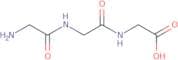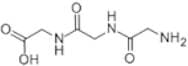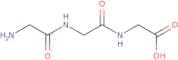
CAS 556-33-2
:Glicilglicilglicina
- 12: PN: WO2020022782 SEQID: 12 claimed protein
- 15: PN: WO2021041934 SEQID: 68 claimed protein
- 18: PN: WO2021026491 SEQID: 21 claimed protein
- 2-[2-(2-Aminoacetamido)acetamido]acetic acid
- 2-[[2-[(2-Azaniumylacetyl)amino]acetyl]amino]acetate
- 23: PN: WO2021030484 SEQID: 23 claimed protein
- 24: PN: WO2019213446 SEQID: 63 claimed protein
- 2: PN: WO2006090813 PAGE: 34 claimed protein
- 2: PN: WO2021011474 SEQID: 15 claimed protein
- 32: PN: FR2860236 PAGE: 10 claimed protein
- 54: PN: WO2004108885 PAGE: 83 claimed protein
- 58: PN: WO2019213442 SEQID: 63 claimed protein
- 6: PN: US20030104526 PAGE: 43 claimed protein
- 8: PN: US20050260564 PAGE: 29 claimed protein
- Adenosine deaminase 2 (synthetic human derivative sequence variant)
- Diglycylglycine
- Gly-L-Gly-L-Gly
- Glycine tripeptide
- Glycine, Glycylglycyl-
- Glycine, N-(N-glycylglycyl)-
- Glycyl-glycyl-glycine
- Glycylglycylglycine
- H-Gly-Gly-Gly-OH
- N-(N-Glycylglycyl)glycin
- N-(N-glicilglicil)glicina
- Nsc 46707
- Triglycine
- α-Diglycylglycin
- Triglycine,99%
- GLY-GLY-GLY PEPTIDE
- H-GLY-GLY-GLY-H
- Additive Screening Solution 48/Fluka kit no 78374, Glycyl-glycyl-glycine solution
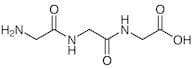
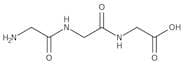
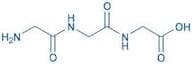
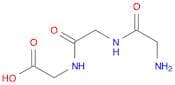
- 2-[[2-[(2-Aminoacetyl)amino]acetyl]amino]acetic acid
- Glycyl-glycyl-glycine 0.3 M Solution
- L-GLYCYL-GLYCYL-GLYCINE
- GLYCYL-GLYCY-L-GLYCINE extrapure
- N-(N-glycylglycyl)glycine
- Glycyl-glycyl-glycine, Triglycine
- GLY-GLY-GLY
- H2N-GGG-OH
- Ver mais sinónimos
Glycylglycylglycine
CAS:Fórmula:C6H11N3O4Pureza:>98.0%(T)Cor e Forma:White powder to crystalPeso molecular:189.17Glycylglycylglycine, 98+%
CAS:Glycylglycylglycine is used as a model peptide for studies of physicochemical parameters and molecular associations of small peptides. Triglycine is used as a copper chelator. It also acts as substrate for reproducible serum protein measurements by the biuret reaction1 and for the assay of aminotripFórmula:C6H11N3O4Pureza:98+%Cor e Forma:Powder, WhitePeso molecular:189.17H-Gly-Gly-Gly-OH
CAS:Triglycine, substrate for tripeptide aminopeptidase.Fórmula:C6H11N3O4Pureza:> 99%Cor e Forma:White PowderPeso molecular:189.17Triglycine
CAS:Acyclic amides (including acyclic carbamates) and their derivatives and salts thereof, nesoiFórmula:C6H11N3O4Cor e Forma:White PowderPeso molecular:189.07496Gly-Gly-Gly
CAS:Fórmula:C6H11N3O4Pureza:(Titration) 98.0 - 102.0 %Cor e Forma:White powderPeso molecular:191.14Glycyl-Glycyl-Glycine
CAS:Produto ControladoApplications Glycyl-glycyl-glycine is used as a model peptide for studies of physicochemical parameters and molecular associations of small peptides. It is also used as a copper chelator.
Fórmula:C6H11N3O4Cor e Forma:NeatPeso molecular:189.17Glycyl-glycyl-glycIne
CAS:Glycyl-glycyl-glycine is a compound that has been shown to have thermal expansion properties. It can be used as a thermometer because it changes its volume in response to temperature changes. Glycyl-glycyl-glycine is structurally similar to the amino acid glycine and can form hydrogen bonds with other molecules. The phase transition temperature of Glycyl-glycyl-glycine has been determined by metal chelate titration calorimetry, which is a technique for measuring the heat capacity change of a chemical reaction. This compound was also found to bind fluorescent probes and methyl myristate, which are compounds often used to study enzyme activities. Glycyl-glycyl-glycine has also been shown to react with x-ray diffraction data and vitro assays, both of which are methods used to study molecular structures.
Fórmula:C6H11N3O4Pureza:Min. 98 Area-%Cor e Forma:PowderPeso molecular:189.17 g/molGlycyl-Glycyl-L-Glycine (Triglycine) extrapure, 99%
CAS:Fórmula:C6H11N3O4Pureza:min. 99%Cor e Forma:White, Crystalline powder, Clear, ColourlessPeso molecular:189.22-(2-(2-Aminoacetamido)acetamido)acetic acid
CAS:Fórmula:C6H11N3O4Pureza:95%Cor e Forma:SolidPeso molecular:189.171Gly-Gly-Gly
CAS:Gly-Gly-Gly is a fluorescent probe that has been shown to be cytotoxic, with a 1:1 ratio of glycolic acid and glyoxylic acid. Gly-Gly-Gly is an ester hydrochloride that can be used as a fluorescence probe in electrochemical impedance spectroscopy. It has been shown to have biological properties and to be structurally similar to the group P2 polymerase chain reaction (PCR) primer. Gly-Gly-Gly is able to inhibit the polymerase chain reaction by binding to the template DNA strands, inhibiting the formation of the hydrogen bonds required for DNA replication. This inhibition leads to strand breakage, preventing duplication of genetic material.Fórmula:C6H11N3O4Pureza:Min. 95%Peso molecular:189.17 g/mol






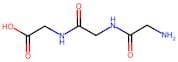

![2-[[2-[(2-Aminoacetyl)amino]acetyl]amino]acetic Acid (Triglycine)](/_next/image/?url=https%3A%2Fstatic.cymitquimica.com%2Fproducts%2F86%2Fthumb%2FMM1509.03-0025.jpg&w=3840&q=75)