CAS 556-50-3
:Glicilglicina
Descrição:
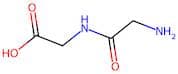
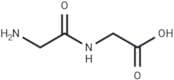
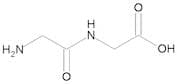
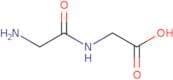
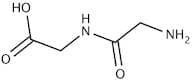
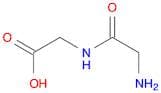
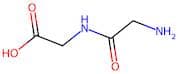
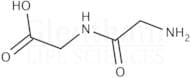
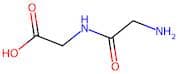
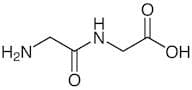
Glicilglicina, também conhecido como diglicina, é um dipeptídeo composto por dois aminoácidos de glicina ligados por uma ligação peptídica. Sua fórmula química é C4H8N2O3 e tem um peso molecular de aproximadamente 132,12 g/mol. Glicilglicina é um sólido cristalino branco que é solúvel em água, tornando-o útil em várias aplicações bioquímicas. Apresenta propriedades típicas de aminoácidos, como a capacidade de formar zwitterions, o que significa que pode carregar tanto uma carga positiva quanto uma carga negativa, dependendo do pH da solução. Glicilglicina é frequentemente utilizado na síntese de peptídeos, como agente tampão em ensaios bioquímicos e em estudos relacionados à estrutura e função de proteínas. Além disso, tem aplicações potenciais em farmacêuticos e nutrição, particularmente em formulações destinadas a melhorar a absorção de aminoácidos. Sua estrutura relativamente simples permite fácil incorporação em peptídeos e proteínas maiores, tornando-o um composto valioso tanto em contextos de pesquisa quanto industriais.
Fórmula:C4H8N2O3
InChI:InChI=1/C4H8N2O3/c5-1-3(7)6-2-4(8)9/h1-2,5H2,(H,6,7)(H,8,9)
Chave InChI:InChIKey=YMAWOPBAYDPSLA-UHFFFAOYSA-N
SMILES:C(NCC(O)=O)(CN)=O
Sinónimos:- 13: PN: WO2017167712 SEQID: 23 claimed protein
- 16: PN: WO2021041934 SEQID: 69 claimed protein
- 2-(2-Aminoacetamido)acetic acid
- 2-(Aminoacetamido)acetic acid
- 2-[(2-Aminoacetyl)amino]acetic acid
- 29: PN: US20200095309 SEQID: 56 claimed protein
- 31: PN: FR2860236 PAGE: 10 claimed protein
- 38: PN: WO2020048525 SEQID: 46 claimed protein
- 4: PN: WO2018201047 SEQID: 102 claimed protein
- 89: PN: WO2019035010 SEQID: 89 claimed protein
- Diglycine
- Diglycocoll
- G 0124
- Gly-Gly
- Gly-Gly Free Base
- Gly2
- Gly<sub>2</sub>
- Glycine dipeptide
- Glycine, Glycyl
- Glycine, N-glycyl-
- Glycine-glycine
- Glycyl-glycine,(Diglycine)
- Glycylglycine, Free Base
- H-Gly-Gly-OH
- N-Glycyl-Glycine
- N-Glycylglycin
- N-Glycylglycine
- N-glicilglicina
- Nsc 49346
- α-Glycylglycine
- Glycylglycine
- Glycyl-glycin
- GLY-GLY-OH
- (2-Amino-acetylamino)-aceticacid
- Glycinedipeptide
- 2-(Aminoacetamido)aceticacid
- Glycylglycin
- n-glycyl-glycin
- Ver mais sinónimos
Ordenar por
Pureza (%)
0
100
|
0
|
50
|
90
|
95
|
100
Glycylglycine, ≥98.5%
CAS:Thermo Scientific GlycylglycineFórmula:C4H9ClN2O3Pureza:98.5%Cor e Forma:White crystalline powderPeso molecular:168.58Glycylglycine, 99%
CAS:Glycylglycine is as a buffering reagent and also used in biochemical research. It is the simplest of all dipeptides and is used as a starting template for preparation of more complex peptides. It is also employed as a practical buffer with a buffering range of 7.5 - 8.9 (at 25C). Valuable agent foFórmula:C4H9ClN2O3Pureza:99%Cor e Forma:White, Crystals or powder or crystalline powderPeso molecular:168.58H-Gly-Gly-OH
CAS:Standard acceptor in γ-glutamyltransferase assays, e.g. with H-Glu(pNA)-OH (GPNA) or H-Glu(AMC)-OH.Fórmula:C4H8N2O3Pureza:99.82%Cor e Forma:WhitePeso molecular:132.12Diglycine (glycylglycine)
CAS:Acyclic amides (including acyclic carbamates) and their derivatives and salts thereof, nesoiFórmula:C4H8N2O3Cor e Forma:White PowderPeso molecular:132.05349Ref: IN-DA0038NG
5g20,00€10g20,00€25g25,00€5kgA consultar100g40,00€10kgA consultar25kgA consultar500g115,00€Gly-Gly
CAS:Fórmula:C4H8N2O3Pureza:98.5 - 101.5 %Cor e Forma:White crystalline powderPeso molecular:132.12Glycylglycine
CAS:Fórmula:C4H8N2O3Pureza:>99.0%(T)Cor e Forma:White powder to crystalPeso molecular:132.12Glycylglycine
CAS:Glycylglycine (Diglycine) is a dipeptide used in biochemical research. It is the simplest and is used as a starting template for more complex peptides.Fórmula:C4H8N2O3Pureza:≥95%Cor e Forma:SolidPeso molecular:132.12N-Glycylglycine
CAS:Produto ControladoApplications N-Glycylglycine is a derivative of Glycine (G615990), a non-essential amino acid that enhances N-methyl-D-aspartate (NMDA) receptor mediated synaptic potentials in the neocortex of rats. Glycine is also being used as adjuvant therapy for the treatment of schizophrenia.
References Logan, W. & Snyder, S.: Brain Res., 42, 413 (1972); Rosse, R., et al.: Clin. Neuropharmacol., 12, 416 (1989)Fórmula:C4H8N2O3Cor e Forma:NeatPeso molecular:132.12Glycyl-glycine
CAS:Glycyl-glycine is a versatile building block that can be used as a reaction component in the production of a wide range of compounds. It is also an intermediate in the manufacture of pharmaceuticals, speciality chemicals and research chemicals. Glycyl-glycine is a high quality reagent and can be used as a raw material for the synthesis of other compounds.Fórmula:C4H8N2O3Peso molecular:132.12 g/molRef: 3D-G-6001
1kgA consultar5kgA consultar10kgA consultar25kgA consultar2500gA consultar-Unit-kgkgA consultarGlycyl Glycine extrapure, 99%
CAS:Fórmula:C4H8N2O3Pureza:min. 99%Cor e Forma:White, Crystalline powderPeso molecular:132.12Gly-Gly
CAS:Gly-Gly is a natural compound that belongs to the group of esters. It has been shown to have an antioxidative effect in vitro and in vivo. Gly-Gly has been shown to inhibit the growth of carcinoma cells by binding with hydrogen bonding interactions, which leads to cell death. This compound also has a strong antibacterial efficacy against Gram-positive bacteria, such as methicillin-resistant Staphylococcus aureus (MRSA). In addition, gly-gly has been shown to be effective against Mycobacterium tuberculosis and Mycobacterium avium complex. This compound may be useful for treating infectious diseases caused by Gram-positive bacteria such as MRSA or methicillin resistant Staphylococcus aureus (MRSA).Fórmula:C4H8N2O3Pureza:Min. 95%Peso molecular:132.12 g/mol







![2-[(2-Aminoacetyl)amino]acetic Acid (Diglycine; N-Glycylglycine)](/_next/image/?url=https%3A%2Fstatic.cymitquimica.com%2Fproducts%2F86%2Fthumb%2FMM1509.02-0100.jpg&w=3840&q=75)