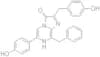
CAS 55779-48-1
:Coelenterazina
Descrição:
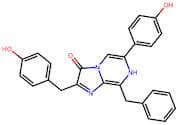
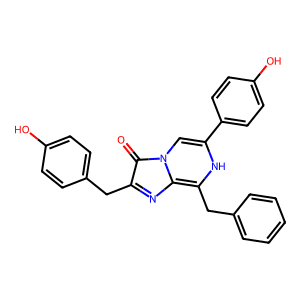
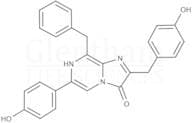
Coelenterazina é um composto bioluminescente encontrado principalmente em vários organismos marinhos, incluindo certas espécies de águas-vivas e criaturas de profundidade. É classificado como uma luciferina, um tipo de molécula emissora de luz que passa por uma reação química na presença de oxigênio, catalisada pela enzima luciferase, para produzir luz. Coelenterazina possui uma fórmula molecular que inclui carbono, hidrogênio, nitrogênio e oxigênio, contribuindo para suas propriedades únicas. Este composto é notável por seu papel na bioluminescência, que serve a várias funções ecológicas, como predação, comunicação e camuflagem. Além de sua ocorrência natural, Coelenterazina é utilizado em ambientes de laboratório para ensaios bioluminescentes e técnicas de imagem, tornando-o valioso na pesquisa biológica. Sua capacidade de emitir luz ao reagir com enzimas específicas o torna uma ferramenta útil em biologia molecular e bioquímica. O composto também é de interesse no estudo da biologia marinha e no desenvolvimento de biossensores.
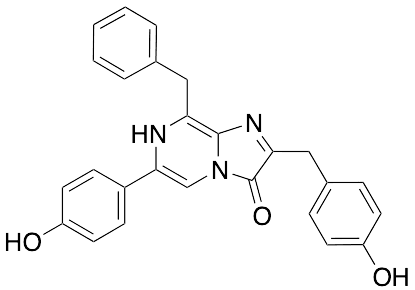
Fórmula:C26H21N3O3
InChI:InChI=1S/C26H21N3O3/c30-20-10-6-18(7-11-20)15-23-26(32)29-16-24(19-8-12-21(31)13-9-19)27-22(25(29)28-23)14-17-4-2-1-3-5-17/h1-13,16,27,30-31H,14-15H2
Chave InChI:InChIKey=YHIPILPTUVMWQT-UHFFFAOYSA-N
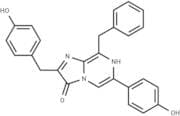
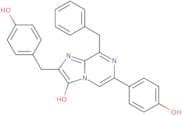
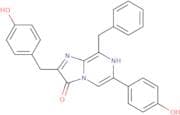
SMILES:C(C1=C2N(C=C(N1)C3=CC=C(O)C=C3)C(=O)C(CC4=CC=C(O)C=C4)=N2)C5=CC=CC=C5
Sinónimos:- 2-[(4-Hydroxyphenyl)Methyl]-6-(4-Hydroxyphenyl)-8-(Phenylmethyl)-Imdazo[1,2-A]Pyrazin-3-(7H)-One
- 6-(4-Hydroxyphenyl)-2-[(4-hydroxyphenyl)methyl]-8-(phenylmethyl)imidazo[1,2-a]pyrazin-3(7H)-one
- 8-Benzyl-2-(4-Hydroxybenzyl)-6-(4-Hydroxyphenyl)Imidazo[1,2-A]Pyrazin-3(7H)-One
- Coelenterazin
- Coelenterazine
- Coelenterazine luciferin
- Coelenterazine ntv
- Imidazo[1,2-a]pyrazin-3(7H)-one, 6-(4-hydroxyphenyl)-2-[(4-hydroxyphenyl)methyl]-8-(phenylmethyl)-
- Luciferin
- Luciferin (Oplophorus)
- NanoFuel
- Native coelenterazine
- Preluciferin
- Preluciferin (Watasenia)
- Ver mais sinónimos
Ordenar por
Pureza (%)
0
100
|
0
|
50
|
90
|
95
|
100
12 produtos.
Coelenterazine, native, Aequorea sp.
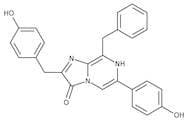
CAS:Coelenterazine, native, Aequorea sp.Fórmula:C26H21N3O3Peso molecular:423.468-benzyl-6-(4-hydroxyphenyl)-2-[(4-hydroxyphenyl)methyl]-7H-imidazo[1,2-a]pyrazin-3-one
CAS:Fórmula:C26H21N3O3Pureza:98%Cor e Forma:SolidPeso molecular:423.4632Coelenterazine
CAS:CoelenterazineFórmula:C26H21N3O3Cor e Forma: yellow to brown crystalline powderPeso molecular:423.46g/molCoelenterazine
CAS:Fórmula:C26H21N3O3Pureza:≥ 95.0%Cor e Forma:Yellow to brown solidPeso molecular:423.46Coelenterazine
CAS:Coelenterazine is a superoxide anion-sensitive chemiluminescent probe.Cost-effective and quality-assured.Fórmula:C26H21N3O3Pureza:97.05% - 99.02%Cor e Forma:Yellow SolidPeso molecular:423.46Ref: TM-T6808
500µg57,00€1mg94,00€2mg138,00€5mg288,00€10mg442,00€25mg648,00€50mg888,00€100mg1.234,00€200mg1.648,00€Coelenterazine - lyopholised
CAS:Coelenterazine is a bio-luminescent substrate of luciferases such as Renilla luciferase (Rluc) and Gaussia luciferase (Gluc). The main applications of Coelenterazine are monitoring of reporter genes and chemiluminescence-based methods for Calcium detection. The substrate is also used in bioluminescence resonance energy transfer (BRET), ELISA, HTS and chemiluminescent detection of superoxide anion and peroxynitritein cells or tissues. About this grade Coelenterazine, native, dried (C-7002): in order to provide milligram and sub-milligram quantities of native Coelenterazine we pre-dissolve the substance; defined amounts of Coelenterazine are subsequently dried under nitrogen in individual vials. Coelenterazine, native, dried is identical in quality and chemistry to our product Coelenterazine, native which is provided as a powder. Information to the user: since Coelenterazine is sensitive to oxygen, degas your solvents for stock solutions, if possible. To dissolve Coelenterazine, native, dried please proceed as follows. 1) Add the appropriate amount of solvent. If possible through the septum using a needle. Otherwise open the cap with pliers. 2) Vortex the closed vial briefly to completely dissolve the content of the vial. 3) Take out the solution, if possible with a needle through the septum.Fórmula:C26H21N3O3Pureza:Min. 95 Area-%Peso molecular:423.48 g/molCoelenterazine, native
CAS:Coelenterazine is the substrate for the enzymes Renilla luciferase, Gaussia luciferase and other luciferase enzymes. Marine organisms like squids, shrimps, fish and jellyfish use coelenterazine to produce spectacular bioluminescence (in analogy with insects which utilize firefly luciferine). Today, coelenterazine is used in numerous applications like immunoassays, ELISA, monitoring of reporter genes, chemiluminescence detection of superoxide anion and peroxynitritein cells or tissues. The substrate is also used in bioluminescence resonance energy transfer (BRET), HTS and protein based methods for Calcium detection. The isolation and structure determination of coelenterazine was reported independently by two different groups in the seventies who discovered the molecule in sea pansy (Renilla reniformis) and in the cnidarian Aequorea victoria, respectively. Interestingly it was also found that the luminescent jellyfish Aequorea victoria does not produce coelenterazine itself but it rather assimilates it through ingestion of small preys like shrimps and copepods. This product Coelenterazine, native, which is provided as a powder, is identical in quality and chemistry to our product Coelenterazine, native, dried.Fórmula:C26H21N3O3Pureza:Min. 95 Area-%Peso molecular:423.48 g/molCoelenterazine Native (CLZN) ex. Aequorea Sp., 95%
CAS:Fórmula:C26H21N3O3Pureza:min 95% by TLCCor e Forma:Slightly brownish yellow to yellow orange, Crystalline powderPeso molecular:423.46Coelenterazine, native
CAS:Produto ControladoApplications Coelenterazine is a luminophore of the aequorin complex which is oxidized by oxygen to illuminate at 465nm when Ca2+ binds to the complex. Used to measure Ca2+ concentration in cells with high sensitivity an dlarge dynamic range.
References Fluck, R.A., et al.: J. Cell Biol., 115, 1259 (1991), Jones, K., et al.: Trends Biotechnol., 17, 477 (1999), Dubuisson, M.L., et al.: Biochem. Pharmacol., 60, 471 (2000)Fórmula:C26H21N3O3Cor e Forma:NeatPeso molecular:423.46

![8-benzyl-6-(4-hydroxyphenyl)-2-[(4-hydroxyphenyl)methyl]-7H-imidazo[1,2-a]pyrazin-3-one](/_next/image/?url=https%3A%2Fstatic.cymitquimica.com%2Fproducts%2FIN%2Fthumb%2FDA00I9Y7.jpg&w=3840&q=75)