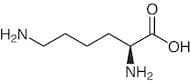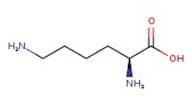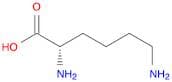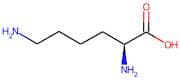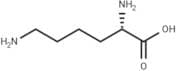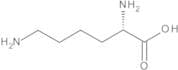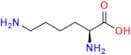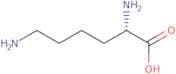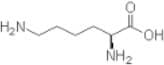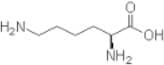
CAS 56-87-1
:L-Lisina
Descrição:
L-Lisina, com o número CAS 56-87-1, é um aminoácido essencial que desempenha um papel crucial na síntese de proteínas e em vários processos metabólicos. É classificado como um aminoácido básico devido à sua cadeia lateral carregada positivamente em pH fisiológico, o que contribui para sua solubilidade em água. L-Lisina é tipicamente encontrado em proteínas animais e é vital para o crescimento, reparo de tecidos e produção de hormonas e enzimas. Também está envolvido na síntese de colágeno, que é importante para a saúde da pele e dos tecidos conectivos. Além de suas funções biológicas, L-Lisina é frequentemente utilizado como um suplemento dietético para apoiar a função imunológica e pode ajudar no manejo de surtos do vírus herpes simplex. A substância é geralmente reconhecida como segura quando consumida em quantidades apropriadas, embora a ingestão excessiva possa levar a desconforto gastrointestinal. L-Lisina está disponível em várias formas, incluindo pós e cápsulas, e é comumente incluído em alimentos ricos em proteínas, como carne, laticínios e leguminosas.
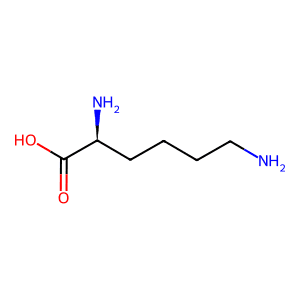
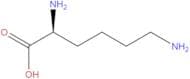
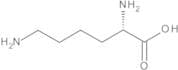
Fórmula:C6H14N2O2
InChI:InChI=1/C6H14N2O2/c7-4-2-1-3-5(8)6(9)10/h5H,1-4,7-8H2,(H,9,10)/t5-/m0/s1
Chave InChI:InChIKey=KDXKERNSBIXSRK-YFKPBYRVSA-N
SMILES:[C@H](CCCCN)(C(O)=O)N
Sinónimos:- (+)-S-Lysine
- (S)-2,6-Diaminohexanoic acid
- (S)-α,ε-Diaminocaproic acid
- 114: PN: WO2021061872 SEQID: 114 claimed protein
- 2,6-Diaminohexanoic acid
- 38: PN: WO2020027640 SEQID: 101 claimed protein
- <span class="text-smallcaps">L</span>-(+)-Lysine
- <span class="text-smallcaps">L</span>-2,6-Diaminocaproic acid
- <span class="text-smallcaps">L</span>-Lys
- <span class="text-smallcaps">L</span>-Norleucine, 6-amino-
- Aminutrin
- Aminutrin, 6-amino-
- Biolys
- Hexanoic acid, 2,6-diamino-, (S)-
- L-2,6-Diaminocaproic acid
- L-Lys
- L-Lysin
- L-Norleucine, 6-amino-
- L-lisina
- Llb 50
- Lysin
- Lysine
- Lysine acid
- Lysine, <span class="text-smallcaps">L</span>-
- Lysine, L-
- Malandil
- h-Lys-oh
- α-Lysine
- L-Lysine Base
- L-Lysine
- 2,6-DIAMINOCAPROIC ACID
- alpha,epsilon-diaminocaproicacid
- (S)-alpha,epsilon-Diaminocaproic acid
- 2,6-diaminohexanoicacid
- FEMA 3847
- alpha,epsilon-Diaminocaproic acid
- alpha-Lysine
- (S)-2,6-DIAMINOCAPROIC ACID
- Ver mais sinónimos
Ordenar por
Pureza (%)
0
100
|
0
|
50
|
90
|
95
|
100
L-(+)-Lysine
CAS:Fórmula:C6H14N2O2Pureza:>97.0%(T)Cor e Forma:White to Light yellow powder to crystalPeso molecular:146.19L-Lysine, 98%
CAS:L-Lysine is an essential amino acid used in human nutrition. It plays a vital role in calcium absorption, building muscle protein and recovering from surgery or sports injuries. It is used for the treatment of herpes infections and cold sores. Its derivatives lysine acetylsalicylate is utilized to tFórmula:C6H14N2O2Pureza:98%Cor e Forma:White to pale yellow, Crystalline powder or powderPeso molecular:146.19L-Lysine
CAS:L-LysineFórmula:C6H14N2O2Pureza:≥95%Cor e Forma: off-white solidPeso molecular:146.18756g/molL-Lysine
CAS:Fórmula:C6H14N2O2Pureza:≥ 98.0% (anhydrous)Cor e Forma:White to yellow crystalline powderPeso molecular:146.19L-Lysine
CAS:L-Lysine (Aminutrin) is one of nine essential amino acids in humans required for growth and tissue repair, Lysine is supplied by many foods.Fórmula:C6H14N2O2Pureza:98.96% - 99.7%Cor e Forma:Needles From Water Hexagonal Plates From Dilute Alcohol SolidPeso molecular:146.19L-Lysine
CAS:Produto ControladoApplications L-Lysine is an essential amino acid for human development. Lysine residues are useful in many cellular processes, due to their ability to accept a wide variety of post-translational modifications.
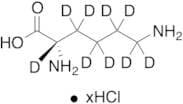
References Tosha, L. et. al.: Biochem. J. 435, 509 (2011);Fórmula:C6H14N2O2Cor e Forma:NeatPeso molecular:146.19L-Lysine-2,3,3,4,4,5,5,6,6-d9 Hydrochloride
CAS:Produto ControladoFórmula:C6H5D9N2O2•x(HCl)Cor e Forma:NeatPeso molecular:155.243646L-Lysine, free base
CAS:Please enquire for more information about L-Lysine, free base including the price, delivery time and more detailed product information at the technical inquiry form on this page
Fórmula:C6H14N2O2Peso molecular:146.19 g/molRef: 3D-L-8994
-Unit-kgkgA consultar1kgA consultar5kgA consultar10kgA consultar25kgA consultar2500gA consultarL-Lysine
CAS:L-Lysine is an amino acid that is necessary for the production of proteins. It plays a key role in the regulation of transcription and cellular metabolism. L-Lysine is synthesized from lysine, which is derived from ornithine and aspartate. L-Lysine can also be formed by methylation of lysine residues on histones, which leads to changes in gene expression. L-Lysine has been shown to inhibit cancer cells by inhibiting the proliferation of tumor cells, preventing cellular transformation, and inhibiting viral replication. The inhibition of viral replication may be due to the ability of L-lysine to act as a competitive inhibitor against cyclic peptides, such as polyoma virus T antigen (PVT) or SV40 large T antigen (SV40 LT).Fórmula:C6H14N2O2Pureza:Min. 95%Cor e Forma:PowderPeso molecular:146.19 g/molL-Lysine (free base) Anhydrous for tissue culture, 98%
CAS:Fórmula:C6H14N2O2Pureza:min.98%Cor e Forma:White to pale yellow, Crystalline powder, Clear, Colourless to pale yellowPeso molecular:146.20L-Lysine (free base) Anhydrous for cell culture, 98%, Endotoxin (BET) 0.05EU/mg
CAS:Fórmula:C6H14N2O2Pureza:min.98%Cor e Forma:White to pale yellow, Crystalline powder, Clear, Colourless to pale yellowPeso molecular:146.20L-Lysine (free base) Anhydrous ExiPlus, Multi-Compendial, 98.5%
CAS:Fórmula:C6H14N2O2Pureza:min. 98%Cor e Forma:White to pale yellow, Crystalline powder, Clear, Colourless to pale yellowPeso molecular:146.20L-Lysine (free base) Anhydrous extrapure, 98%
CAS:Fórmula:C6H14N2O2Pureza:min. 98%Cor e Forma:White to pale yellow, Crystalline powder, Clear, Colourless to pale yellowPeso molecular:146.20