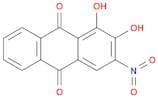
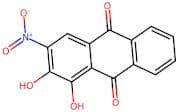
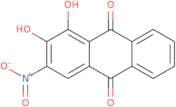
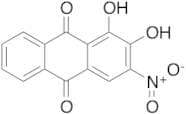
CAS 568-93-4
:1,2-Dihidroxi-3-nitro-9,10-antracenediona
- 1,2-Dihydroxy-3-Nitroanthracene-9,10-Dione
- 1,2-Dihydroxy-3-nitro-9,10-anthracenedione
- 1,2-Dihydroxy-3-nitro-9,10-anthraquinone
- 209-310-2
- 3-Nitroalizarin
- 3-Nitroalizarine
- 568-93-4
- 9,10-Anthracenedione, 1,2-dihydroxy-3-nitro-
- Alizarin orange
- Alizarine Orange A
- Alizarine orange
- Anthraquinone, 1,2-dihydroxy-3-nitro-
- NSC 37586
- β-Nitroalizarin
- Ver mais sinónimos
1,2-Dihydroxy-3-nitroanthraquinone
CAS:1,2-Dihydroxy-3-nitroanthraquinonePureza:98%Peso molecular:285.21g/mol1,2-Dihydroxy-3-nitroanthraquinone
CAS:1,2-Dihydroxy-3-nitroanthraquinone is a chemical compound that is an inorganic pigment with an orange color. It has been used as a dyestuff and as a reagent in organic synthesis. The compound is obtained by the oxidation of 1,2-dihydroxynaphthalene with nitric acid and hydrogen peroxide. 1,2-Dihydroxy-3-nitroanthraquinone has been studied electrochemically using cyclic voltammetry. Hydrogen bonding to the hydroxyl groups on the ring structure increases its activation energy. Inorganic reactions include protonation and alpha-synuclein formation, which can be prevented by adding ammonium acetate or sodium bicarbonate. Optical properties are also affected by pH and concentration gradients. This chemical has hydrophilic properties due to its high content of oxygen atoms and dry weight is determined through gravimetric analysis.
SynonymsFórmula:C14H7NO6Pureza:Min. 98 Area-%Cor e Forma:PowderPeso molecular:285.21 g/mol1,2-Dihydroxy-3-nitroanthraquinone
CAS:Produto ControladoApplications 1,2-Dihydroxy-3-nitroanthraquinone (cas# 568-93-4) is useful for the development of allosteric PGAM1 inhibitors that are effective at suppressing the proliferation of pancreatic ductal adenocarcinoma cells.
References Wen, C. L., et al.: Proc. Natl. Acad. Sci. U.S.A, 116, 23264 (2019)Fórmula:C14H7NO6Cor e Forma:YellowPeso molecular:285.21