CAS 57-04-5
:Fosfato de diidroxiacetona
Descrição:
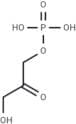
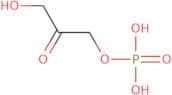
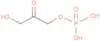
Fosfato de diidroxiacetona (DHAP) é um intermediário chave no metabolismo de carboidratos, particularmente na via glicolítica e no ciclo de Calvin. É um açúcar de três carbonos fosforilado e existe como um sólido incolor e higroscópico à temperatura ambiente. DHAP é uma molécula importante na interconversão de carboidratos, pois pode ser facilmente convertida em glicerol-3-fosfato, outro metabolito crucial. O composto é solúvel em água, o que facilita seu papel nos processos metabólicos. DHAP desempenha um papel significativo na produção de energia e está envolvido na síntese de triglicerídeos e fosfolipídios. Sua estrutura apresenta dois grupos hidroxila e um grupo fosfato, contribuindo para sua reatividade e função nas vias bioquímicas. Além disso, DHAP é utilizado em vários ensaios bioquímicos e aplicações de pesquisa, particularmente em estudos relacionados ao metabolismo e à atividade enzimática. Devido ao seu papel central no metabolismo, entender as características do DHAP é essencial para obter insights sobre a produção de energia e a utilização de carboidratos em organismos vivos.
Fórmula:C3H7O6P
InChI:InChI=1S/C3H7O6P/c4-1-3(5)2-9-10(6,7)8/h4H,1-2H2,(H2,6,7,8)
Chave InChI:InChIKey=GNGACRATGGDKBX-UHFFFAOYSA-N
SMILES:C(C(CO)=O)OP(=O)(O)O
Sinónimos:- (3-Hydroxy-2-oxopropoxy)phosphonic acid
- 1,3-Dihydroxy-2-propanone phosphate
- 1,3-Dihydroxyacetone 1-phosphate
- 1-Hydroxy-2-Oxopropyl Phosphate
- 1-Hydroxy-3-(phosphonooxy)-2-propanone
- 1-Hydroxy-3-(phosphonooxy)aceton
- 2-Propanone, 1,3-dihydroxy-, mono(dihydrogen phosphate)
- 2-Propanone, 1,3-dihydroxy-, phosphate
- 2-Propanone, 1-hydroxy-3-(phosphonooxy)-
- 3-(Fosfonooxi)-1-Hidroxiacetona
- 3-Hydroxy-2-Oxopropyl Dihydrogen Phosphate
- Dhap
- Dihydroxyacetone 3-phosphate
- Dihydroxyacetone monophosphate
- Dihydroxyacetone phosphate
- Dioxyacetone phosphate
- Glycerone phosphate
- Phosphodioxyacetone
- Phosphoric acid, ester with 1,3-dihydroxy-2-propanone
- Ver mais sinónimos
Ordenar por
Pureza (%)
0
100
|
0
|
50
|
90
|
95
|
100
7 produtos.
Dihydroxyacetone phosphate
CAS:Dihydroxyacetone phosphate is a central metabolite in lipid biosynthesis and glycolysis, involved in Calvin cycle and affected by transaldolase deficiency.Fórmula:C3H7O6PPureza:99.9%Cor e Forma:SolidPeso molecular:170.06Dihydroxyacetone Phosphate Lithium Salt (Technical Grade)
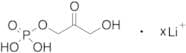
CAS:Produto ControladoFórmula:C3H7O6P•xLiCor e Forma:Dark YellowPeso molecular:170.06694Dihydroxyacetone Phosphate Lithium Salt (>90%)
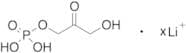
CAS:Produto ControladoStability Hygroscopic
Applications Dihydroxyacetone Phosphate Lithium Salt, is a metabolic intermediate involved in involved in a wide variety of metabolic pathways including glycolysis and lipid biosynthesis. In plants, Dihydroxyacetone phosphate is involved with the synthesis of vitamin B6.
References Jun Ogawa et. al.: et al.: Bioscience, biotechnology, and biochemistry, 67(4), undefined (2003-6-6); John P Richard, Biochemistry, 51(13), undefined (2012-3-14);Fórmula:C3H7O6P•xLiPureza:>90%Cor e Forma:NeatPeso molecular:170.06694Glycerone phosphate lithium salt
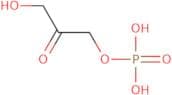
CAS:Glycerone phosphate lithium salt is a reactive molecule that serves as an intermediate in the synthesis of rapamycin, a complex of glycerone phosphate and rapamycin. Glycerone phosphate lithium salt is used to detect the presence of glutamate dehydrogenase and to purify monoclonal antibodies. Glycerone phosphate lithium salt has been shown to react with platinum-based chemotherapy, which may be due to its ability to bind to active sites on cancer cells. This molecule also has been shown to reduce high cholesterol levels in mice and inhibit skin cancer tumor growth. Glycerone phosphate lithium salt's physiological effects have not been fully determined, but it may have some anticancer activity.Fórmula:C3H7O6P·xLiPureza:Min. 95%Peso molecular:170.06 g/molGlycerone phosphate hemimagnesium salt hydrate
CAS:Glycerone phosphate hemimagnesium salt hydrate is a substrate molecule that is used in the control analysis of dihydroxyacetone phosphate. Glycerone phosphate hemimagnesium salt hydrate is an optimum concentration for 3T3-L1 preadipocytes and has been shown to have an effect on energy metabolism. Glycerone phosphate hemimagnesium salt hydrate also has enzymatic activity, which can lead to neuronal death or skin cancer. This compound is a monosodium salt that can be found in cytosolic calcium, which is present in cells and helps regulate muscle contraction. Glycerone phosphate hemimagnesium salt hydrate can also be found in basic proteins that are vital for cell function.Fórmula:C3H5O6P·xH2OMgPureza:Min. 95 Area-%Cor e Forma:PowderPeso molecular:180.19 g/molGlycerone phosphate
CAS:Glycerone phosphate is a cytosolic calcium (Ca2+) substrate molecule that is used to measure the activity of phospholipase A2, an enzyme that catalyzes the hydrolysis of membrane lipids. Glycerone phosphate has been shown to inhibit neuronal death and may be useful in treating neurodegenerative diseases such as Alzheimer's disease. Glycerone phosphate has also been shown to bind to monoclonal antibodies, which are proteins that bind specifically to antigens on the surface of cancer cells, thereby preventing them from binding to their corresponding receptors on healthy cells. This may limit the spread of tumor growth and increase their sensitivity to platinum-based chemotherapy.Fórmula:C3H7O6PPureza:Min. 95%Peso molecular:170.06 g/mol