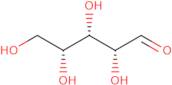
CAS 58-86-6
:(+)-Xilose
Descrição:
(+)-Xilose, com o número CAS 58-86-6, é um açúcar aldopentose que ocorre naturalmente, especificamente um monossacarídeo de cinco carbonos. É classificado como um D-açúcar e é comumente encontrado em vários materiais vegetais, particularmente na hemicelulose da madeira e em algumas frutas. A fórmula molecular de (+)-Xilose é C5H10O5, e existe em forma cristalina que é tipicamente branca ou incolor. Este açúcar é conhecido por seu sabor doce, embora seja menos doce que a glicose. (+)-Xilose é solúvel em água, o que facilita sua absorção em sistemas biológicos. Desempenha um papel significativo no metabolismo de carboidratos e é frequentemente utilizado em ambientes de laboratório para vários ensaios bioquímicos, incluindo testes de absorção intestinal. Além disso, é importante na indústria alimentícia e pode ser utilizado na produção de xilo-oligossacarídeos, que têm propriedades prebióticas. O composto pode existir em diferentes formas anoméricas, sendo a configuração D a mais prevalente na natureza.
Fórmula:C5H10O5
InChI:InChI=1S/C5H10O5/c6-1-3(8)5(10)4(9)2-7/h1,3-5,7-10H,2H2/t3-,4+,5+/m0/s1
Chave InChI:InChIKey=PYMYPHUHKUWMLA-VPENINKCSA-N
SMILES:[C@H]([C@@H](CO)O)([C@H](C=O)O)O
Sinónimos:- (+)-Xylose
- (2R,3S,4R)-2,3,4,5-Tetrahydroxypentanal
- 2,3,4,5-Tetrahydroxypentanal
- <span class="text-smallcaps">D</span>-(+)-Xylose
- Brn 1562108
- Ccris 1899
- D-xylopyranose
- FEMA No. 3606
- Holzzucker
- Hsdb 3273
- Unii-A1Ta934Ako
- Wood sugar
- Xilosa, Pura
- Xylose, <span class="text-smallcaps">D</span>-
- Xylose, D-
- alpha-D-xylopyranose
- beta-D-xylopyranose
- Ver mais sinónimos
Filtrar por
Percentagem de pureza
0
100
|
0
|
50
|
90
|
95
|
100
- Preços em ordem crescente
- Preços em ordem decrescente
- Menor grau de pureza
- Maior grau de pureza
- Estimativa de entrega mais rápida
D-Xylose
CAS:Xylose (Xyl) is an aldopentose also known as wood sugar (Collins, 2006). The main sources of xylose are hemicelluloses found in hardwood and perennial plants, such as, grasses, cereals, and herbs (Petzold-Welcke, 2014) and some algae. Xylose is used in the production of xylitol, a low calory sugar substitute. Xylose is used in glycosaminoglycan (GAG) biosynthesis, which is initiated by peptide O-xylosyltransferases, which transfer xylose onto selected serine residues in the core proteins. The first enzyme in the pathway, peptide O-xylosyltransferase, catalyzes the transfer of xylose from uridine diphosphate (UDP)-α-D-xylose onto serine and thus determines the site(s) of GAG attachment on the core protein (Briggs, 2018).Fórmula:C5H10O5Pureza:Min. 99.0 Area-%Peso molecular:150.13 g/mol