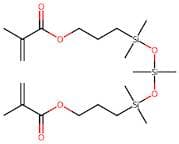
CAS 58130-03-3
:1,3-Bis(3-metacriloxipropil)tetrametildissiloxano
- (1,1,3,3-Tetramethyldisiloxane-1,3-Diyl)Dipropane-3,1-Diyl Bis(2-Methylprop-2-Enoate)
- (1,1,3,3-Tetramethyldisiloxane-1,3-diyl)dipropane-1,3-diyl dimethacrylate
- 1,3-Bis(3-methacryloyloxypropyl)tetramethyldisiloxane
- 2-Propenoic acid, 2-methyl-, (1,1,3,3-tetramethyl-1,3-disiloxanediyl)di-3,1-propanediyl ester
- 2-Propenoic acid, 2-methyl-, 1,1'-((1,1,3,3-tetramethyl-1,3-disiloxanediyl)di-3,1-propanediyl) ester
- 2Ma4000
- Dms-R 05
- Dms-R 11
- Dms-R 18
- Dms-R 22
- Dms-R 31
- Fm 7711
- Fm 7726
- Gp 446
- Gp 478
- Methacryloxypropyl-terminated polydimethylsiloxane
- Poly[oxy(dimethylsilylene)], α-[dimethyl[3-[(2-methyl-1-oxo-2-propen-1-yl)oxy]propyl]silyl]-ω-[[dimethyl[3-[(2-methyl-1-oxo-2-propen-1-yl)oxy]propyl]silyl]oxy]-
- Poly[oxy(dimethylsilylene)], α-[dimethyl[3-[(2-methyl-1-oxo-2-propenyl)oxy]propyl]silyl]-ω-[[dimethyl[3-[(2-methyl-1-oxo-2-propenyl)oxy]propyl]silyl]oxy]-
- Ps 583
- SP 1 (silicone)
- Silaplane FM 7711
- Silaplane FM 7721
- Silaplane FM 7725
- Silaplane FM 7726
- Tc 2000
- X 22-164A
- X 22-164As
- X 22-164B
- X 22-164C
- X 22-164E
- α,ω-Bis(3-methacryloxypropyldimethylsilyl)-terminated polydimethylsiloxane
- METHACRYLOXYPROPYL TERMINATED POLYDIMETHYLSILOXANE, 50-90 cSt
- METHACRYLOXYPROPYL TERMINATED POLYDIMETHYLSILOXANE, 4-6cs
- POLYDIMETHYLSILOXANE, METHACRYLOXYPROPYL TERMINATED: VISCOSITY 8-14 CST.
- METHACRYLOXYPROPYL TERMINATED POLYDIMETHYLSILOXANES
- METHACRYLOXYPROPYL TERMINATED POLYDIMETHYLSILOXANE, 50-90cs
- METHACRYLOXYPROPYL TERMINATED POLYDIMETHYLSILOXANE, 125-250cs
- METHACRYLOXYPROPYL TERMINATED POLYDIMETHYLSILOXANE, 8-14 cSt
- POLYDIMETHYLSILOXANE, METHACRYLOXYPROPYL TERMINATED: VISCOSITY 50-90 CST.
- POLYDIMETHYLSILOXANE, METHACRYLOXYPROPYL TERMINATED: VISCOSITY 125-250 CST.
- METHACRYLOXYPROPYL TERMINATED POLYDIMETHYLSILOXANE, 4-6 cSt
- METHACRYLOXYPROPYL TERMINATED POLYDIMETHYLSILOXANE, 1,000 cSt
- Methacryloxypropyl Terminated PDMS Fluids
- METHACRYLOXYPROPYL TERMINATED POLYDIMETHYLSILOXANE, 1,000cs
- POLYDIMETHYLSILOXANE, METHACRYLOXYPROPYL TERMINATED
- METHACRYLOXYPROPYL TERMINATED POLYDIMETHYLSILOXANE, 8-14cs
- Poly[oxy(dimethylsilylene)],a-[dimethyl[3-[(2-methyl-1-oxo-2-propen-1-yl)oxy]propyl]silyl]-w-[[dimethyl[3-[(2-methyl-1-oxo-2-propen-1-yl)oxy]propyl]silyl]oxy]-
- POLYDIMETHYLSILOXANE, MONOMETHACRYLOXYPROPYL TERMINATED
- METHACRYLOXYPROPYL TERMINATED POLYDIMETHYLSILOXANE, 125-250 cSt
- Ver mais sinónimos
Methacryloxypropyl Terminated Polydimethylsiloxanes
CAS:Methacryloxypropyl Terminated PolydimethylsiloxanesPureza:Mn~25000METHACRYLOXYPROPYL TERMINATED POLYDIMETHYLSILOXANE, 8-14 cSt
CAS:DMS-R11: Methacryloxypropyl Terminated PDMS, 8-14 cSt (Telechelic Functional Fluid)
Methacrylate and Acrylate functional siloxanes undergo the same reactions generally associated with methacrylates and acrylates, the most conspicuous being radical induced polymerization. Unlike vinylsiloxanes which are sluggish compared to their organic counterparts, methacrylate and acrylate siloxanes have similar reactivity to their organic counterparts. The principal applications of methacrylate functional siloxanes are as modifiers to organic systems. Upon radical induced polymerization, methacryloxypropyl terminated siloxanes by themselves only increase in viscosity. Copolymers with greater than 5 mole % methacrylate substitution crosslink to give non-flowable resins. Acrylate functional siloxanes cure greater than ten times as fast methacrylate functional siloxanes on exposure to UV in the presence of a photoinitiator such as ethylbenzoin.
Oxygen is an inhibitor for methacrylate polymerization in general. The high oxygen permeability of siloxanes usually makes it necessary to blanket these materials with nitrogen or argon in order to obtain reasonable cures.
DMS-R11 Properties
Viscosity: 8-14 cStMolecular Weight: 900-1,200 g/molRefractive Index: 1.422Cor e Forma:LiquidPeso molecular:900-1200METHACRYLOXYPROPYL TERMINATED POLYDIMETHYLSILOXANE, 1,000 cSt
CAS:DMS-R31: Methacryloxypropyl Terminated PDMS, 1,000 cSt (Telechelic Functional Fluid)
Methacrylate and Acrylate functional siloxanes undergo the same reactions generally associated with methacrylates and acrylates, the most conspicuous being radical induced polymerization. Unlike vinylsiloxanes which are sluggish compared to their organic counterparts, methacrylate and acrylate siloxanes have similar reactivity to their organic counterparts. The principal applications of methacrylate functional siloxanes are as modifiers to organic systems. Upon radical induced polymerization, methacryloxypropyl terminated siloxanes by themselves only increase in viscosity. Copolymers with greater than 5 mole % methacrylate substitution crosslink to give non-flowable resins. Acrylate functional siloxanes cure greater than ten times as fast methacrylate functional siloxanes on exposure to UV in the presence of a photoinitiator such as ethylbenzoin.
Oxygen is an inhibitor for methacrylate polymerization in general. The high oxygen permeability of siloxanes usually makes it necessary to blanket these materials with nitrogen or argon in order to obtain reasonable cures.
DMS-R31 Properties
Viscosity: 1,000 cStMolecular Weight: 25,000 g/molRefractive Index: 1.404Cor e Forma:LiquidPeso molecular:25000.0METHACRYLOXYPROPYL TERMINATED POLYDIMETHYLSILOXANE, 125-250 cSt
CAS:DMS-R22: Methacryloxypropyl Terminated PDMS, 125-250 cSt (Telechelic Functional Fluid)
Methacrylate and Acrylate functional siloxanes undergo the same reactions generally associated with methacrylates and acrylates, the most conspicuous being radical induced polymerization. Unlike vinylsiloxanes which are sluggish compared to their organic counterparts, methacrylate and acrylate siloxanes have similar reactivity to their organic counterparts. The principal applications of methacrylate functional siloxanes are as modifiers to organic systems. Upon radical induced polymerization, methacryloxypropyl terminated siloxanes by themselves only increase in viscosity. Copolymers with greater than 5 mole % methacrylate substitution crosslink to give non-flowable resins. Acrylate functional siloxanes cure greater than ten times as fast methacrylate functional siloxanes on exposure to UV in the presence of a photoinitiator such as ethylbenzoin.
Oxygen is an inhibitor for methacrylate polymerization in general. The high oxygen permeability of siloxanes usually makes it necessary to blanket these materials with nitrogen or argon in order to obtain reasonable cures.
DMS-R22 Properties
Viscosity: 125-250 cStMolecular Weight: 10,000 g/molRefractive Index: 1.405Cor e Forma:LiquidPeso molecular:10000.0METHACRYLOXYPROPYL TERMINATED POLYDIMETHYLSILOXANE, 4-6 cSt
CAS:DMS-R05: Methacryloxypropyl Terminated PDMS, 4-6 cSt (Telechelic Functional Fluid)
Methacrylate and Acrylate functional siloxanes undergo the same reactions generally associated with methacrylates and acrylates, the most conspicuous being radical induced polymerization. Unlike vinylsiloxanes which are sluggish compared to their organic counterparts, methacrylate and acrylate siloxanes have similar reactivity to their organic counterparts. The principal applications of methacrylate functional siloxanes are as modifiers to organic systems. Upon radical induced polymerization, methacryloxypropyl terminated siloxanes by themselves only increase in viscosity. Copolymers with greater than 5 mole % methacrylate substitution crosslink to give non-flowable resins. Acrylate functional siloxanes cure greater than ten times as fast methacrylate functional siloxanes on exposure to UV in the presence of a photoinitiator such as ethylbenzoin.
Oxygen is an inhibitor for methacrylate polymerization in general. The high oxygen permeability of siloxanes usually makes it necessary to blanket these materials with nitrogen or argon in order to obtain reasonable cures.
DMS-R05 Properties
Viscosity: 4-6 cStMolecular Weight: 380-550 g/molRefractive Index: 1.448Cor e Forma:Pale Yellow LiquidPeso molecular:380-550Methacryloxypropyl Terminated PolyDimethylsiloxane cSt 125-250
CAS:Cor e Forma:LiquidPeso molecular:0.0Methacryloxypropyl terminated polydimethylsiloxane, 1000 cSt
CAS:Cor e Forma:Liquid, ClearPeso molecular:0.0Methacryloxypropyl Terminated Polydimethylsiloxane, 8-14 cSt
CAS:Cor e Forma:LiquidPeso molecular:0.0Methacryloxypropyl terminated polydimethylsiloxanes
CAS:MW 20,000 - 30,000
Fórmula:C20H40O6Si3Pureza:Min. 95%Peso molecular:460.8 g/molMETHACRYLOXYPROPYL TERMINATED POLYDIMETHYLSILOXANE, 50-90 cSt
CAS:DMS-R18: Methacryloxypropyl Terminated PDMS, 50-90 cSt (Telechelic Functional Fluid)
Methacrylate and Acrylate functional siloxanes undergo the same reactions generally associated with methacrylates and acrylates, the most conspicuous being radical induced polymerization. Unlike vinylsiloxanes which are sluggish compared to their organic counterparts, methacrylate and acrylate siloxanes have similar reactivity to their organic counterparts. The principal applications of methacrylate functional siloxanes are as modifiers to organic systems. Upon radical induced polymerization, methacryloxypropyl terminated siloxanes by themselves only increase in viscosity. Copolymers with greater than 5 mole % methacrylate substitution crosslink to give non-flowable resins. Acrylate functional siloxanes cure greater than ten times as fast methacrylate functional siloxanes on exposure to UV in the presence of a photoinitiator such as ethylbenzoin.
Oxygen is an inhibitor for methacrylate polymerization in general. The high oxygen permeability of siloxanes usually makes it necessary to blanket these materials with nitrogen or argon in order to obtain reasonable cures.
DMS-R18 Properties
Viscosity: 50-90 cStMolecular Weight: 4,500-5,500 g/molRefractive Index: 1.409Cor e Forma:LiquidPeso molecular:4500-5500Methacryloxypropyl Terminated PolyDimethylsiloxane cSt 50-90
CAS:Cor e Forma:Liquid, ClearPeso molecular:0.0