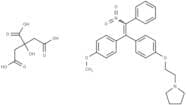
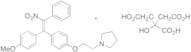
![Pyrrolidine, 1-[2-[4-[1-(4-methoxyphenyl)-2-nitro-2-phenylethenyl]phenoxy]ethyl]-, 2-hydroxy-1,2,3…](/_next/image/?url=https%3A%2Fstatic.cymitquimica.com%2Fcas-image%2Fthumb-webp%2F384411-pyrrolidine-1-2-4-1-4-methoxyphenyl-2-nitro-2-phenylethenyl-phenoxy-ethyl-2-hydroxy-123-propanetricarboxylate-1-1.webp&w=3840&q=75)
CAS 5863-35-4
:Pirrolidina, 1-[2-[4-[1-(4-metoxifenil)-2-nitro-2-feniletenil]fenoxi]etil]-, 2-hidroxi-1,2,3-propanotricarboxilato (1:1)
Descrição:
Pirrolidina, 1-[2-[4-[1-(4-metoxifenil)-2-nitro-2-feniletenil]fenoxi]etil]-, 2-hidroxi-1,2,3-propanotricarboxilato (1:1), com número CAS 5863-35-4, é um composto orgânico complexo caracterizado por sua estrutura multifuncional. Apresenta um anel de pirrolidina, que é um heterociclo de cinco membros contendo nitrogênio, contribuindo para sua potencial atividade biológica. A presença de um grupo fenoxi e um grupo fenil substituído por metoxi sugere que o composto pode exibir uma lipofilicidade significativa, potencialmente influenciando sua solubilidade e interação com membranas biológicas. O grupo nitro indica possível reatividade e o potencial para atividade biológica, enquanto o componente tricarboxilato pode conferir acidez e propriedades quelantes. Este composto pode ser de interesse na química medicinal devido à sua complexidade estrutural e ao potencial para diversos efeitos farmacológicos. No entanto, propriedades específicas como ponto de fusão, ponto de ebulição e solubilidade exigiriam dados empíricos para uma caracterização precisa. No geral, a estrutura intrincada deste composto sugere uma variedade de aplicações potenciais em pesquisa e desenvolvimento.
Fórmula:C27H28N2O4·C6H8O7
InChI:InChI=1S/C27H28N2O4.C6H8O7/c1-32-24-13-9-21(10-14-24)26(27(29(30)31)23-7-3-2-4-8-23)22-11-15-25(16-12-22)33-20-19-28-17-5-6-18-28;7-3(8)1-6(13,5(11)12)2-4(9)10/h2-4,7-16H,5-6,17-20H2,1H3;13H,1-2H2,(H,7,8)(H,9,10)(H,11,12)
Chave InChI:InChIKey=LHAPNDAERSFWSC-UHFFFAOYSA-N
SMILES:C(=C(N(=O)=O)C1=CC=CC=C1)(C2=CC=C(OCCN3CCCC3)C=C2)C4=CC=C(OC)C=C4.C(CC(O)=O)(CC(O)=O)(C(O)=O)O
Sinónimos:- 1-(2-(p-(alpha-(p-Methoxyphenyl)-beta-nitrostyryl)phenoxy)ethyl) pyrrolidine monocitrate
- 1-(2-(p-(alpha-(p-Methoxyphenyl)-beta-nitrostyryl)phenoxy)ethyl)pyrrolidine citrate (1:1)
- 1-[2-(p-[a-(p-Methoxyphenyl)-β-nitrostyryl]-phenoxy)ethyl]pyrrolidine monocitrate
- 1-[2-[4-[2-(4-Methoxyphenyl)-1-nitro-2-phenylethenyl]phenoxy]ethyl]pyrrolidine monocitrate
- 1-[2-[p-[α-(p-Methoxyphenyl)-β-nitrostyryl]phenoxy]ethyl]pyrrollidine monocitrate
- Ai3-52826
- CI-628 citrate
- Ci-628
- Cn-55945-27
- Nitromifene citrate [USAN]
- Nsc 110407
- Parke davis CI-628
- Pyrrolidine, 1-(2-(4-(1-(4-methoxyphenyl)-2-nitro-2-phenylethenyl)phenoxy)ethyl)-, 2-hydroxy-1,2,3-propanetricarboxylate (1:1)
- Pyrrolidine, 1-(2-(p-(alpha-(p-methoxyphenyl)-beta-nitrostyryl)phenoxy)ethyl)-, citrate (1:1) (8CI)
- Pyrrolidine, 1-[2-[p-[α-(p-methoxyphenyl)-β-nitrostyryl]phenoxy]ethyl]-, citrate
- Pyrrolidine, 1-[2-[p-[α-(p-methoxyphenyl)-β-nitrostyryl]phenoxy]ethyl]-, citrate (1:1)
- Ver mais sinónimos
Ordenar por
Pureza (%)
0
100
|
0
|
50
|
90
|
95
|
100
3 produtos.
Nitromifene Citrate
CAS:Nitromifene Citrate is a nonsteroidal estrogen antagonist most commonly used as a research tool in animal studies.Fórmula:C33H36N2O11Cor e Forma:SolidPeso molecular:636.654Nitromifene Citrate (E/Z mixture)
CAS:Produto ControladoApplications Nitromifene citrate is a non-steroidal estrogen antagonist. It is structurally similar to Tamoxifen (T006000) which is a selective estrogen response modifier (SERM).
References Rudick, C., et al.: Endorcrinol., 144, 179 (2003); Sutherland, R., et al.: Nature, 267, 434 (1977)Fórmula:C33H36N2O11Cor e Forma:Yellow To OrangePeso molecular:636.65Nitromifene citrate
CAS:Nitromifene citrate is a nonsteroidal drug that inhibits the enzyme fatty acid synthase, thereby preventing the production of prostaglandins. It has been shown to inhibit tumor growth in mice and to be effective against autoimmune diseases, such as rheumatoid arthritis and multiple sclerosis. Nitromifene citrate also binds to neurokinin-1 receptor and inhibits tissue culture granulosa cells. This drug has been shown to have clinical significance in the treatment of breast cancer. Nitromifene citrate is metabolized by the liver and is taken up into the brain where it can affect brain functions, such as emotional behavior or memory. Nitromifene citrate is synthesized by cultured cells in vitro and has been used for research purposes in vivo.Fórmula:C33H36N2O11Pureza:Min. 95%Peso molecular:636.6 g/mol