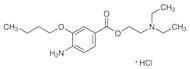
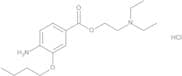
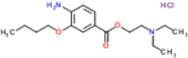
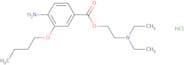
CAS 5987-82-6
:Cloridrato de oxibuprocaina
Descrição:
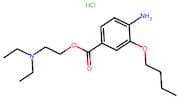
Cloridrato de oxibuprocaina, também conhecido como proximetacaína, é um anestésico local que pertence à classe dos anestésicos ésteres. É comumente utilizado em oftalmologia por sua capacidade de fornecer anestesia superficial durante vários procedimentos oculares. A substância aparece como um pó cristalino branco a off-white e é solúvel em água, o que facilita sua aplicação em soluções aquosas. Cloridrato de oxibuprocaina atua bloqueando os canais de sódio, inibindo assim a propagação dos impulsos nervosos e resultando em uma perda temporária de sensação na área alvo. Seu início de ação é relativamente rápido, e a duração da anestesia pode variar dependendo da concentração utilizada e da aplicação específica. O composto é geralmente bem tolerado, embora os efeitos colaterais potenciais possam incluir irritação local ou reações alérgicas. Devido à sua eficácia e perfil de segurança, Cloridrato de oxibuprocaina é amplamente utilizado em ambientes clínicos, particularmente para procedimentos envolvendo o olho, como tonometria e cirurgia de catarata.
Fórmula:C17H28N2O3·ClH
InChI:InChI=1S/C17H28N2O3.ClH/c1-4-7-11-21-16-13-14(8-9-15(16)18)17(20)22-12-10-19(5-2)6-3;/h8-9,13H,4-7,10-12,18H2,1-3H3;1H
Chave InChI:InChIKey=PRGUDWLMFLCODA-UHFFFAOYSA-N
SMILES:C(OCCN(CC)CC)(=O)C1=CC(OCCCC)=C(N)C=C1.Cl
Sinónimos:- 2-(Diethylamino)ethyl 4-amino-3-butoxybenzoate hydrochloride
- 2-[(4-amino-3-butoxybenzoyl)oxy]-N,N-diethylethanaminium chloride
- Benoxil
- Benoxinate Hcl
- Benzoic acid, 4-amino-3-butoxy-, 2-(diethylamino)ethyl ester, hydrochloride (1:1)
- Benzoic acid, 4-amino-3-butoxy-, 2-(diethylamino)ethyl ester, monohydrochloride
- Boxinate
- Cebesine
- Conjucaine
- Conjuncain
- Dorsacaine
- Dorsacaine hydrochloride
- Lacrimin
- Minims
- Novesin
- Novesine
- Oxybuprocaine HCL
- Oxybuprocaine hydrochloride
- Ver mais sinónimos
Ordenar por
Pureza (%)
0
100
|
0
|
50
|
90
|
95
|
100
15 produtos.
Oxybuprocaine Hydrochloride
CAS:Fórmula:C17H28N2O3·HClPureza:>98.0%(T)(HPLC)Cor e Forma:White to Light yellow powder to crystalPeso molecular:344.88OXYBUPROCAINE HYDROCHLORIDE CRS
CAS:OXYBUPROCAINE HYDROCHLORIDE CRSFórmula:C17H29ClN2O3Cor e Forma:Added ModifiedPeso molecular:344.8768Oxybuprocaine hydrochloride
CAS:Oxybuprocaine hydrochlorideFórmula:C17H28N2O3HClPureza:99.8%Cor e Forma:WhitePeso molecular:344.18667Benoxinate Hydrochloride
CAS:Aromatic amino-alcohol-phenols, aromatic amino-acid-phenols and other aromatic amino compounds with oxygen functionFórmula:C17H28N2O3·HClCor e Forma:Off-White White PowderPeso molecular:308.20999Oxybuprocaine hydrochloride
CAS:Oxybuprocaine hydrochloride (Oxybuprocaine HCl), a local anesthetic, is used especially in otolaryngology and ophthalmology.Fórmula:C17H29ClN2O3Pureza:>99.99%Cor e Forma:White Crystalline PowderPeso molecular:344.88Benoxinate hydrochloride
CAS:Fórmula:C17H29ClN2O3Cor e Forma:White to off-white powder or crystalsPeso molecular:344.88Oxybuprocaine Hydrochloride
CAS:Produto ControladoFórmula:C17H28N2O3·ClHCor e Forma:NeatPeso molecular:344.88Benoxinate Hydrochloride
CAS:Produto ControladoApplications Benoxinate is a local anesthetic used in ophthalmology to numb the surface of the eye for a variety of procedures.
References Ogbuehi, K.C., et al.: Clin. Ophthalmol., 6, 871 (2012); Hung, C.H., et al.: Anesthesia. Anal., 110, 238 (2009); Schmidt, A.C., et al.: Pharma. Res., 22, 2121 (2005);Fórmula:C17H28N2O3·ClHCor e Forma:NeatPeso molecular:344.88Oxybuprocaine hydrochloride
CAS:Produto ControladoOxybuprocaine hydrochloride is a local anesthetic that belongs to the group of x-ray diffraction data. It is a chemical compound that has been shown to be effective in inducing anesthesia in humans. Oxybuprocaine hydrochloride binds to proteins, such as benzalkonium chloride, and inhibits cell growth. It also has an anti-inflammatory effect by preventing the release of prostaglandins. Oxybuprocaine hydrochloride stabilizes chemical bonds and does not react with oxygen or water, making it a suitable candidate for use in eye drops and other solutions for application to skin cells. As well as this, oxybuprocaine hydrochloride can be used as a contrast agent for x-rays when dissolved in human serum or nutrient solution and can be detected using an electrochemical detector.Fórmula:C17H29ClN2O3Pureza:Min. 95%Cor e Forma:White PowderPeso molecular:344.88 g/mol2-(Diethylamino)ethyl 4-amino-3-butoxybenzoate hydrochloride
CAS:Fórmula:C17H29ClN2O3Pureza:99+%Cor e Forma:SolidPeso molecular:344.88Oxybuprocaine hydrochloride
CAS:Produto ControladoOxybuprocaine hydrochloride is a local anesthetic agent that blocks nerve conduction and inhibits the generation of action potentials. It has a high lipid solubility, which allows for rapid onset and short duration of action. Oxybuprocaine hydrochloride is used in the treatment of corneal ulcers, eye disorders, and other conditions where pain relief is desired. The safety and efficacy of oxybuprocaine hydrochloride has been studied in pregnant women, fetal bovine serum, and other animal models. In vitro studies demonstrated that it is chemically stable when exposed to benzalkonium chloride or benoxinate. Clinical relevance in humans has been established by demonstrating that human serum does not contain sufficient quantities of oxybuprocaine to cause toxicity.Fórmula:C17H29ClN2O3Pureza:Min. 95%Peso molecular:344.88 g/mol