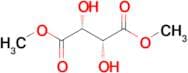
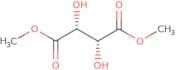
CAS 608-68-4
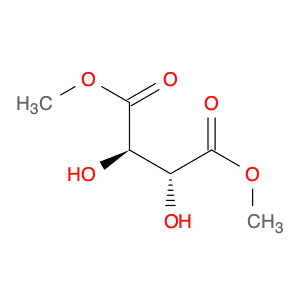
:1,4-Dimetil 2,3-diidroxi- (2R,3R)butanodióico
Descrição:
1,4-Dimetil 2,3-diidroxibutanoato (2R,3R), com o número CAS 608-68-4, é um composto químico caracterizado por sua estereoisomeria específica e grupos funcionais. Apresenta dois grupos hidroxila (-OH) e um grupo funcional diéster, que contribui para sua reatividade e solubilidade em solventes polares. A presença dos grupos metila melhora seu caráter hidrofóbico, enquanto os grupos hidroxila aumentam seu potencial para formar ligações de hidrogênio. Este composto é tipicamente um sólido cristalino branco a off-white à temperatura ambiente e é solúvel em água e vários solventes orgânicos. Sua estereoisomeria, indicada pela configuração (2R,3R), desempenha um papel crucial em sua atividade biológica e interações com outras moléculas. O 1,4-Dimetil 2,3-diidroxibutanoato é frequentemente estudado por suas potenciais aplicações em farmacêutica e bioquímica, particularmente na síntese de moléculas orgânicas mais complexas. Como muitos compostos orgânicos, o manuseio e armazenamento adequados são essenciais para manter sua estabilidade e prevenir degradação.
Fórmula:C6H10O6
InChI:InChI=1S/C6H10O6/c1-11-5(9)3(7)4(8)6(10)12-2/h3-4,7-8H,1-2H3/t3-,4-/m1/s1
Chave InChI:InChIKey=PVRATXCXJDHJJN-QWWZWVQMSA-N
SMILES:[C@@H]([C@H](C(OC)=O)O)(C(OC)=O)O
Sinónimos:- (+)-Tartaric acid dimethyl ester
- (2R,3R)-(+)-Dimethyl tartrate
- 1,4-Dimethyl 2,3-dihydroxy- (2R,3R)butanedioate
- <span class="text-smallcaps">L</span>-(+)-Dimethyl tartrate
- <span class="text-smallcaps">L</span>-Tartaric acid dimethyl ester
- Butanedioic acid, 2,3-dihydroxy- (2R,3R)-, 1,4-dimethyl ester
- Butanedioic acid, 2,3-dihydroxy- (2R,3R)-, dimethyl ester
- Butanedioic acid, 2,3-dihydroxy- [R-(R*,R*)]-, dimethyl ester
- Dimethyl (+)-<span class="text-smallcaps">L</span>-tartrate
- Dimethyl (+)-tartrate
- Dimethyl (R,R)-tartrate
- Dimethyl <span class="text-smallcaps">L</span>-tartarate
- Dimethyl L-(+)-tartarate
- Dimethyl d-tartrate
- Dimethyl-L-(+)-Tartratic
- L-plus-tartaric acid dimethyl ester
- NSC 517
- Ver mais sinónimos
Ordenar por
Pureza (%)
0
100
|
0
|
50
|
90
|
95
|
100
6 produtos.
Dimethyl L-tartrate
CAS:Fórmula:C6H10O6Pureza:≥ 98.0%Cor e Forma:White to off-white or light yellow crystalline powderPeso molecular:178.14L-(+)-Tartaric acid dimethyl ester
CAS:L-(+)-Tartaric acid dimethyl esterFórmula:C6H10O6Pureza:99%Cor e Forma: white solidPeso molecular:178.14g/molDimethyl L-(+)-Tartrate
CAS:Fórmula:C6H10O6Pureza:>98.0%(GC)Cor e Forma:White to Almost white powder to crystalPeso molecular:178.14(2R,3R)-Dimethyl 2,3-dihydroxysuccinate
CAS:Pureza:95.0%Cor e Forma:SolidPeso molecular:178.13999938964844Dimethyl L-(+)-tartrate
CAS:Dimethyl L-(+)-tartrate is a natural compound that can be found in wines and honey. It has been shown to have antiviral activity against herpes simplex virus type 1 (HSV-1). Dimethyl L-(+)-tartrate has also been shown to be a potent inhibitor of the human immunodeficiency virus type 1 (HIV-1) by preventing it from entering cells. Dimethyl L-(+)-tartrate inhibits HIV-1 by interfering with the ability of the virus to bind to CD4 receptors, thereby blocking entry into cells. Dimethyl L-(+)-tartrate is a tetronic acid, which is an organic acid that contains two carboxyl groups, one on each end of the molecule. It exhibits structural features such as vibrational and hydrogen bonding properties that are similar to those observed for other nucleophilic compounds, such as trifluoroacetic acid and dimethyl sulfate. The molecule consists of twoFórmula:C6H10O6Pureza:Min. 98%Cor e Forma:White PowderPeso molecular:178.14 g/mol