CAS 610-78-6
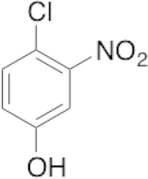
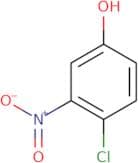
:4-Cloro-3-nitrofenol
Descrição:
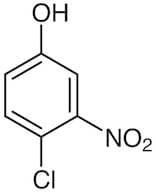
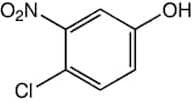
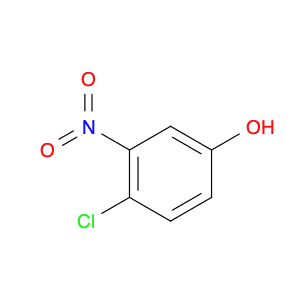
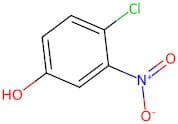
4-Cloro-3-nitrofenol é um composto orgânico caracterizado pela presença de um átomo de cloro e um grupo nitro ligados a um anel fenólico. Sua fórmula molecular é C6H4ClN O3, e apresenta um grupo hidroxila (-OH), que confere propriedades ácidas ao composto. Esta substância geralmente aparece como um sólido amarelo a marrom e é conhecida por sua solubilidade moderada em água, bem como por sua maior solubilidade em solventes orgânicos. O composto exibe características ácidas e básicas devido à presença do grupo hidroxila e aos efeitos de atração eletrônica dos substituintes nitro e cloro. É frequentemente utilizado na síntese de corantes, produtos farmacêuticos e agroquímicos. Além disso, 4-Cloro-3-nitrofenol pode ser tóxico e apresenta riscos ambientais, exigindo manuseio e descarte cuidadosos. Sua reatividade pode ser influenciada pelos substituintes no anel aromático, tornando-o um intermediário útil em várias reações químicas.
Fórmula:C6H4ClNO3
InChI:InChI=1S/C6H4ClNO3/c7-5-2-1-4(9)3-6(5)8(10)11/h1-3,9H
Chave InChI:InChIKey=JUIKCULGDIZNDI-UHFFFAOYSA-N
SMILES:N(=O)(=O)C1=C(Cl)C=CC(O)=C1
Sinónimos:- 3-Nitro-4-chlorophenol
- 2-Chloro-5-hydroxynitrobenzene
- 4-Chloro-3-nitrophenol
- NSC 211001
- Phenol, 4-chloro-3-nitro-
Ordenar por
Pureza (%)
0
100
|
0
|
50
|
90
|
95
|
100
8 produtos.
4-Chloro-3-nitrophenol
CAS:Fórmula:C6H4ClNO3Pureza:>98.0%(GC)(T)Cor e Forma:Light yellow to Yellow to Green powder to crystalPeso molecular:173.554-Chloro-3-nitrophenol, 99%
CAS:This Thermo Scientific Chemicals brand product was originally part of the Alfa Aesar product portfolio. Some documentation and label information may refer to the legacy brand. The original Alfa Aesar product / item code or SKU reference has not changed as a part of the brand transition to Thermo SciFórmula:C6H4ClNO3Pureza:99%Cor e Forma:Crystals or powder or crystalline powder, Yellow to brownPeso molecular:173.554-Chloro-3-nitrophenol
CAS:Fórmula:C6H4ClNO3Pureza:98.0%Cor e Forma:Yellow to olive green crystalline powderPeso molecular:173.554-Chloro-3-nitrophenol
CAS:Produto ControladoApplications 4-Chloro-3-nitrophenol is degraded by Burkholderia sp. strain SJ98 and utilizes it as sole source of carbon, nitrogen and energy under aerobic conditions. Also it is an intermediate of 8-Hydroxychlorpromazine (H824905), which is a metabolite of chlorpromazine (C424750) which is used as an antiemetic.
References Pandey, J., et al.: Appl. Microbiol. Biotechnol., 92, 597-607 (2011); Roth, J., et al.: Comm. Psychopharmacol., 3, 235 (1979); Zhang, Z.: Handbook of Metabolic Pathways of Xenobiotics, 3, 1102 (2014); Anden, N.-E., et al.: Eur. J. Pharmacol., 11, 303 (1970), Curzon, G., et al.: Trends Pharmacol. Sci., 11, 61 (1990)Fórmula:C6H4ClNO3Cor e Forma:NeatPeso molecular:173.554-Chloro-3-nitrophenol
CAS:4-Chloro-3-nitrophenol is a chemical compound that has been used as a dye and as an intermediate in the synthesis of other chemicals. 4-Chloro-3-nitrophenol is not found in nature, but it is produced by the reaction of nitric acid with phenols. The functional theory of 4-chloro-3-nitrophenol suggests that this chemical may be toxic to aquatic life because it can inhibit photosynthesis by blocking the light reactions of photosystem II. This chemical also has been shown to have endpoints for chlorine and chloride, which are essential for aerobic respiration.Fórmula:C6H4ClNO3Pureza:Min. 95%Peso molecular:173.55 g/mol