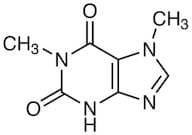
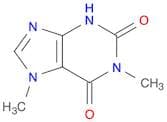
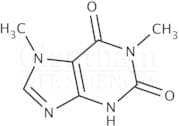
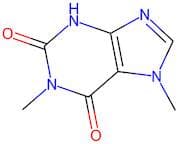
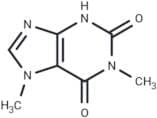
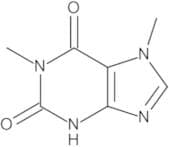
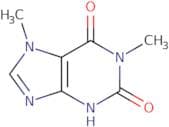
CAS 611-59-6
:Paraxantina
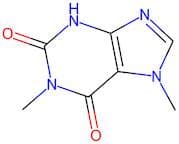
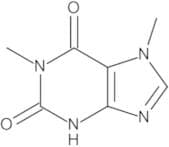
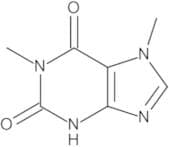
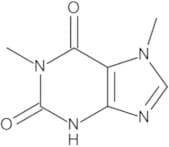
- Paraxanthine
- NSC 400018
- 1H-Purine-2,6-dione, 3,7-dihydro-1,7-dimethyl-
- 1,7-Dimethylxanthine
- 3,7-Dihydro-1,7-dimethyl-1H-purine-2,6-dione
1,7-Dimethylxanthine
CAS:Fórmula:C7H8N4O2Pureza:>98.0%(HPLC)Cor e Forma:White to Almost white powder to crystalPeso molecular:180.17Caffeine Related Compound F (1,7-Dimethyl-3,7-dihydro-1H-purine-2,6-dione)
CAS:Compounds containing a pyrimidine ring, whether or not hydrogenated, or piperazine ring in the structure, nesoiFórmula:C7H8N4O2Cor e Forma:White Fine PowderPeso molecular:180.064731,7-Dimethyl-1H-purine-2,6(3H,7H)-dione
CAS:Fórmula:C7H8N4O2Pureza:98%Cor e Forma:SolidPeso molecular:180.16401,7-Dimethylxanthine
CAS:Fórmula:C7H8N4O2Pureza:≥ 98.0%Cor e Forma:White to light-yellow powderPeso molecular:180.16Caffeine EP Impurity F (Caffeine USP Related Compound F, Paraxanthine)
CAS:Fórmula:C7H8N4O2Cor e Forma:Off-White SolidPeso molecular:180.171,7-Dimethyl-3,7-dihydro-1H-purine-2,6-dione (Paraxanthine; 1,7-Dimethylxanthine)
CAS:Produto ControladoFórmula:C7H8N4O2Cor e Forma:NeatPeso molecular:180.161,7-Dimethylxanthine 100 µg/mL in Acetonitrile
CAS:Fórmula:C7H8N4O2Cor e Forma:Single SolutionPeso molecular:180.16Paraxanthine
CAS:Paraxanthine (1,7-dimethylxanthine), a metabolite of caffeine, functions as an adenosine receptor ligand and a PARP-1 inhibitor in pulmonary epithelial cells.Fórmula:C7H8N4O2Pureza:99.62%Cor e Forma:SolidPeso molecular:180.16Paraxanthine
CAS:Stability Store tightly sealed at RT
Applications Paraxanthine is an adenosine receptor ligand and a major metabolite of caffeine.This compound is a contaminant of emerging concern (CECs).
References Proc. Natl. Acad. Sci. USA 78, 3260 (1981); Cell Mol. Neurobiol., 3, 69 (1983); Eur. J. Pharmacol., 179, 295 (1990)Fórmula:C7H8N4O2Cor e Forma:White To Light YellowPeso molecular:180.16Paraxanthine
CAS:Produto ControladoParaxanthine is a metabolite of caffeine that has been shown to be an effective blood pressure-lowering agent in humans. It causes vasodilation by inhibiting the phosphodiesterase enzyme, which leads to the activation of nitric oxide synthase and the production of nitric oxide. Paraxanthine also inhibits angiotensin-converting enzyme (ACE) and blocks calcium channels, which are both involved in blood pressure regulation. Paraxanthine has been shown to have toxicological effects on wastewater treatment systems because it is not biodegradable and can inhibit the growth of bacteria that break down organic matter. This drug is being studied as a model system for vivi human research because it is structurally similar to caffeine and has similar pharmacological activity.
Fórmula:C7H8N4O2Pureza:Min. 95%Cor e Forma:PowderPeso molecular:180.16 g/mol